Festive journeys can involve busy roads, unfamiliar routes and rapidly changing winter weather. Whether you are visiting relatives, travelling to work or driving home after a seasonal event, good preparation can make the journey safer and less stressful.
For learner drivers, winter also provides a practical reminder that safe driving is about adapting to conditions rather than simply following the speed limit. Darkness, glare, rain, ice and fatigue can all affect how much time and space you need.
The following essential advice will help you prepare your vehicle, plan your journey and make safer decisions throughout the festive season.
Check your vehicle before a festive journey
A few simple checks can prevent delays and reduce the risk of losing control or becoming stranded in cold weather. Complete them before a long journey rather than waiting until departure time.
Inspect your tyres
Tyres provide the contact between your vehicle and the road, so their condition becomes especially important in rain, snow and ice.
For cars, the legal minimum tread depth is 1.6mm across the central three-quarters of the tyre and around its entire circumference. However, you should not treat the legal minimum as a target. Replace damaged or excessively worn tyres promptly, and seek professional advice if you are unsure about their condition.
Check tyre pressures when the tyres are cold, using the figures recommended by the vehicle manufacturer. Remember to inspect the spare tyre if your vehicle carries one. Some cars have a temporary repair kit instead, so make sure you know where it is and how it works.
Check lights, fluids and battery condition
Winter journeys often take place in darkness or poor visibility. Walk around the vehicle and make sure its lights are clean and working, including the brake lights and indicators. Ask another person to help or use a reflection to check lights that are difficult to see from the driver’s seat.
Top up the windscreen washer reservoir with a suitable concentration of winter screenwash. Plain water may freeze and will not clean winter road dirt effectively. Check the engine coolant and oil according to the manufacturer’s instructions.
Cold weather places extra demand on the battery. Slow starting, dim lights or electrical problems may indicate that it needs attention. Having it tested before a long Christmas trip is more convenient than discovering a fault in a remote car park.
Clear the vehicle properly
Before moving off, clear ice, snow and condensation from every window needed for a full view. Do not rely on a small gap scraped into the windscreen.
Clear snow from the lights, mirrors and number plates. Remove loose snow from the roof as well, because it could slide onto the windscreen or fall into the path of another road user. Never use boiling water to clear an iced windscreen, as the sudden temperature change may damage the glass.
Plan ahead for busy festive roads
Christmas and New Year travel can produce congestion around shopping areas, stations, airports and popular routes. Allowing extra time helps you avoid feeling pressured into unsafe decisions.
Check the weather forecast and traffic conditions before leaving. If severe weather is expected, consider whether the journey is essential or whether it can be delayed. Conditions can vary significantly along a longer route, particularly on exposed, rural or higher roads.
Plan where you will stop on a lengthy journey. If you are driving an electric vehicle, identify suitable charging options and alternatives in case your preferred charger is unavailable. Cold weather, heating use and congestion can affect energy consumption, so leave a sensible margin.
Tell someone your expected route and arrival time if you are travelling in difficult conditions. Keep your phone charged, but do not use a handheld phone while driving. Set navigation and music before moving off, or stop somewhere safe and legal to make changes.
Carry useful winter equipment
A winter travel kit does not need to take up much space. Useful items include:
- An ice scraper and de-icer
- A torch with spare batteries
- Warm clothing, gloves and a blanket
- A high-visibility jacket
- A phone charging cable or power bank
- Drinking water and a small amount of food
- A first-aid kit
- A shovel for journeys where snow is forecast
- Any essential medication
Make sure luggage and gifts are secured. Loose items can become dangerous during sudden braking, while an overloaded or poorly packed vehicle may handle differently. Do not block your view through the windows or obscure lights and number plates.
Adapt your driving to winter conditions
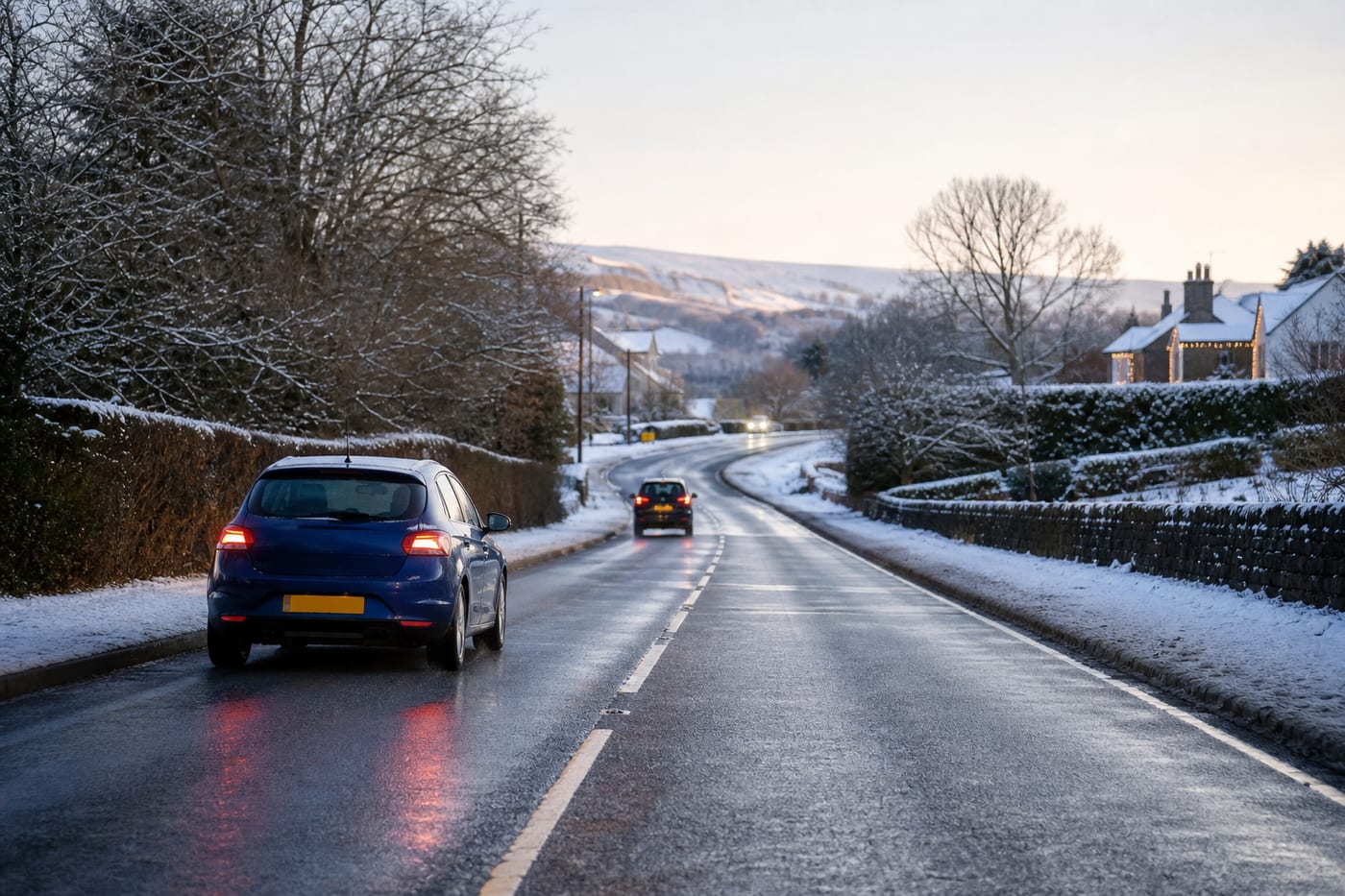
The posted speed limit is a maximum, not a target. A safe speed may be much lower when the road is wet, icy or covered by snow.
Increase the gap between you and the vehicle ahead. On wet roads, the Highway Code advises leaving at least twice the normal stopping distance. In icy conditions, stopping distances can be up to ten times greater than on a dry road.
Accelerate, steer and brake smoothly. Harsh inputs can reduce grip and cause a skid. Look well ahead so that you can slow down early rather than braking suddenly for bends, junctions or queues.
Watch for hidden ice
Ice may form even when the road does not appear snowy. Be particularly careful on bridges, shaded stretches, untreated rural roads and areas where water collects.
If the steering suddenly feels unusually light or the tyres become quiet, you may be driving over ice. Avoid abrupt steering or braking. Ease off the accelerator and keep your movements gentle until grip returns.
If your vehicle begins to skid, take your feet off the pedals and steer carefully in the direction of the skid. The precise response can depend on the vehicle and its safety systems, so consult its handbook and consider professional tuition if you have limited experience of winter conditions.
Use lights correctly
Use dipped headlights when visibility is reduced. Daytime running lights may not illuminate the rear of every vehicle, so do not assume they are sufficient in poor weather.
Fog lights should only be used when visibility is seriously reduced, generally when you cannot see for more than 100 metres. They can dazzle other road users, so switch them off when visibility improves.
Keep the windscreen clean inside and out. A dirty or misted windscreen can intensify glare from low winter sun and oncoming headlights. Slow down if glare makes it difficult to see, and never continue at a speed that prevents you from stopping within the distance you can see to be clear.
Expect vulnerable road users
Pedestrians, cyclists, motorcyclists and horse riders may be harder to see during dark winter afternoons. Wet weather can also cause pedestrians to hurry, carry umbrellas or step around puddles without noticing approaching traffic.
Scan pavements and side roads carefully, especially near shops, schools, pubs, Christmas markets and public transport stops. Give cyclists and motorcyclists plenty of room because slippery surfaces and potholes may cause them to change position.
Take particular care near people who appear distracted or affected by alcohol. Their actions may be unpredictable, but you remain responsible for driving at a speed that allows you to respond safely.
Avoid drink-driving and drug-driving
The safest choice is not to drink any alcohol if you are driving. Do not try to calculate whether one or two drinks will leave you under the legal limit. Alcohol affects people differently, and factors such as drink strength, body size, food and the time since drinking can influence impairment.
Alcohol may remain in your system the morning after a celebration. Coffee, food, sleep and a cold shower do not remove it more quickly. Arrange a designated driver, use public transport, book a taxi or stay overnight, but remember that staying overnight does not automatically mean you will be fit to drive in the morning.
Illegal drugs can seriously impair driving. Some prescription and over-the-counter medicines can also cause drowsiness, blurred vision or slower reactions. Read the instructions and speak to a pharmacist or doctor if you are unsure. Do not drive if a medicine affects your ability to do so safely.
Manage tiredness and festive pressure
Late nights, disrupted sleep and long social visits can make festive drivers tired. Warning signs include repeated yawning, difficulty concentrating, drifting from your lane and failing to remember the last few miles.
Do not begin a journey when you already feel exhausted. On longer trips, take proper breaks in safe places. Opening a window or turning up the radio is not an effective solution to dangerous tiredness.
Avoid pressure from passengers or arrival deadlines. Missing a dinner reservation or arriving late is far less serious than taking risks. If conditions deteriorate, slow down, stop safely or change your plans.
Know what to do if you break down
If possible, leave the road at the next safe location, such as a service area or emergency area. Switch on the hazard warning lights and contact your breakdown provider.
On a motorway, if you can stop in a safe place to the left and leave the vehicle safely, exit through the side away from traffic and wait behind a safety barrier where one is available. Keep well away from moving vehicles.
If your vehicle stops in a live motorway lane and you cannot reach a safer place or leave safely, keep your seat belt on, switch on the hazard lights and call 999. Never ignore a red X signal above a motorway lane; it means the lane is closed.
Conclusion
Safer festive winter driving begins before you turn the key. Check the vehicle, monitor the forecast, allow extra time and carry suitable equipment. Once on the road, reduce your speed, increase following distances and use smooth control inputs.
Most importantly, never drive after drinking or when tired. A flexible plan and a calm approach can help everyone reach their destination safely.
Frequently asked questions
How much extra distance should I leave in winter?
On wet roads, leave at least twice the normal stopping distance. On icy roads, stopping distances can be up to ten times greater than on a dry surface. Increase the gap further if visibility is poor or traffic conditions require it.
Should I warm up my car before driving?
You need to ensure the windows are fully clear and the vehicle is ready to drive, but avoid leaving the engine running unnecessarily. Follow the manufacturer’s guidance, use the demisters and heated screens where fitted, and never leave the vehicle unattended with the engine running.
Can I drive the morning after drinking alcohol?
Only if you are completely fit and legally safe to drive. Alcohol can remain in your body the following morning, and there is no quick way to remove it. If there is any doubt, do not drive and arrange another form of transport.
What should I do if heavy snow is forecast?
Consider postponing any non-essential journey. If you must travel, check official weather and traffic information, use main roads where possible, carry winter supplies and tell someone your plans. Drive slowly, leave a much larger gap and be prepared to turn back if conditions worsen.