Good eyesight is essential for recognising hazards, reading signs and judging the movement of other road users. It is also a legal requirement: you must meet the relevant eyesight standards whenever you drive, not only when you take your practical test.
For most car and motorcycle drivers, meeting the standard means being able to read a registration plate from the required distance, achieving the minimum level of visual acuity and having an adequate field of vision. You may wear glasses or contact lenses to meet these requirements, but you must use them every time you drive.
This guide explains the UK driving eyesight rules, what happens during the practical test and what to do if your vision changes.
What are the legal eyesight standards for driving?
To drive a car or motorcycle, you must be able to read a vehicle registration plate made after 1 September 2001 from a distance of 20 metres. You can wear glasses or contact lenses while doing this.
You must also have:
- visual acuity of at least decimal 0.5, equivalent to 6/12 on the Snellen scale, measured with both eyes together
- an adequate field of vision
If you have sight in only one eye, the visual acuity requirement applies to that eye. You must still meet the necessary field-of-vision standard. An optometrist can assess both your visual acuity and visual field and explain whether you meet the requirements.
These are the ordinary Group 1 standards for car and motorcycle licence holders. Drivers of lorries and buses are subject to stricter medical eyesight standards and should check the rules applying to their licence category.
Licensing is administered by the DVLA in England, Scotland and Wales. In Northern Ireland, drivers should follow the relevant DVA process.
Understanding the number plate eyesight test
The registration plate check is a simple way of testing whether you can see clearly enough at a distance. It is not a replacement for a full eye examination because it does not assess every aspect of vision.
A plate made after 1 September 2001 must be readable from 20 metres. During a practical driving test, an older-style registration plate may instead be used from 20.5 metres.
Twenty metres is roughly the length of five average-sized cars parked end to end, although estimating the distance yourself is not a reliable substitute for a properly measured check.
The plate should be read in good daylight. You can use the glasses or contact lenses you normally wear for driving. If you are practising, use a legal, standard-sized number plate and make sure the distance has been measured accurately.
Passing this check does not necessarily mean every aspect of your eyesight is satisfactory. You could potentially read a plate while still having a problem with peripheral vision, double vision or another condition affecting safe driving. Regular professional eye examinations remain important.
What happens at the practical driving test?
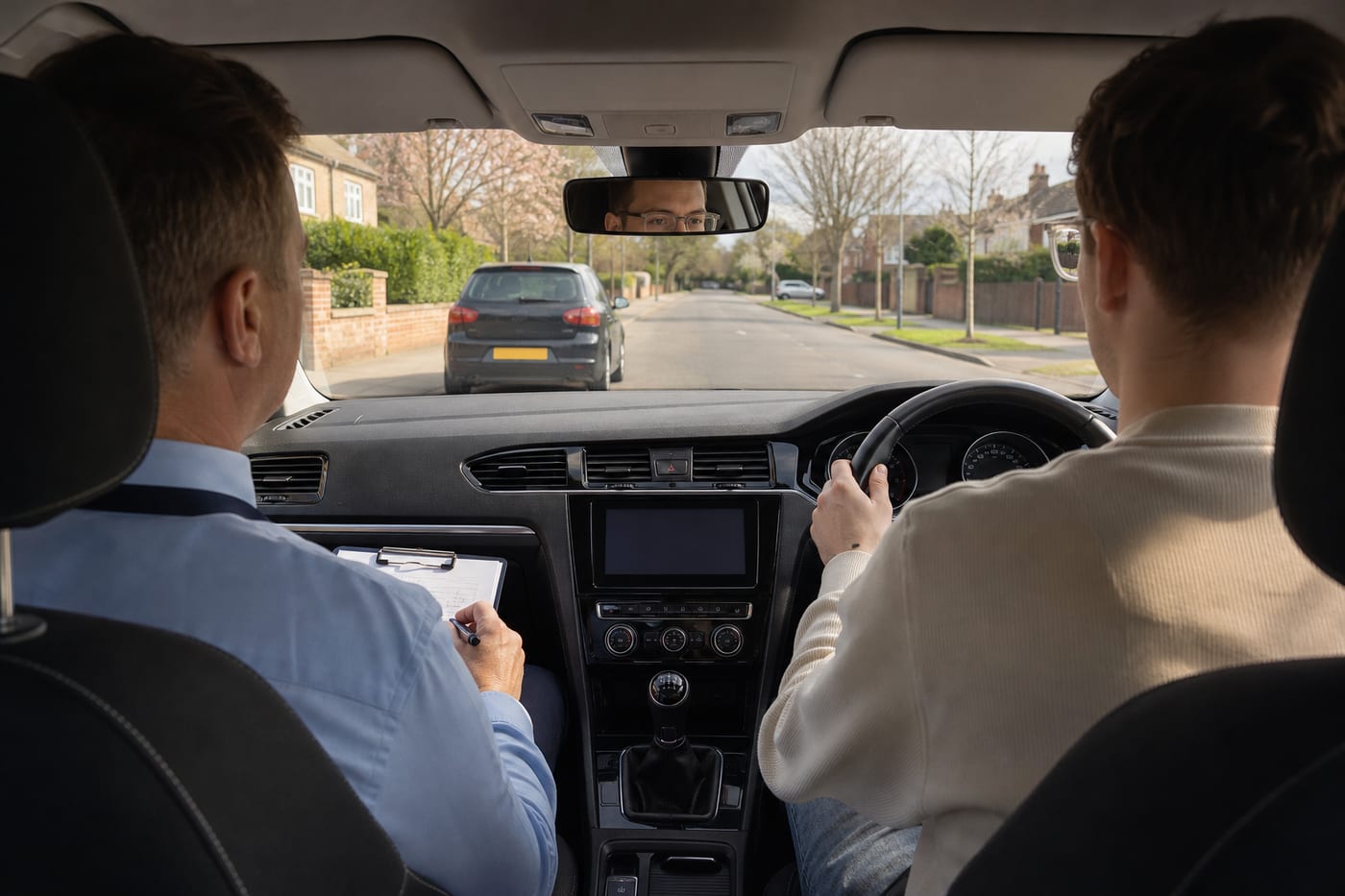
At the beginning of the practical driving test, the examiner will ask you to read a registration plate on a parked vehicle. You will normally be given up to three opportunities, with the examiner changing the distance or plate where appropriate.
If necessary, the examiner will measure the exact distance before the final attempt. If you cannot read the plate at the required distance, the driving part of the test will not go ahead.
The DVLA will be informed and your licence may be revoked. You would then need to follow the official process to reapply and demonstrate that your eyesight meets the required standard before driving again.
Do not wait until test day to discover that your prescription is no longer suitable. Ask your instructor to help you perform an informal number plate check early in your lessons, then arrange a professional eye examination if you struggle.
Can you wear glasses or contact lenses while driving?
Yes. You may use prescription glasses or contact lenses to meet the legal eyesight standard. However, if you need them to meet that standard, you must wear them whenever you drive.
Your driving licence may include a restriction code showing that eyesight correction is required. Regardless of whether you have noticed a code, you must never drive without the correction needed to meet the legal standard.
Useful habits include:
- keeping your glasses clean and free from scratches
- carrying a spare pair on longer journeys
- replacing damaged or poorly fitting frames
- following the recommended replacement schedule for contact lenses
- keeping suitable lens solution available rather than using water
- avoiding driving if your eyes are irritated or your lenses have become uncomfortable
Prescription sunglasses can be useful in bright conditions, but they must not be so dark that they impair your vision. Dark lenses should not be worn at night or when visibility is poor. Some photochromic lenses may not darken as expected inside a car because the windscreen filters part of the ultraviolet light that activates them.
Why visual acuity is only part of safe driving
Visual acuity describes how clearly you can see detail. Driving also depends on several other visual abilities.
Field of vision
Your field of vision includes what you can see ahead and towards the sides without turning your head. A restricted visual field may make it difficult to notice pedestrians, cyclists, vehicles at junctions or hazards approaching from either side.
Contrast and low-light vision
Rain, darkness, spray and fog reduce contrast. A road user who is easy to see in daylight can become much harder to identify at night. Slow down and allow more time to interpret what you see when visibility deteriorates.
Depth and distance judgement
Drivers must judge gaps, closing speeds and the distance to the vehicle ahead. Never rely on eyesight alone to justify a risky gap. Use safe routines and leave enough space to respond if the situation changes.
Glare recovery
Low sun and bright headlights can temporarily reduce what you can see. Keep your windscreen clean, reduce speed and avoid staring directly at dazzling lights. If you are dazzled at night, look towards the left-hand edge of the road while maintaining awareness of your surroundings.
Developing effective observation is also central to identifying road hazards early, both in everyday driving and during hazard perception practice.
Keeping your view clear before setting off
Even excellent eyesight cannot compensate for an obstructed or dirty windscreen. Before driving, check that you have a clear view through the windscreen, side windows and mirrors.
Remove condensation fully rather than wiping a small viewing hole. In winter, clear ice and snow from the glass before moving away. The guidance on removing ice from your car safely explains how to prepare the vehicle without damaging its windows.
Also check that:
- the windscreen washer reservoir contains suitable screen wash
- the wipers clear the glass effectively without smearing
- mirrors are clean and correctly adjusted
- loose objects are not blocking your view
- sat-navs and phone holders are not positioned where they obscure the road
- demisters work correctly
Make these checks part of your pre-drive cockpit safety routine, alongside adjusting your seat, steering wheel and mirrors.
When must an eyesight condition be reported?
You are responsible for telling the relevant licensing agency about any medical condition that must be reported. In Great Britain, this is the DVLA; in Northern Ireland, it is the DVA.
Not every minor change in prescription needs to be reported. However, some eye conditions, visual-field problems, double vision and other medical issues affecting safe driving may be notifiable. The exact reporting requirement can depend on the condition, whether one or both eyes are affected and the type of licence you hold.
Do not guess. Check the official government guidance for your specific condition and ask an optometrist, ophthalmologist or doctor for advice. A health professional can assess your vision, but the licensing authority makes decisions about licensing.
You should stop driving and seek advice if you no longer meet the eyesight standard. Continuing to drive despite unsafe vision could put you and others at risk and may invalidate your insurance.
Signs that your eyesight may need checking
Changes in vision can be gradual, so they are not always obvious. Arrange an eye examination if you notice:
- difficulty reading road signs until you are unusually close
- blurred or double vision
- increased difficulty seeing at night
- frequent headaches or eye strain after driving
- halos or excessive glare around lights
- trouble judging gaps or distances
- missing objects towards one side of your vision
- repeated difficulty reading number plates at the legal distance
Do not simply move closer to signs or rely on other people to identify hazards for you. A new prescription may solve the problem, but some symptoms require further medical assessment.
Practical ways to protect your vision when driving
Have eye examinations as often as your optometrist recommends, even if you believe your eyesight is fine. A professional check can identify changes you may not have noticed.
Before a lesson, test or long journey:
- Put on the glasses or contact lenses required for driving.
- Make sure lenses, windows and mirrors are clean.
- Check that your view is not obstructed.
- Allow time for windows to demist completely.
- Avoid driving if your vision is temporarily affected by illness, eye drops or severe irritation.
- Ask a pharmacist or doctor whether any medicine could affect your ability to drive.
If conditions make it difficult to see, reduce your speed and increase the gap from the vehicle ahead. If visibility becomes too poor to continue safely, stop somewhere legal and secure rather than pressing on.
Frequently asked questions
How far away must I read a number plate?
For the standard car and motorcycle eyesight requirement, you must be able to read a registration plate made after 1 September 2001 from 20 metres. Glasses or contact lenses may be worn. During a practical test, an older plate may be read from 20.5 metres.
Can I drive if I need glasses?
Yes, provided your corrected vision meets the required standard. If you need glasses or contact lenses to meet it, you must use them every time you drive. Keeping a spare pair in the car is sensible, although they should be stored securely and away from extreme heat.
Is reading a number plate enough to prove my eyesight is legal?
No. You must also meet the visual acuity requirement and have an adequate field of vision. The number plate check is useful, but a professional eye examination provides a more complete assessment.
What should I do if my eyesight changes after passing my test?
Stop driving if you may no longer meet the legal standard. Arrange an eye examination and check whether the condition must be reported to the DVLA or DVA. Resume driving only when you are satisfied that you meet the applicable requirements and have followed any licensing instructions.
Conclusion
Meeting the legal driving eyesight standards is a continuing responsibility. Check that you can read a modern number plate from 20 metres, wear any correction you need and arrange professional eye examinations when advised. Clear vision, a clean windscreen and early action when your eyesight changes all help make every journey safer.