Knowing what will happen on theory test day can make the experience feel much less intimidating. Instead of worrying about unfamiliar procedures or how long each stage will take, you can concentrate on answering the questions and spotting developing hazards.
For the standard car theory test in England, Scotland and Wales, the two assessed sections take approximately 80 minutes in total: 57 minutes for the multiple-choice questions, followed by an optional three-minute break and then the hazard perception section, which usually takes around 20 minutes. You should allow extra time for arrival, identity checks, instructions and receiving your result.
This guide takes you through the day in order, from reaching the test centre to leaving with your result.
Theory test timings at a glance
A typical car theory test appointment follows this pattern:
- Arrive at least 15 minutes before your appointment
- Complete the centre’s identity and security checks
- Receive instructions and sit at your allocated computer
- Complete the multiple-choice section in up to 57 minutes
- Take an optional break of up to three minutes
- Complete the hazard perception section in around 20 minutes
- Leave the testing room and receive your result
The assessed parts therefore take about one hour and 20 minutes if you use all the available multiple-choice time and take the break. Your complete visit may be longer because checking in and collecting your result also take time.
These timings apply to the standard car theory test administered by the DVSA in England, Scotland and Wales. Theory tests in Northern Ireland are administered by the Driver & Vehicle Agency, so candidates should check the instructions supplied with their booking.
Before leaving home
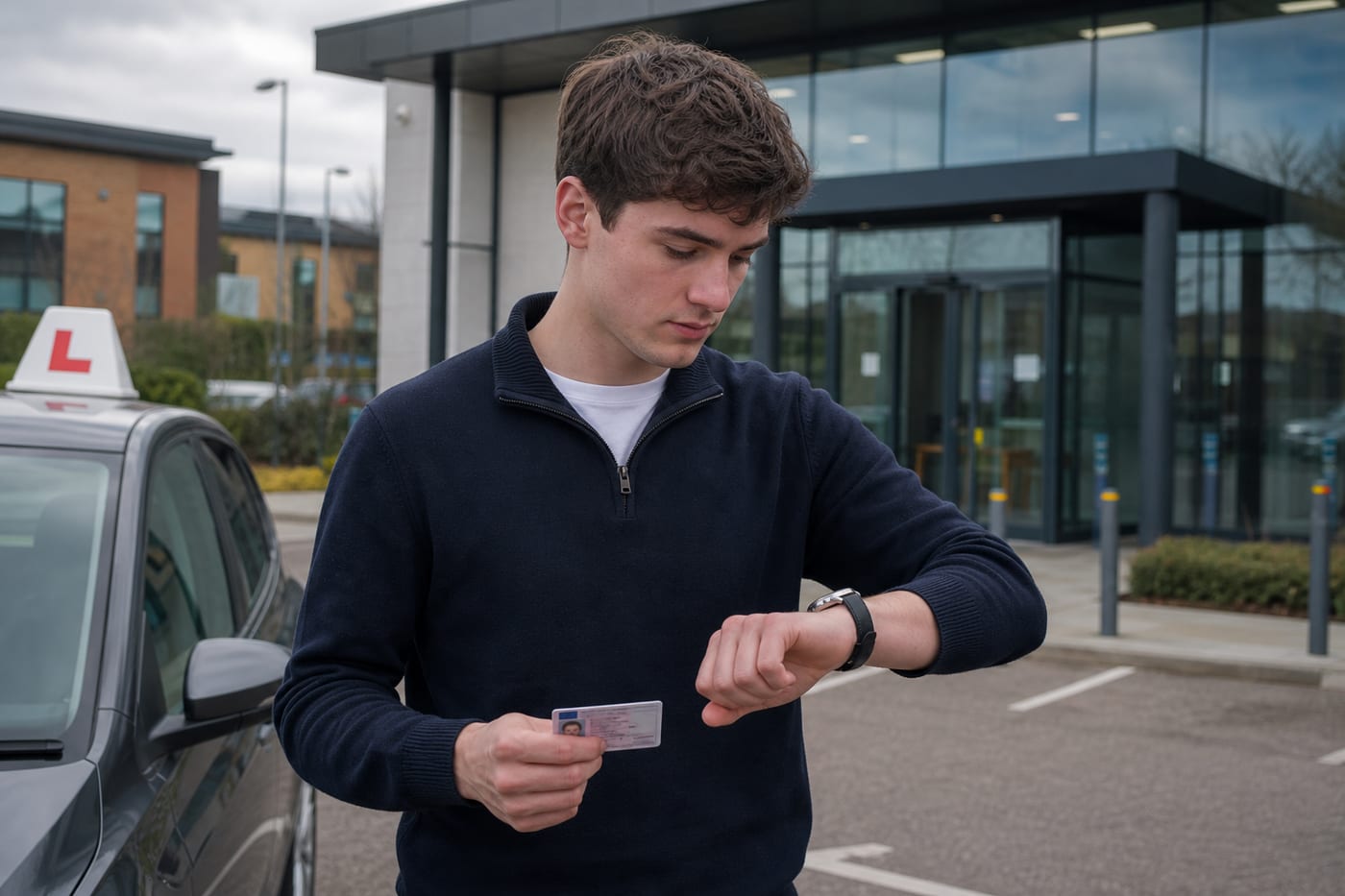
Your appointment time is when the test is due to begin, not when you should arrive at the building. Plan to be at the test centre at least 15 minutes early.
Check your route in advance and allow for traffic, public transport delays, parking and the time needed to find the correct entrance. If possible, identify a backup route as well. Rushing through the door at the last moment can leave you flustered before you have answered a single question.
Make sure you have the correct identification. In England, Scotland and Wales, you normally need to take your UK photocard driving licence. The requirements can differ if you have an old-style paper licence from Northern Ireland, so follow the official instructions in your booking confirmation.
Our theory test day checklist explains what to bring and which items are best left at home.
Arriving at the theory test centre
Aim to enter the centre around 15 minutes before the booked start time. Arriving much earlier does not necessarily mean you will be allowed to begin early, but arriving late could mean that you are unable to take the test.
At reception, staff will check your identity and booking details. You will also be asked to follow the centre’s security procedures. Personal belongings such as your mobile phone, smartwatch, bag, coat and revision materials must not be taken into the testing room. Storage arrangements vary by centre, so listen carefully to the staff’s instructions.
You may also be reminded of the rules about candidate conduct. You must not use notes, communicate with other candidates, record test content or receive help during the examination.
Although these checks may feel formal, they are routine. Cooperate with staff, ask if you do not understand an instruction and use the time to settle your breathing.
Getting set up at the computer
Once the check-in process is complete, a member of staff will direct you to a computer station. Candidates generally work in individual booths or separated spaces to reduce distractions.
Before the scored questions begin, the computer provides instructions explaining how to use the test system. There is also an opportunity to practise using the controls and become familiar with the question screen.
Do not rush through this stage simply because you have used mock-test software before. Check that you understand how to:
- Select and change an answer
- Move between questions
- Flag a question for review
- See which questions remain unanswered
- Finish the section when you are ready
If you experience a technical problem, alert a member of staff rather than attempting to fix it yourself. Technical issues should not be treated as part of your test time without assistance.
The multiple-choice section: up to 57 minutes
The standard car theory test contains 50 multiple-choice questions, and you have 57 minutes to complete them. You need at least 43 correct answers to pass this section.
Some questions are based on a short video clip. You can watch the clip as many times as necessary during the multiple-choice part, subject to the overall time limit. Several questions may relate to the same clip.
Fifty questions in 57 minutes gives you slightly more than a minute per question on average. However, you do not need to divide your time evenly. A straightforward road-sign question may take only a few seconds, while a question involving a scenario may require more thought.
A practical time-management approach
Work steadily through the questions and select the best answer you can. If you are uncertain, flag the question and move on rather than spending several minutes stuck on it.
After reaching question 50, use your remaining time to:
- Check that every question has an answer.
- Return to the questions you flagged.
- Re-read any wording you may have misunderstood.
- Change an answer only when you have a clear reason.
Pay particular attention to words such as must, should, first, least and most. Reading too quickly can cause you to answer a slightly different question from the one being asked.
You can finish the section before the 57 minutes are up, but there is no reward for being the fastest person in the room. Use the time available to check your work without repeatedly second-guessing sensible answers.
For a wider explanation of question formats and pass marks, see our complete breakdown of the UK theory test.
The optional three-minute break
After the multiple-choice section, you can take an optional break of up to three minutes before hazard perception begins.
This is not a long rest or an opportunity to leave the test centre. It is simply a brief pause at the computer. Use it to relax your shoulders, rest your eyes and reset your concentration.
Even if you feel keen to continue, taking part or all of the break can be worthwhile. Hazard perception requires a different style of thinking. Instead of recalling facts, you must watch moving road scenes closely and respond as hazards develop.
Avoid using the break to worry about questions from the first section. You cannot go back and change those answers once that part has ended. Your only useful task now is to prepare for the next section.
The hazard perception section: around 20 minutes
The hazard perception section begins with an instructional video. Pay attention even if you have practised extensively, as it reminds you how the assessment works.
You will then watch 14 video clips featuring everyday road scenes. There are 15 scoreable developing hazards altogether because one clip contains two developing hazards. The remaining clips contain one each.
A developing hazard is something that would cause you, as the driver, to take action such as changing speed or direction. You score by responding while the hazard is developing, with earlier valid responses earning more points. The pass mark for car drivers is 44 out of 75.
The clips play one at a time, and you cannot return to a previous clip. The exact duration of individual clips varies, but the complete section generally takes about 20 minutes, including the instructions.
Click when you recognise that a potential hazard has started to develop. A carefully placed follow-up click may be sensible if the situation continues to change, but do not click continuously or in a regular pattern. The system includes checks designed to identify inappropriate clicking, and you may score nothing for a clip if your response pattern is unacceptable.
Our guide to scoring highly in hazard perception covers developing hazards, click timing and common errors in more detail.
What happens when the test finishes?
After the final hazard perception clip, follow the on-screen instructions and wait to be told that you can leave your workstation. Collect your belongings according to the centre’s procedure.
You will normally receive your result before leaving the centre. The result confirms whether you passed or failed and provides separate scores for the multiple-choice and hazard perception sections.
You must pass both sections at the same appointment to pass the theory test overall. A strong score in one part cannot compensate for falling below the pass mark in the other.
If you pass, keep your pass certificate details safe because you will need them when arranging your practical test. A car theory test pass certificate is normally valid for two years. You must pass your practical driving test within that period or take and pass the theory test again.
If you do not pass, use the score report to identify which area needs more work. Failing can be disappointing, but the result gives you useful evidence for planning your next round of revision.
How to avoid feeling rushed
Good timing starts before exam day. These practical steps can help you stay calm:
- Confirm the centre and appointment time: Do not rely on memory; check your booking confirmation.
- Plan to arrive early: Build in a realistic delay allowance rather than aiming to arrive at the exact time.
- Eat normally: A light meal can help you concentrate, but avoid making sudden changes to your usual routine.
- Use the practice screens: Familiarity with the controls reduces avoidable mistakes.
- Watch the clock without obsessing over it: Check your progress occasionally during the multiple-choice section.
- Answer every multiple-choice question: An educated choice gives you a chance of a mark; leaving it blank does not.
- Use the break: A brief mental reset can improve your focus for hazard perception.
- Ignore other candidates: People may finish before you for many reasons. Their pace has no bearing on your result.
Candidates with approved support or reasonable adjustments may have a different test-day experience or additional time. If you need support, arrange it through the official booking process rather than waiting until you arrive at the centre.
Frequently asked questions
How early should I arrive for my theory test?
You should arrive at least 15 minutes before your booked appointment. Allow additional journey time for traffic, parking, public transport delays and finding the test centre. Turning up late may mean you cannot take the test.
How long does the car theory test take in total?
The assessed sections take about one hour and 20 minutes when you use the full 57 minutes for multiple choice, take the optional three-minute break and complete roughly 20 minutes of hazard perception. Allow longer for check-in, security procedures and receiving your result.
Can I leave the theory test early?
You can end the multiple-choice section before the time limit if you have finished and checked your answers. However, you cannot skip through hazard perception clips or return to previous clips. Follow the on-screen instructions and do not leave your workstation until permitted.
Do I get my theory test result straight away?
You will normally receive your result at the test centre shortly after finishing. It shows whether you passed and gives separate scores for the multiple-choice and hazard perception sections.
Conclusion
A standard car theory test is structured and predictable: arrive at least 15 minutes early, complete up to 57 minutes of multiple-choice questions, take an optional three-minute break and then spend around 20 minutes on hazard perception.
Plan your journey, bring the correct identification and use your available time carefully. Once you know the order of events, exam day becomes less about uncertainty and more about demonstrating what you have learned.