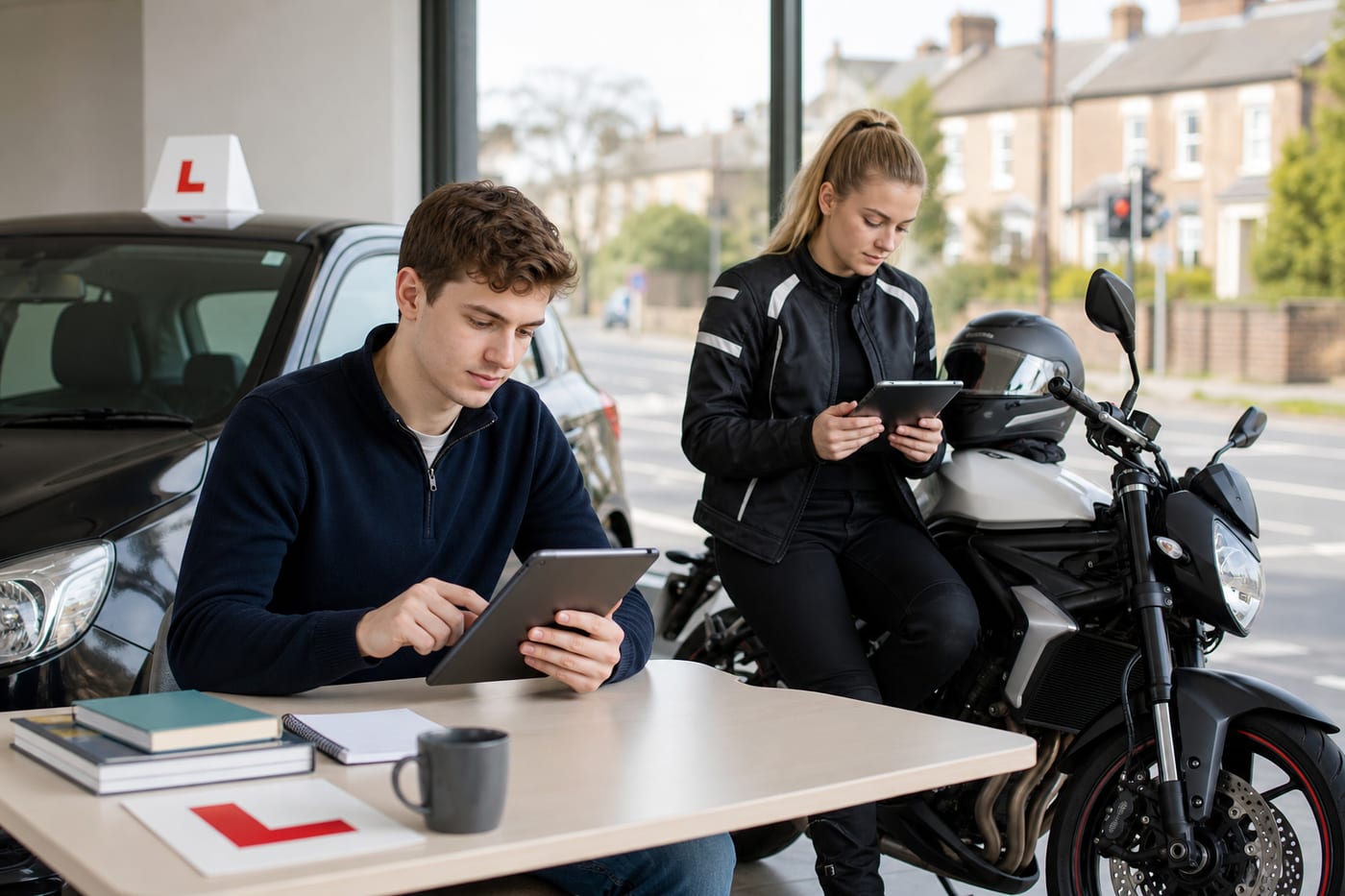
Preparing for a car or motorcycle theory test can raise plenty of questions. How many questions are there? Is the bike test different from the car test? What happens if you pass one section but fail the other?
This guide answers the most frequently asked questions about car and bike theory exams in Great Britain. It covers the test format, pass marks, booking, revision, test-day documents and what to do if you do not pass.
Rules and booking arrangements are different in Northern Ireland, so learners there should use the official nidirect service.
Are the car and motorcycle theory tests the same?
The car and motorcycle theory tests follow the same basic structure. Both contain:
- A multiple-choice section
- A hazard perception section
The number of questions, time limit and pass marks are also the same. However, the subject matter is not identical.
Car candidates may be tested on areas such as vehicle handling, motorway driving, towing, passenger safety and car maintenance. Motorcycle candidates need knowledge relevant to riding, including protective equipment, road positioning, stability, carrying a pillion passenger and motorcycle-specific hazards.
You should therefore use revision materials designed for the vehicle category you intend to drive or ride. Studying only car questions is not suitable preparation for a motorcycle test.
For a fuller explanation of each section, see our complete breakdown of the UK theory test.
How many questions are in the theory test?
The multiple-choice section contains 50 questions. You have 57 minutes to complete it, although you can finish earlier if you are confident that you have checked your answers.
You need at least 43 correct answers to pass this section. Questions are drawn from a wide range of road safety topics rather than one narrow part of The Highway Code.
Some questions may require you to choose more than one answer. Read every instruction carefully instead of assuming that only one option is correct.
What is the hazard perception pass mark?
The hazard perception section contains 14 video clips. There are 15 developing hazards because one clip contains two hazards.
The highest possible score is 75, and car and motorcycle candidates need at least 44 to pass. You can score up to five points for each developing hazard, depending on how early you recognise and respond to it.
A developing hazard is something that is beginning to make you change speed or direction. A parked vehicle is a potential hazard; it becomes a developing hazard when its indicator comes on and it starts moving into your path.
You should click when you first recognise the development, then use a measured follow-up click if the situation continues to become more serious. Avoid rhythmic, continuous or excessive clicking, as the scoring system may award no points for a clip if it detects an unacceptable response pattern.
Our guide to scoring highly on the hazard perception test explains how to practise without relying on guesswork.
Must I pass both parts on the same day?
Yes. You must pass both the multiple-choice and hazard perception sections during the same appointment.
If you pass the multiple-choice questions but fail hazard perception, you fail the overall test. The same applies if you pass hazard perception but miss the multiple-choice pass mark. You will need to book another full theory test and complete both parts again.
This is why revision should cover both knowledge and hazard awareness. Strong mock-test results do not compensate for limited hazard perception practice.
How much does a car or motorcycle theory test cost?
The official fee for a standard car or motorcycle theory test in Great Britain is £23. The safest approach is to book through GOV.UK, which directs you to the official DVSA booking service.
Third-party websites may charge extra booking or administration fees. They cannot provide a special pass, easier questions or priority treatment during the exam.
Our step-by-step theory test booking guide explains how to choose a test centre, request support and avoid unnecessary charges.
Do I need a provisional licence before booking?
Yes. You normally need the appropriate provisional driving licence entitlement before you can book your theory test.
Enter your driving licence details accurately when booking. Your name should match the name shown on your licence. If your personal details have changed, resolve any licence issues before test day rather than hoping the test centre will accept different documents.
Motorcycle learners should also check that their licence covers the category of vehicle they plan to ride.
Can I use a car theory test pass for a motorcycle test?
In the usual learner route, no. A car theory test pass does not qualify you to take a motorcycle practical test. You normally need to pass the motorcycle theory test, even if you already hold a full car licence.
Likewise, passing a motorcycle theory test does not cover a car practical test. Each test is designed around its relevant vehicle category.
There are limited exemptions based on particular existing entitlements and previous tests. If you believe an exemption applies to you, check the current GOV.UK motorcycle test rules before booking.
Do I need to complete CBT before the motorcycle theory test?
You do not usually need to complete compulsory basic training, commonly called CBT, before taking the motorcycle theory test. The two requirements serve different purposes.
CBT is practical training designed to teach essential riding skills before most learners ride unaccompanied on the road. The theory test checks your knowledge and hazard awareness.
Most learner motorcyclists need a valid CBT certificate and a motorcycle theory test pass before completing their practical motorcycle tests. Plan the timing carefully because certificates and test passes have validity periods.
How long does a theory test pass last?
A car or motorcycle theory test pass certificate is valid for two years from the date you pass.
You must pass the relevant practical test within that period. If the theory pass expires before you complete the practical test, you will need to pass the theory test again, even if you already have a practical appointment planned.
Avoid leaving practical training until the final weeks of your certificate’s validity. Test availability, illness, weather or an unsuccessful practical attempt could leave too little time to try again.
What should I bring to the test centre?
Bring your UK photocard driving licence. This is used to confirm your identity and eligibility.
Check your booking confirmation and the current official instructions if you hold a licence from Northern Ireland or have an older licence format. Test-centre staff must follow identity rules and may refuse to test you if you do not bring the required document. You would normally lose the fee.
Personal items such as your phone, smartwatch, notes, bag and outerwear must be stored as instructed. Electronic devices must not be used during the exam.
Arrive with enough time to complete the centre’s security and registration procedures. Turning up at the exact appointment time creates an avoidable risk if you are delayed or cannot find the entrance.
Can I change or cancel my appointment?
Yes, but you must provide sufficient notice to protect your fee. In Great Britain, you normally need to change or cancel at least three full working days before the test. Sundays and public holidays do not count as working days for this purpose.
Use the official service and have your driving licence number and booking reference available. If you miss the deadline, you will usually have to pay for another appointment unless an accepted special circumstance applies.
What support is available for candidates with additional needs?
Support can be requested for candidates with a reading difficulty, disability or health condition. Depending on your needs and eligibility, arrangements may include extra time, a voiceover or other reasonable support.
Request help when booking rather than waiting until test day. The DVSA may ask for evidence explaining why an adjustment is needed, so allow enough time for the request to be considered.
The test is available in English and Welsh in Great Britain. Translation into other spoken languages is not offered.
How should I revise for a car or bike theory exam?
Start with the current editions of the official learning materials relevant to your vehicle category. These include The Highway Code, traffic signs guidance and the appropriate driving or riding skills material.
A practical revision routine should include:
- Studying one topic at a time, such as signs, vulnerable road users or stopping distances.
- Answering practice questions without immediately checking the solution.
- Reviewing why each incorrect answer was wrong.
- Completing timed mock tests once your knowledge improves.
- Practising hazard perception regularly rather than only before the exam.
Do not memorise the position of answers from a practice app. The real test will not simply reproduce every practice question word for word. Aim to understand the safety principle so that you can apply it when a question is phrased differently.
Motorcycle candidates should give extra attention to riding-specific topics. Think about how wind, poor surfaces, bends, other vehicles and road positioning affect a two-wheeled vehicle.
What happens if I fail?
You will receive a result showing your score for each section. Use it to identify whether your main weakness was road knowledge, hazard perception or both.
You must wait at least three working days before taking the test again. Rather than rebooking the earliest available slot automatically, allow enough time to correct the problems shown by your result.
If you missed the pass mark narrowly, do not assume that luck will carry you through next time. Review every weak topic and complete several fresh mock tests under timed conditions.
Frequently asked questions
Can I take the theory test before starting driving or riding lessons?
Yes. You can take the theory test before beginning practical lessons, provided you meet the licence and age requirements. However, practical experience can make road situations and hazard perception easier to understand.
Can I flag questions and return to them?
Yes. During the multiple-choice section, you can flag questions and review them before finishing. Answer straightforward questions first, then use your remaining time to reconsider difficult ones.
Will I get my result immediately?
You will normally receive your result at the test centre after completing both sections. The result shows whether you passed and gives separate scores for multiple choice and hazard perception.
Can I take a break between the two sections?
A short break of up to three minutes is offered between the multiple-choice and hazard perception sections. Use it to reset your concentration, but remain ready to begin when instructed.
Conclusion
Car and motorcycle theory exams share the same format and pass marks, but the knowledge required is tailored to each vehicle type. Prepare with the correct materials, practise both sections and make sure your licence and booking details are in order.
Understanding the process removes much of the uncertainty. On test day, focus on each question, respond naturally to developing hazards and use the time available rather than rushing.