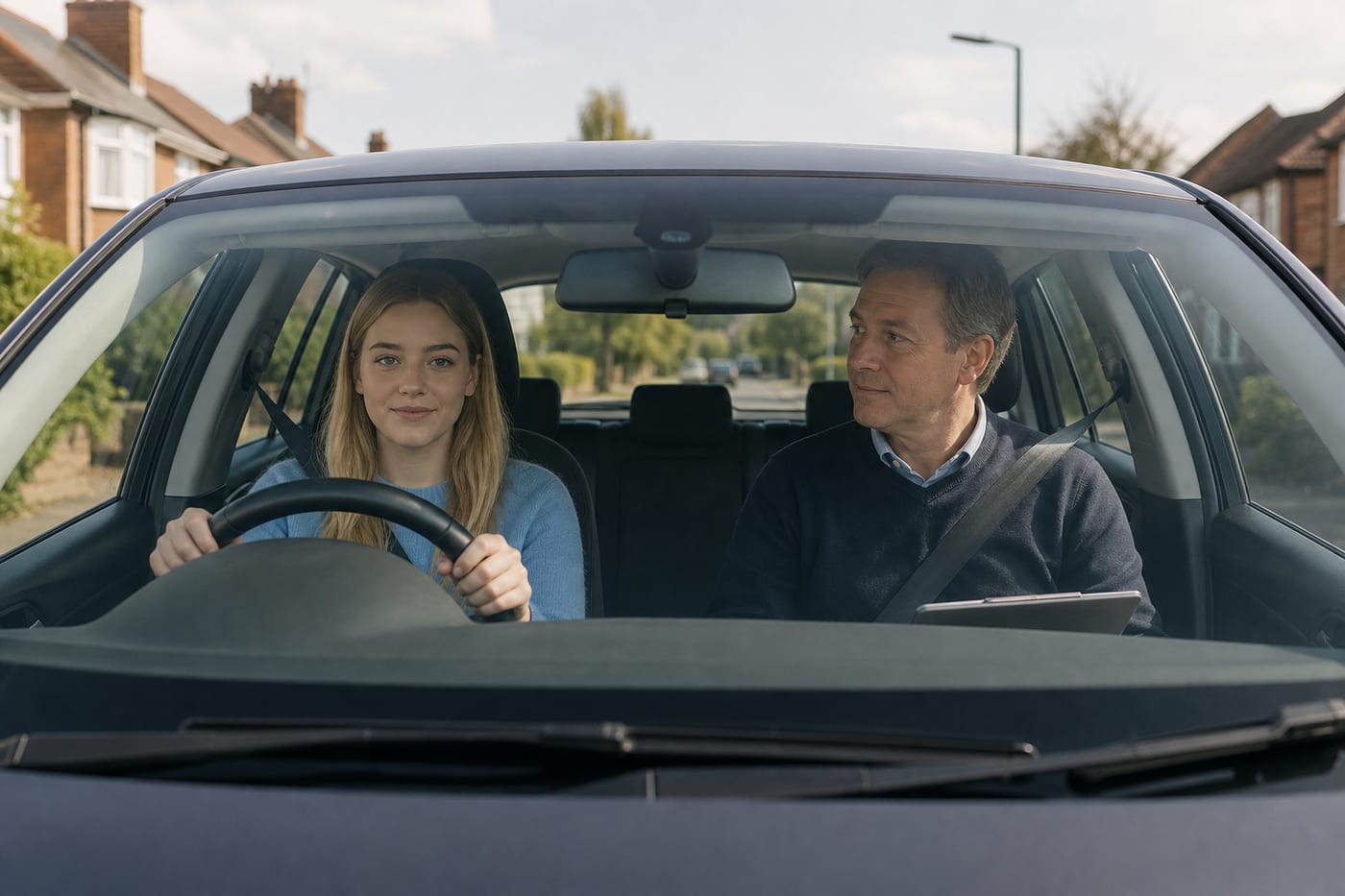
Returning to driving lessons after a long break can feel more daunting than starting for the first time. You may remember enough to know what you should be doing, yet find that your timing, observations and confidence are no longer as sharp as they once were.
That does not mean you have failed or must begin again from the very first lesson. With an honest assessment, a patient instructor and regular practice, previously learned skills often start to return.
This learner’s story is a representative example of the challenges people commonly face when resuming lessons. It also shows how a structured approach can turn an uncertain return into steady progress towards the UK theory and practical tests.
Why the learner stopped driving lessons
Sam had taken driving lessons for several months and had covered the main controls, junctions, roundabouts and basic manoeuvres. Progress had been encouraging, but a change in working hours made regular lessons difficult.
One missed week became a month. As the break grew longer, returning felt increasingly uncomfortable. Sam worried about stalling, making mistakes in front of an instructor and discovering that all the earlier lessons had been wasted.
This is a familiar cycle. Learners pause for many reasons, including:
- Financial pressure
- Work, university or family commitments
- Moving to a different area
- Illness or changes in health
- A difficult lesson or loss of confidence
- Trouble finding a suitable instructor
- An unsuccessful theory or practical test
A break is not proof that you are incapable of learning to drive. It simply changes the best way to approach your next lesson.
Making the decision to return
Sam’s motivation returned after changing jobs and facing a longer commute. Rather than immediately booking a block of lessons, Sam contacted several local instructors and explained the situation clearly.
The message included roughly how many lessons had been completed, which skills had previously been covered and how long the break had lasted. Sam also mentioned feeling anxious about restarting.
That honesty helped the chosen instructor plan an assessment lesson rather than assuming Sam was either a complete beginner or nearly ready for the test.
If you are returning, tell a prospective instructor:
- When you last drove
- How much previous experience you have
- Whether you have passed the theory test
- Which areas you found difficult
- Whether you have driven privately with family or friends
- What caused you to stop
- What you hope to achieve now
You can also ask how the instructor supports nervous learners, how frequently lessons are available and whether they use a progress record.
The first lesson back
Before the first session, Sam expected to drive into busy traffic almost immediately. Instead, the instructor began on quiet roads and treated the lesson as a calm assessment.
The opening minutes covered the cockpit drill, use of the main controls and moving off safely. Sam’s clutch control was hesitant and mirror checks needed prompting, but steering and basic road positioning returned more quickly.
The lesson then moved on to straightforward junctions. Rather than trying to correct every issue at once, the instructor identified three priorities:
- Re-establish a consistent observation routine.
- Improve clutch control and gear selection.
- Plan earlier when approaching junctions.
This made the situation feel manageable. Sam had not forgotten everything; some skills were simply rusty.
Treat the first session as an assessment
Your first lesson back is not a test of whether you deserve to continue. Its purpose is to establish your current level and create a sensible plan.
You might remember vehicle control but struggle with decision-making. Alternatively, your road awareness may remain good while your coordination needs practice. Returning learners do not all restart at the same point.
Try not to compare the number of lessons you had before the break with how you perform now. Previous experience still has value, even when it takes time to become comfortable again.
Rebuilding confidence without rushing
After the assessment, Sam booked weekly lessons at a consistent time. Each session began with a short recap and finished with a discussion about what had improved and what needed further work.
Early lessons used familiar, quieter routes. As Sam became more confident, the instructor gradually introduced busier roundabouts, dual carriageways and unfamiliar roads.
This gradual progression mattered. Avoiding every difficult situation would have limited progress, but moving into demanding traffic too soon could have reinforced the anxiety.
Focus on specific actions
“Become more confident” is a vague target. Confidence usually grows from repeated evidence that you can handle particular situations safely.
More useful lesson goals include:
- Moving off without unnecessary delay
- Checking mirrors before changing speed or direction
- Choosing a safe gap at a roundabout
- Maintaining an appropriate following distance
- Approaching junctions at a controlled speed
- Completing a manoeuvre with effective observations
After each lesson, note one success and one priority for next time. This keeps mistakes in perspective and gives you a clear focus.
Expect an uneven return
Progress is rarely perfectly smooth. Sam had one lesson where roundabouts felt controlled, followed by another where hesitation returned in heavier traffic.
A difficult lesson does not erase earlier improvement. Weather, unfamiliar roads, tiredness and traffic conditions can all affect performance. Look for progress across several lessons rather than judging yourself by one session.
Refreshing theory knowledge
Although Sam remembered many road signs, some rules and stopping-distance knowledge had become uncertain. Practical lessons were therefore combined with theory revision.
This was useful even before booking another theory test. Understanding the rules supported better decisions on the road, particularly around speed limits, road markings, vulnerable road users and developing hazards.
Returning learners should revise rather than relying on what they remember from months or years ago. Use up-to-date learning materials, practise multiple-choice questions and spend time developing hazard perception skills.
If your theory test certificate has expired, you will need to pass the theory test again before taking the practical test. Check your own dates rather than assuming an earlier pass is still valid.
Sam used short, regular revision sessions instead of attempting to cover everything in one weekend. Reviewing mistakes was more valuable than repeatedly answering familiar questions correctly.
Practising between professional lessons
Sam was able to practise occasionally in a family member’s car. The instructor suggested suitable areas and skills to work on, helping private practice support rather than conflict with professional lessons.
Any private practice must be legal. The learner needs a valid provisional licence, must be properly supervised and must meet the relevant insurance requirements. The car must also be legal and roadworthy, with L plates displayed as required.
The supervising driver should remain calm and avoid introducing techniques that contradict the instructor’s guidance. It is also sensible to begin on roads suited to the learner’s current ability.
Before setting off, basic vehicle checks can help make private practice safer. Our guide to checking vital engine fluids safely explains how learners can inspect oil, coolant, brake fluid and screen wash without taking unnecessary risks.
Private practice is helpful, but it is not essential for every learner. If it is unavailable or causes arguments, well-planned professional lessons may be the better option.
Dealing with anxiety after a bad experience
Part of Sam’s reluctance to return came from one earlier lesson that had felt overwhelming. The previous instructor had intervened at a busy junction, and Sam had interpreted that moment as evidence of being unsafe.
The new instructor explained that intervention is sometimes necessary during tuition. The important step is to understand why it happened and how to respond differently next time.
If a past lesson still affects you, discuss it before driving. A good instructor can break the situation into smaller skills, such as speed control, observation, judgement and planning.
It may help to:
- Arrange lessons when you are normally alert
- Avoid squeezing a lesson between stressful commitments
- Use slow breathing before moving off
- Ask for clear, timely directions
- Request a brief pause if you feel overloaded
- Talk through mistakes rather than dwelling on them silently
If anxiety is severe or affects everyday life, consider seeking appropriate professional support. Also remember that some medical conditions may affect driving or need to be reported. The guidance on medical conditions that must be reported to the DVLA is a useful starting point, although individual circumstances should always be checked with the DVLA.
Knowing when to think about the practical test
As Sam’s driving became more consistent, lessons began to include longer periods of independent decision-making. The instructor reduced prompts and used unfamiliar routes to see whether Sam could apply skills without relying on memorised roads.
The decision to take the practical test was based on safe, consistent performance rather than simply reaching a certain number of lessons. Sam needed to show effective observations, sound judgement and control across different road and traffic conditions.
A mock test helped identify remaining weaknesses. It also made the format feel less mysterious, while leaving enough lesson time to address the issues found.
Learners approaching this stage can use these strategies for the practical driving test to organise preparation, manage nerves and understand how to make the most of final lessons.
Do not pressure yourself into taking the test just to prove that returning was worthwhile. Being genuinely prepared gives you the best opportunity to demonstrate safe driving.
What Sam learned from returning
The biggest lesson was that restarting did not require perfect confidence. Sam returned while still nervous and allowed confidence to develop through preparation and experience.
The break had caused some skills to fade, but it had not removed the ability to learn. A clear plan made the difference: assess the current level, rebuild the foundations, revise theory and increase the challenge gradually.
Sam also learned that changing instructor was not a sign of failure. Teaching styles and personalities differ, and a learner needs someone who communicates in a way that supports safe progress.
Practical checklist for returning learners
Before resuming your lessons:
- Check that your provisional driving licence is valid and your details are correct.
- Find out whether your previous theory test pass is still valid.
- Tell your instructor about your experience and concerns.
- Book an assessment lesson before making assumptions about your level.
- Refresh the Highway Code and current theory topics.
- Set a realistic lesson schedule and budget.
- Keep brief notes on progress after each session.
- Arrange legal private practice if it is suitable and available.
- Avoid booking a practical test before your driving is consistently ready.
Conclusion
Returning to driving lessons can feel like a major step, but a break does not have to end your goal of gaining a full licence. Start with an honest assessment, focus on one skill at a time and give yourself room to rebuild consistency.
Like Sam, you may discover that more knowledge has stayed with you than you expected. With regular lessons, refreshed theory knowledge and patient practice, driving can begin to feel achievable again.
Frequently asked questions
Will I have to start driving lessons from the beginning after a break?
Not necessarily. An instructor can assess your control, observations, planning and judgement before recommending what to cover. Some skills may return quickly, while others will need structured practice.
How long does it take to regain driving confidence?
There is no fixed timescale. It depends on the length of your break, your previous experience, the reason you stopped and how regularly you can practise. Focus on safe, consistent progress rather than a deadline.
Should I use the same driving instructor when I return?
You can return to the same instructor if you found their teaching helpful and they are available. However, it is reasonable to choose someone else if you need a different teaching style, have moved area or did not feel comfortable previously.
Should I pass the theory test before restarting practical lessons?
You do not normally need to have passed the theory test before taking lessons, but revising theory alongside practical driving can improve your road knowledge. You must have a valid theory test pass before you can take the practical car test.