Reverse bay parking can feel complicated because several things happen at once. You must control the car at very low speed, steer at the right moment, watch the bay markings and remain alert to pedestrians and other vehicles.
The good news is that the manoeuvre becomes much easier when you stop treating it as one continuous movement. Break it into a repeatable sequence: assess, position, observe, reverse slowly, steer, straighten and secure the car.
No parking technique is completely foolproof in every vehicle or car park. Cars have different dimensions and steering characteristics, while bay markings and available space vary. However, the strategy below gives you a dependable framework that can be adapted with your instructor.
What is reverse bay parking?
Reverse bay parking means driving past or alongside a parking space and reversing into it. When you leave, you can drive forwards with a clearer view of the surrounding area.
During the practical driving test in Great Britain, you may be asked to park in a bay. This could involve driving forwards into a bay and reversing out, or reversing into a bay and driving out. The precise circumstances will depend on the test and location.
The examiner is interested in more than whether the finished car looks tidy. You need to demonstrate effective observations, appropriate speed, accurate steering and proper control throughout the manoeuvre.
Why reversing into a bay feels difficult
When reversing, the back of the car travels in the direction you steer. Steer left and the rear moves left; steer right and it moves right. At the same time, the front of the car swings in the opposite direction.
Learners commonly concentrate so heavily on the bay behind them that they forget about the front corner. Others focus entirely on a mirror and miss a pedestrian approaching from the side.
Reference points can help, but they are not universal. A mark that works in an instructor’s car may be unsuitable in another vehicle because of differences in seating position, mirror adjustment, wheelbase and turning circle. Treat reference points as prompts rather than substitutes for observation and judgement.
Before practising manoeuvres, make sure your seating position and mirrors are correct. Our pre-drive cockpit safety routine explains how to set up the seat, steering and mirrors before moving away.
The reliable reverse bay parking strategy
A consistent routine reduces the temptation to rush or guess. Practise the following stages with an approved driving instructor in a suitable location.
1. Assess the bay and surroundings
Choose the bay early enough to plan your approach. Check that it is available and suitable for the vehicle. Look at the width of the bay, the clarity of its markings and any nearby kerbs, posts, trolley shelters or parked cars.
Also consider what might change while you park. A quiet space can quickly become busy when a pedestrian appears, a car begins reversing or somebody opens a door.
If you are practising in an empty car park, do not assume it will remain empty. Keep scanning throughout the manoeuvre.
2. Position the car for the turn
Drive slowly past the chosen bay and position the car parallel to the row of spaces, leaving enough room for the front to swing safely as you reverse.
Your instructor may give you a vehicle-specific reference point showing when to stop. For example, they may ask you to line up part of the bay with a point in a side window. Use this only as an initial guide. Your mirrors and observations should confirm what the car is actually doing.
Stop under control and keep the wheels straight unless your chosen method requires otherwise. Select reverse gear and pause before moving.
3. Complete effective all-round observations
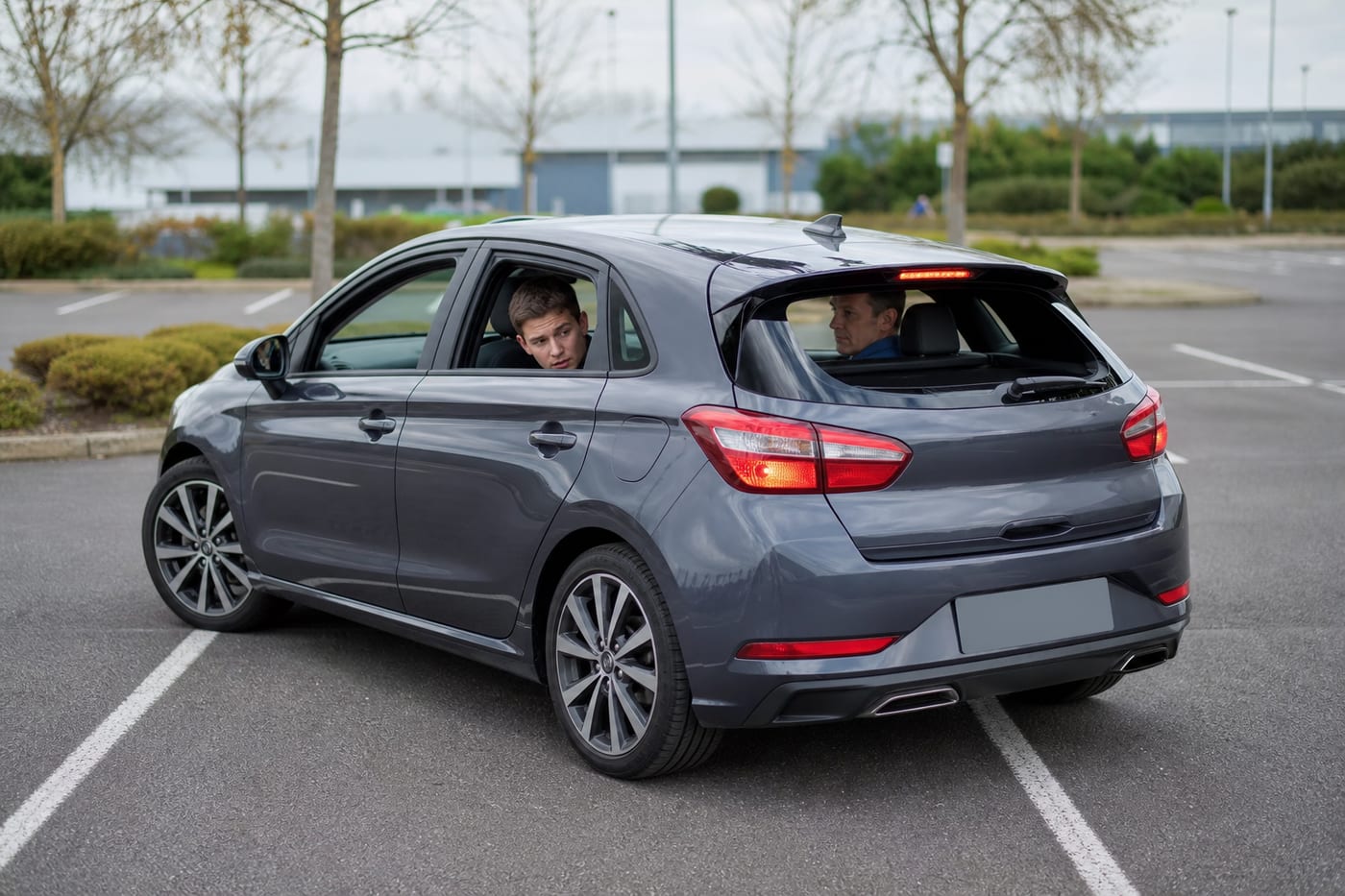
Before the car moves backwards, check all around it. This normally means looking through the rear window, checking both sides, using the mirrors and checking blind spots as necessary.
Do not turn this into a rapid head movement performed only to satisfy an examiner. You are looking for real hazards, including:
- Pedestrians crossing behind or beside the car
- Children who may be difficult to see
- Cyclists passing through the car park
- Vehicles entering, leaving or reversing from nearby bays
- The front of your car swinging towards another vehicle or object
If anyone could be affected, stop and allow the situation to develop. Never try to hurry through the manoeuvre before a pedestrian reaches you.
4. Reverse at a slow, controllable pace
Move the car as slowly as necessary to maintain control. In a manual car, this usually involves careful clutch control, with gentle braking when needed. In an automatic, control the vehicle using the brake in accordance with your instructor’s guidance.
A slow car gives you time to observe and adjust. If the vehicle starts moving faster than you can comfortably assess the situation, stop, secure it if necessary and reset.
Remember that slow does not mean uncontrolled. Avoid repeatedly surging and braking sharply. Aim for smooth, deliberate movement.
5. Steer towards the chosen bay
When you reach the turning point taught by your instructor, steer firmly towards the bay. If the bay is behind you on the left, steering left sends the rear of the car left. If it is on the right, steer right.
As the rear enters the space, the front swings out. Continue checking the opposite front corner as well as the rear and sides. This is particularly important when parking between vehicles.
Avoid staring at the reversing camera if the car has one. Cameras and parking sensors can provide useful additional information, but they do not show every possible hazard and do not replace direct observation.
6. Compare both bay lines
Use both side mirrors to judge the position of the car in relation to the markings. Looking at only one line can make the car appear correctly positioned when it is actually angled across the space.
Ask yourself:
- Is the car becoming parallel with the bay lines?
- Is the gap reasonably balanced on both sides?
- Are all four wheels likely to finish within the bay?
- Is there enough space behind the car?
- Is the front still clear as it swings around?
Keep alternating between the direction of travel, the mirrors and the wider surroundings. The bay markings matter, but people and moving vehicles take priority.
7. Straighten the wheels
As the car becomes parallel with the bay lines, unwind the steering so that the wheels return to a straight-ahead position. Continue reversing slowly while checking both sides.
Straightening too early may leave the car angled towards one line. Straightening too late can cause the rear to travel too far across the space. If the position is not developing as expected, stop rather than hoping it will correct itself.
8. Stop in the correct position and secure the car
Reverse far enough into the bay without crossing the rear boundary or approaching an obstacle too closely. Do not depend entirely on sensors, as their operation and warning distances vary.
Stop under control. Apply the parking brake and select neutral or park as appropriate. Before opening a door or moving away again, check the surrounding area.
How to correct reverse bay parking safely
A correction is often better than continuing with a poor angle. During a driving test, making a correction is not automatically a failure; the examiner will consider your control, accuracy and observations throughout.
If you notice the problem early, a small steering adjustment while reversing slowly may be enough. Think about where the rear of the car needs to go. If it needs to move left, steer left while reversing; if it needs to move right, steer right. Straighten again as the position improves.
If the angle is too large, stop. Check all around, drive forwards slowly to create space and straighten the car, then complete fresh observations before reversing again. Never pull forwards without checking for pedestrians or vehicles crossing in front.
The objective is not to avoid adjustments at all costs. It is to solve the problem safely and under control.
Common reverse bay parking mistakes
Relying on one reference point
A reference point can begin the turn, but it cannot confirm that the bay is clear or that the vehicle is correctly aligned. Always support it with direct observation and mirror checks.
Reversing too quickly
Excessive speed reduces the time available to notice hazards and correct the steering. Slow the car before attempting to fix the angle.
Looking only in the mirrors
Mirrors have limited coverage. Keep checking through the windows and into relevant blind spots, especially before moving and while the front swings out.
Steering while stationary unnecessarily
Turning the wheel when the car is stationary can make it harder to understand how steering affects its path. Unless your instructor has a reason for teaching otherwise, coordinate the steering with very slow movement.
Continuing after the position has gone wrong
If you know the car will cross a line, stop. A calm correction demonstrates better judgement than continuing and hoping for a good result.
Forgetting to straighten the wheels
The initial turn gets the car into the bay, but the steering must then be unwound. Watch how the bay lines change in both mirrors rather than attempting to count steering-wheel turns alone.
Practical test tips for reverse bay parking
Practise in different bays and conditions rather than repeating the same space. Try bays on both sides, slightly faded markings and locations with different amounts of room, but only where practice is permitted and safe.
Ask your instructor to vary the starting position. This helps you understand the car’s movement instead of memorising a single routine that works only from one spot.
During the test, listen carefully to the examiner’s instruction and take a moment to assess the area. You are not expected to rush. Continue observations for the entire manoeuvre and be prepared to stop for other car park users.
Aim to finish with the car reasonably straight and within the bay markings. If you are unsure about the position, use the mirrors to assess it and correct it safely if required.
Manoeuvres are only one part of test preparation. Our guide to practical driving test strategies also covers independent driving, nerves and preparation for test day.
A simple practice checklist
Use this checklist until the sequence becomes natural:
- Choose a suitable bay and assess the hazards.
- Position the car with enough turning room.
- Select reverse and complete all-round observations.
- Reverse at a very slow, controlled pace.
- Steer towards the bay at the appropriate point.
- Monitor both bay lines and the front swing.
- Straighten as the car becomes parallel.
- Stop in the bay and secure the vehicle.
- Correct calmly if the angle is unsuitable.
Frequently asked questions
Can I adjust my reverse bay parking during the driving test?
Yes, you can correct the position if necessary. A correction is not automatically a test failure. What matters is that you retain control, observe properly and respond safely to the situation. Repeated or unsafe corrections may affect the examiner’s assessment.
Can I use a reversing camera on the practical test?
You can use fitted parking aids as additional assistance, but you must not rely on them alone. Continue looking through the windows, using the mirrors and checking the surrounding area for hazards.
How can I tell when to start steering?
The turning point depends on the vehicle, your position and the method being used. Your instructor can help you establish an initial reference point, but you should then use the bay lines and the car’s movement to confirm and adjust the turn.
What should I do if a pedestrian walks behind me?
Stop immediately and allow the pedestrian to move clear. Check the entire area again before continuing, as another person or vehicle may have appeared while you were waiting.
Conclusion
Reliable reverse bay parking comes from a calm routine rather than a clever trick. Position carefully, observe all around, reverse slowly and use both bay lines to judge the developing angle. If the position is wrong, stop and correct it safely.
With supervised practice in different spaces, you will become less dependent on fixed reference points and more confident in judging the vehicle for yourself.