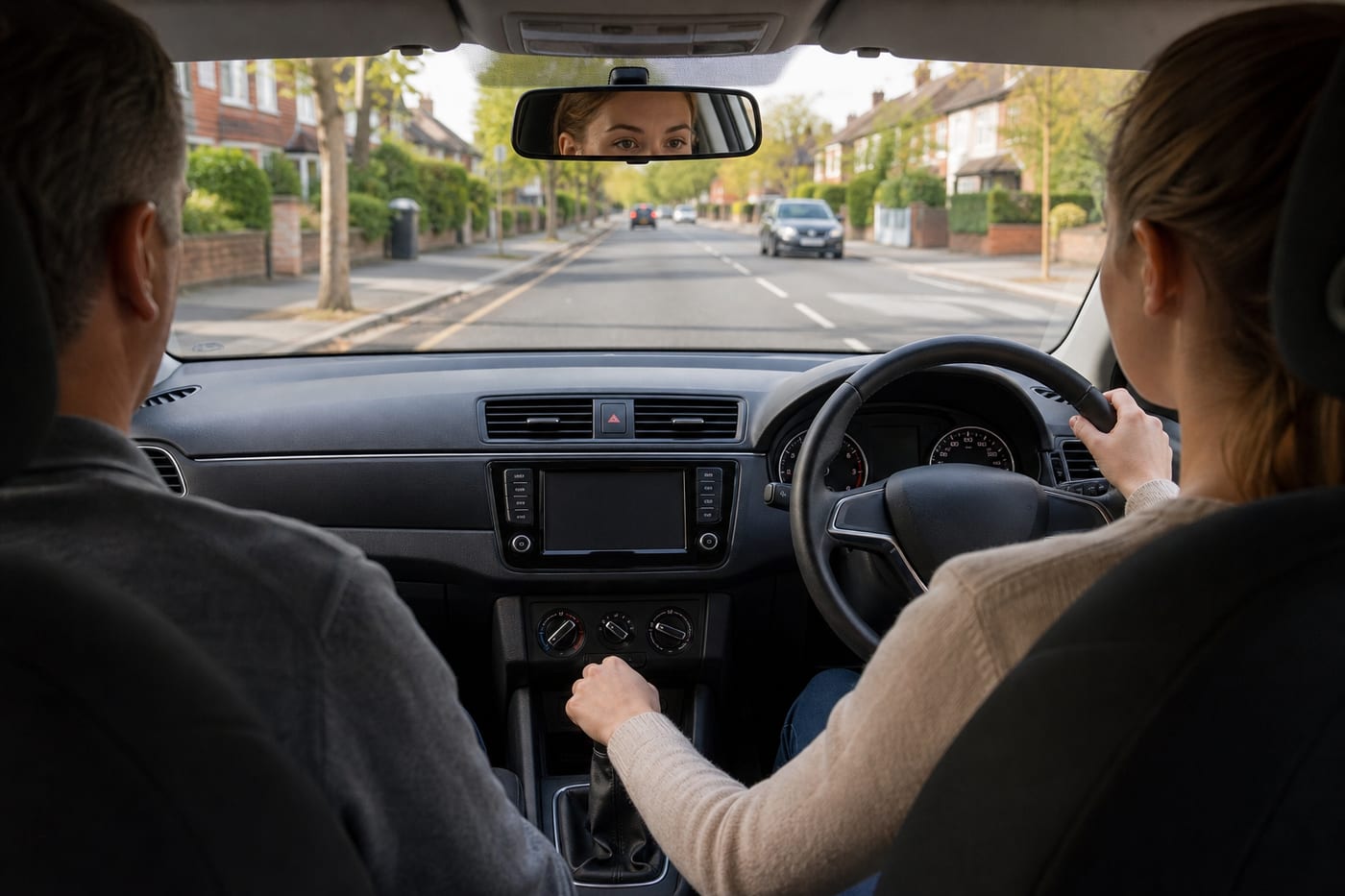
Smooth gear changes make a manual car more comfortable, controlled and efficient to drive. More importantly, choosing the correct gear helps you respond safely to junctions, bends, hills, changing speed limits and developing hazards.
For many learners, changing gear initially feels like a complicated sequence involving the accelerator, clutch and gear lever. With practice, those separate actions become one coordinated routine. The aim is not to rush or to move through every gear in order. It is to select a suitable gear for the car’s speed and the road conditions while maintaining proper observation and control.
Before practising on the road, make sure your seating position allows you to press the clutch fully without stretching or locking your knee. Your instructor can help you adjust the seat, steering wheel and mirrors using an appropriate pre-drive cockpit safety routine.
Why smooth gear changes matter
The gearbox enables the engine to work effectively across different road speeds and situations. Lower gears provide greater pulling power and are useful when moving off, travelling slowly or climbing a steep hill. Higher gears are generally suited to faster, steadier travel.
A suitable gear gives you enough control and acceleration for the situation. An unsuitable gear may cause the engine to labour, make the car jerk or leave you with poor acceleration when you need it.
Smooth changes also help you keep your attention on the road. If you regularly stare at the gear lever or struggle with the pedals, you may miss pedestrians, brake lights, signs or other developing hazards. Learning to recognise those risks is also central to scoring highly on the hazard perception test.
The basic gear-changing technique
Although cars vary, a typical upward gear change follows this sequence:
- Look ahead and decide whether a change is appropriate.
- Ease off the accelerator.
- Press the clutch pedal fully down.
- Move the gear lever smoothly into the required gear.
- Bring the clutch up progressively.
- Apply the accelerator as needed.
These actions should flow together without becoming hurried. Avoid releasing the clutch suddenly, as this can make the car jerk. Equally, do not hold the clutch at its biting point longer than necessary during an ordinary gear change.
When changing down, you will usually slow the car first, press the clutch, select the appropriate lower gear and release the clutch smoothly. Your accelerator use will depend on the road, the selected gear and whether you need to maintain speed or accelerate.
Every car feels slightly different. The clutch biting point, gear pattern and engine response can vary, so take time to become familiar with the vehicle you are driving.
Choosing the right time to change gear
There is no single set of gear-change speeds suitable for every car and every situation. Engine size, road gradient, vehicle load and required acceleration all make a difference.
Instead of relying entirely on the speedometer, learn to use several clues.
Listen to the engine
An engine that sounds increasingly loud or busy may indicate that a higher gear is appropriate. If the engine sounds strained, struggles to accelerate or the car begins to shudder, the selected gear may be too high for the speed or gradient.
Do not focus so closely on engine noise that you neglect observations. Over time, recognising the sound and feel of the car should become natural.
Consider the road ahead
Ask what the car will need to do next. If you are approaching a bend, roundabout or junction, you may need to slow down and select a lower gear. If the road is clear and your speed is increasing, a higher gear may be suitable.
Select a gear that allows you to negotiate the hazard safely and accelerate when appropriate. Planning early gives you more time and reduces rushed pedal movements.
Consider the gradient
Uphill driving may require a lower gear because the engine needs more pulling power. If the car loses speed or labours, change down before the engine begins to struggle severely.
On a downhill stretch, a suitable lower gear can provide engine braking and help you maintain control. This does not replace appropriate use of the brakes, but it can help prevent the car from gathering speed too readily.
Changing up smoothly
When accelerating, build speed progressively rather than pressing the accelerator sharply. Ease off the accelerator as you press the clutch, then move the gear lever without forcing it.
As you release the clutch, coordinate its movement with gentle accelerator pressure. Releasing it too quickly can produce a jolt, while adding excessive acceleration can make the engine race.
Keep your eyes on the road. Learn the gear positions by touch and practise moving the lever accurately while stationary, with the engine off and under your instructor’s guidance. This can reduce the temptation to look down while driving.
Once the change is complete, return your left hand to the steering wheel. Do not rest it on the gear lever, as two-handed steering normally provides better control.
Changing down safely
A common learner mistake is changing down too early and using the lower gear to slow the car abruptly. In normal driving, it is usually better to use the brakes to reduce speed, then select the gear that suits the new speed and situation.
A useful principle is: mirrors, brake, then gear. The exact routine depends on the circumstances, but the important point is to plan before reaching the hazard.
Release the clutch progressively after selecting the lower gear. If the car jerks or the engine speed rises sharply, you may have selected too low a gear or released the clutch too quickly.
You do not always need to change through every intermediate gear. For example, after slowing significantly from a higher speed, you might select a gear appropriate for the new speed rather than moving through each gear in sequence. This is sometimes called block changing. It can reduce unnecessary actions, but the chosen gear must be suitable for the situation.
Avoid coasting
Coasting generally means travelling with the clutch held down or the gear lever in neutral for longer than necessary. This reduces the connection between the engine and the driven wheels and removes the benefit of engine braking.
Avoid pressing the clutch too early when approaching a junction or stopping point. Brake while the car remains in gear, then press the clutch before the engine begins to struggle or stall. The precise timing depends on the car and situation.
At a prolonged stop, select neutral and apply the parking brake when appropriate. Your instructor can help you develop a safe routine for different traffic conditions.
Gear changes at common road features
Junctions and roundabouts
Look well ahead, check your mirrors and begin slowing in good time. Select a suitable gear before entering when possible, so you can concentrate on observations, steering and deciding whether it is safe to proceed.
Avoid rushing to select first gear automatically. If the road is clear and the car is still moving at an appropriate speed, another gear may be suitable. If you must stop, select first gear when preparing to move off.
Bends
Reduce speed before the bend and select a suitable gear while the car is travelling straight. Enter at a controlled speed, keep a steady course and accelerate only when you can see that it is safe to do so.
Changing gear mid-bend can add an unnecessary task when your attention should be on steering and the road ahead.
Hills
Change down before the engine labours on an uphill section. Waiting too long can cause a rapid loss of momentum and make the change more difficult.
When moving off uphill, coordinate the clutch, accelerator and parking brake carefully to prevent rolling back. Use the biting point positively but avoid holding the car on the clutch for an extended period.
Overtaking and joining faster roads
You may need a lower gear to gain speed safely and promptly. Plan the change before beginning the manoeuvre and only proceed when you have a clear, legal and safe opportunity. Never allow gear selection to distract you from observations.
Common gear-changing mistakes
Looking at the gear lever
Looking down takes your attention away from traffic and hazards. Learn the gear layout while stationary and practise with an approved driving instructor.
Releasing the clutch too quickly
An abrupt release can make the car jerk or stall. Bring the pedal up progressively, pausing briefly around the biting point only when necessary.
Keeping the clutch partly pressed
Resting your foot on the clutch can result in unintended clutch operation. Once a change is complete, place your left foot on the footrest where the car provides one.
Selecting the wrong gear
Do not panic if this happens. Keep control, press the clutch if necessary and select the correct gear when safe. Avoid forcing the lever. If the car reacts unexpectedly, deal with the immediate situation calmly and maintain effective observations.
Changing gear too often
Do not change solely because you have reached an assumed speed. Consider the gradient, traffic and what you need the car to do next. Unnecessary changes increase workload without improving control.
Leaving the change too late
Late decisions can lead to harsh braking, rushed gear selection or entering a hazard too quickly. Scan further ahead so you can adjust your speed and gear in good time.
How to practise effectively
Begin on quiet, suitable roads with your instructor. Practise moving up through the gears, slowing down and selecting an appropriate lower gear without looking at the lever.
Ask your instructor to help you recognise engine sounds rather than simply giving you a fixed speed for each change. You can then practise planning for junctions, gradients and changes in speed limits.
If you make a mistake, focus first on keeping the car under control and observing the road. One imperfect gear change does not have to lead to further errors. This calm approach is also useful when following broader strategies for your practical driving test.
With permission from your instructor, reflecting after each attempt can help. Identify whether the issue involved timing, clutch release, accelerator pressure or planning. Work on one element at a time rather than trying to correct everything at once.
FAQ
Should I change down through every gear when slowing?
Not necessarily. You can select a gear suited to your new speed and the road conditions rather than using every intermediate gear. The important points are to slow safely, maintain control and choose a gear that will provide an appropriate response.
Why does the car jerk when I release the clutch?
You may be releasing the clutch too quickly, selecting a gear that does not suit the road speed or using the accelerator unevenly. Practise progressive clutch release and ask your instructor to help identify the precise cause.
Can I keep the clutch down while approaching a junction?
Avoid holding it down earlier or longer than necessary, as this causes the car to coast. Normally, you should reduce speed with the car in gear and press the clutch before the engine struggles or stalls.
Will a rough gear change cause me to fail my driving test?
A single imperfect change does not automatically determine the result. The examiner assesses whether your driving is safe and whether faults are serious, dangerous or repeated. Concentrate on maintaining control, observing effectively and responding safely rather than dwelling on a mistake.
Conclusion
Smooth, safe gear changes come from coordination, observation and forward planning. Listen to the car, consider the road ahead and choose a gear that suits your speed and circumstances. With structured practice, you will spend less time thinking about the mechanics of each change and more time making safe driving decisions.