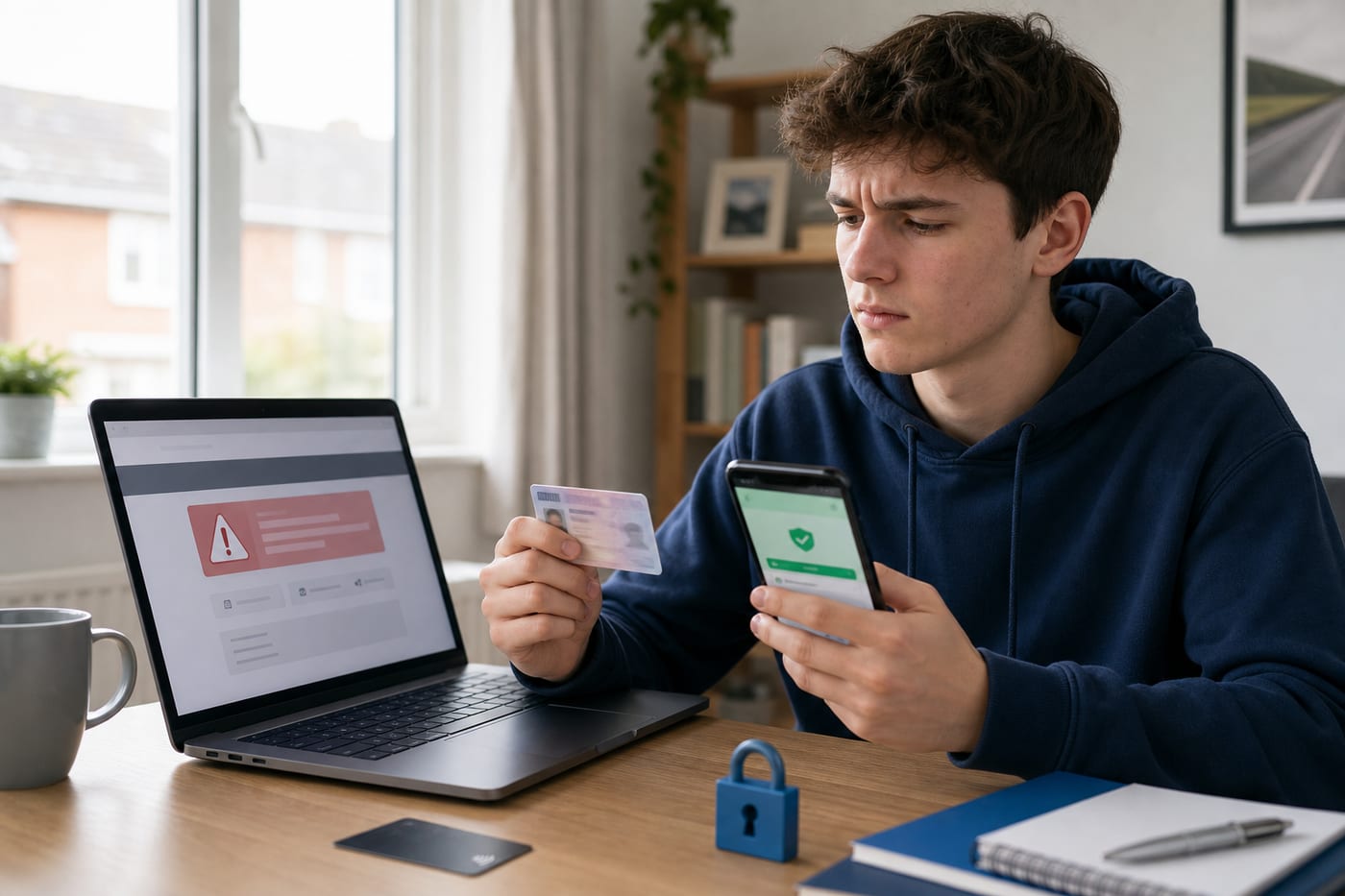
Booking a driving test can be stressful, particularly when waiting times are long or suitable appointments are difficult to find. Unfortunately, that pressure creates an opportunity for fake booking websites, dishonest social media accounts and misleading third-party services.
Some services simply charge an additional fee for finding or managing a test. Others take payment without providing any booking at all. A scammer may also use the promise of an earlier appointment to steal your driving licence details, banking information or account credentials.
Learning how to recognise the warning signs can help you protect your money and personal information while keeping your test preparations on track.
Start with the official booking route
The safest way to arrange a theory or practical driving test is to begin on GOV.UK if you live in England, Scotland or Wales. Learners in Northern Ireland should use the official nidirect service, as tests there are managed separately.
Rather than searching for a booking page and selecting the first result, type the official government web address into your browser or use a saved bookmark. Search results can include paid adverts, third-party booking businesses and websites designed to resemble official services.
Government guidance may direct you from GOV.UK to the relevant secure booking platform. Starting on the official page helps you avoid convincing lookalike addresses.
Before confirming anything, check:
- that you started from GOV.UK or nidirect
- what test you are booking
- the test centre, date and time
- the total amount being charged
- where the confirmation will be sent
- whether the service is official or operated by another business
Official test fees and booking procedures can change, so check the current information on the relevant government website rather than trusting a price shown in an advert or social media post.
Understand the difference between a third-party service and a scam
Not every non-government website is necessarily fraudulent. Some businesses offer to search for cancellations, send appointment alerts or manage bookings in return for a fee.
However, using one may mean paying considerably more than the official test fee. You may also have to provide personal information to a company that is not part of the Driver and Vehicle Standards Agency (DVSA) or the Driver and Vehicle Agency (DVA) in Northern Ireland.
A legitimate third-party business should clearly explain:
- that it is not the official government booking service
- exactly what it provides
- its service fees and any additional charges
- its cancellation and refund terms
- how it stores and uses personal data
- how customers can contact it
Be cautious if this information is missing, hidden in lengthy terms or only revealed after you enter payment details. Even if a service is genuine, consider whether the convenience is worth the extra cost and the need to share your details.
Warning signs of a fake driving test booking service
Scam pages and accounts vary, but several common warning signs should make you stop before paying.
Claims of guaranteed or secret appointments
Be wary of anyone promising a “guaranteed pass”, a guaranteed cancellation or exclusive access to appointments unavailable through official channels. No booking agent can guarantee that you will pass the test, and appointment availability can change quickly.
Claims that somebody has a personal contact inside the DVSA, can bypass official systems or can create a test slot especially for you are particularly suspicious.
Pressure to pay immediately
Fraudsters often create urgency. They may tell you that a test will disappear within minutes, that another buyer is waiting or that you must transfer money before they can reveal the date.
Genuine availability may be limited, but you should still be able to verify what you are buying. Do not let pressure prevent you from checking the website, seller and payment method.
Requests for unusual payment methods
Treat requests for cryptocurrency, gift cards or payment to an unrelated personal account as major warning signs. Bank transfers can also provide less protection than some card payments.
A social media seller who refuses to use a normal, traceable checkout process may be trying to prevent you from recovering your money.
A website that looks official but is not
Fake services may copy government colours, layouts or official-looking symbols. Some use web addresses containing terms such as “DVSA”, “driving test”, “official” or “UK booking” to appear trustworthy.
Look carefully for misspellings, extra words, unusual domain endings and substituted characters. Remember that a padlock symbol and an HTTPS address only show that the connection is encrypted; they do not prove the business is genuine.
Poor or missing contact information
A booking service should provide clear business and support details. Warning signs include a contact form with no other information, an address that cannot be verified, a mobile number that goes unanswered or an email address unrelated to the company name.
Do not rely only on testimonials displayed on the seller’s own website. Search independently for the business name alongside terms such as “reviews”, “complaints” or “scam”. Even then, remain cautious because reviews can be manipulated.
Requests for excessive personal information
Some information is necessary to book or manage a test, including details that identify the candidate. That makes driving test scams useful to identity thieves.
A seller should not need your online banking password, card PIN, email password or a security code sent by your bank. Never give somebody remote access to your phone or computer so they can “complete the booking” for you.
Social media driving test scams
Social media posts offering short-notice test dates can look convincing. A profile may display screenshots of supposed bookings, positive comments and messages from successful customers. These are not reliable proof.
Check when the account was created, whether its posts have genuine engagement and whether the same images appear elsewhere online. An account with a recently changed name, copied photographs or repetitive comments deserves extra caution.
A common tactic is to move the conversation into private messages and ask for a deposit. The seller may then demand further payments for a transfer charge, insurance, administration or “releasing” the booking. If you refuse, they may threaten to sell the slot to somebody else.
Do not send your licence photograph or booking reference to an unverified person. These details could be used to access or alter a genuine booking.
How to check a booking before relying on it
A screenshot is not proof that a test has been booked in your name. Images can be edited, reused or taken from another candidate’s booking.
After booking, make sure you receive confirmation through the expected official route. Check that your name, test type, centre, date and time are correct. Use the official government service to view or manage the appointment rather than following a link sent by an unknown seller.
If a third party says it has booked a test but will not provide information that allows you to verify it securely, do not assume the appointment exists. Contact the official service using contact details found independently on GOV.UK or nidirect.
Keep confirmation messages and payment receipts. Your driving instructor may also need to know the date, particularly if you want to use their car. Once the appointment is genuine, use these practical driving test strategies to prepare effectively rather than rushing into a test simply because a slot became available.
Protect your booking and personal details
Use a strong, unique password for the email account connected to your booking and switch on two-step verification where available. Your email account may contain confirmation messages and information that could help somebody target you with a convincing scam.
Do not publish screenshots containing your driving licence number, booking reference, address or other personal details. If you need to send proof of an appointment to your instructor, check the image carefully and cover information they do not need.
Be cautious with cancellation-finder apps and browser extensions. Before using one, establish who operates it, what permissions it requests, what it costs and how to cancel. Download apps only from trusted sources and inspect the privacy information before supplying candidate details.
Booking systems and test arrangements can evolve, so consult reliable sources when you hear rumours online. Our guide to upcoming UK driving test changes explains the importance of separating confirmed updates from trials and speculation.
What to do if you think you have been scammed
Act quickly if you have paid a fake service or disclosed sensitive information.
- Contact your bank or card provider immediately. Explain what happened and ask whether the payment can be stopped or disputed.
- Secure your accounts. Change affected passwords, starting with your email account, and enable two-step verification where possible.
- Check your genuine test booking. Use the official service to make sure it has not been changed or cancelled.
- Preserve evidence. Save messages, email headers, receipts, account names, telephone numbers and website addresses.
- Report the fraud. Action Fraud handles fraud reports in England, Wales and Northern Ireland. In Scotland, contact Police Scotland, normally through 101 unless it is an emergency.
- Report suspicious online content. Notify the social platform and use the National Cyber Security Centre’s suspicious website or phishing reporting options where appropriate.
If the incident has disrupted your learning, avoid booking a test before you are ready merely to recover lost time. Learners returning after a delay may find the advice on rebuilding confidence after a break from lessons helpful.
A quick safety checklist before paying
Pause and ask yourself:
- Did I reach this service through an official government page?
- Is it clear who operates the website or account?
- Does it openly state whether it is a third party?
- Can I see the full price before paying?
- Are the refund and cancellation terms understandable?
- Is the seller making unrealistic guarantees?
- Am I being pressured to pay by transfer or another unusual method?
- Can I verify the booking independently through the official service?
If anything feels wrong, leave the page and start again from GOV.UK or nidirect.
Conclusion
Fake driving test booking services rely on urgency, confusion and the understandable desire to find an earlier appointment. The safest response is to slow down, begin with the official government website and verify any booking independently.
Never treat a screenshot, social media profile or official-looking design as proof. Check the provider, price, payment method and data request before handing over money or personal details.
Frequently asked questions
Is it illegal to use a third-party driving test booking service?
A third-party service is not automatically a scam simply because it charges a fee. However, it should make clear that it is not the official booking service and explain its charges and terms. Booking directly through the official government route is usually the simplest way to understand what you are paying for.
Can somebody guarantee me an earlier driving test?
No seller can guarantee that a suitable cancellation will appear. Availability changes as candidates book, move or cancel appointments. Treat claims of guaranteed dates or secret access to DVSA appointments with caution.
Is an HTTPS padlock enough to show that a booking website is safe?
No. HTTPS encrypts information sent between your browser and the website, but scammers can also obtain security certificates. You must still check the address, operator, terms, payment request and whether you reached the service from an official government page.
What details should I never give to a booking agent?
Never share your online banking password, card PIN, email password or bank security codes. Do not allow an unknown person to control your device remotely. Only provide booking-related personal details after verifying who will receive them, why they are needed and how they will be protected.