
Changes to driving tests can create understandable concern, particularly when you are already trying to learn the Highway Code, develop practical skills and find an available test appointment. However, an announced trial or consultation does not always mean that the test is about to change nationwide.
The Driver and Vehicle Standards Agency (DVSA) regularly reviews how theory and practical tests work in Great Britain. Its aim is to ensure that new drivers are assessed on skills that reflect modern roads and real journeys. Recent developments have focused on more realistic practical test routes, booking arrangements and the way learners prepare.
This guide explains the main overhauls learners may encounter, what remains unchanged and how to prepare without being distracted by rumours.
First, understand which changes apply to you
The DVSA manages driving tests in England, Scotland and Wales. Tests in Northern Ireland are administered separately by the Driver & Vehicle Agency (DVA), so announcements made by the DVSA do not automatically apply there.
It is also important to distinguish between three types of announcement:
- A confirmed change has an official implementation date.
- A trial is being tested at selected locations and may never be introduced nationally.
- A proposal or consultation is under consideration but has not become a rule.
Headlines sometimes describe all three as an “overhaul”. Before changing your preparation, check the latest information on GOV.UK or, in Northern Ireland, the nidirect website.
Practical tests may place more emphasis on real-world driving
One of the most significant recent developments has been the DVSA’s trial of a revised car driving test at selected centres in Great Britain.
The trial explores whether more of the appointment can be spent driving independently on a wider variety of roads. The intention is to make the assessment more representative of the journeys newly qualified drivers are likely to make.
Elements tested have included:
- Extending the independent driving section
- Reducing the number of occasions on which the candidate is asked to pull up
- Asking fewer candidates to perform an emergency stop
- Giving examiners greater flexibility over the roads used during the test
These trial arrangements should not be treated as a guaranteed national format. Unless the DVSA formally announces a wider introduction, candidates should prepare for the test described in their current official booking and learning materials.
Why more independent driving is being considered
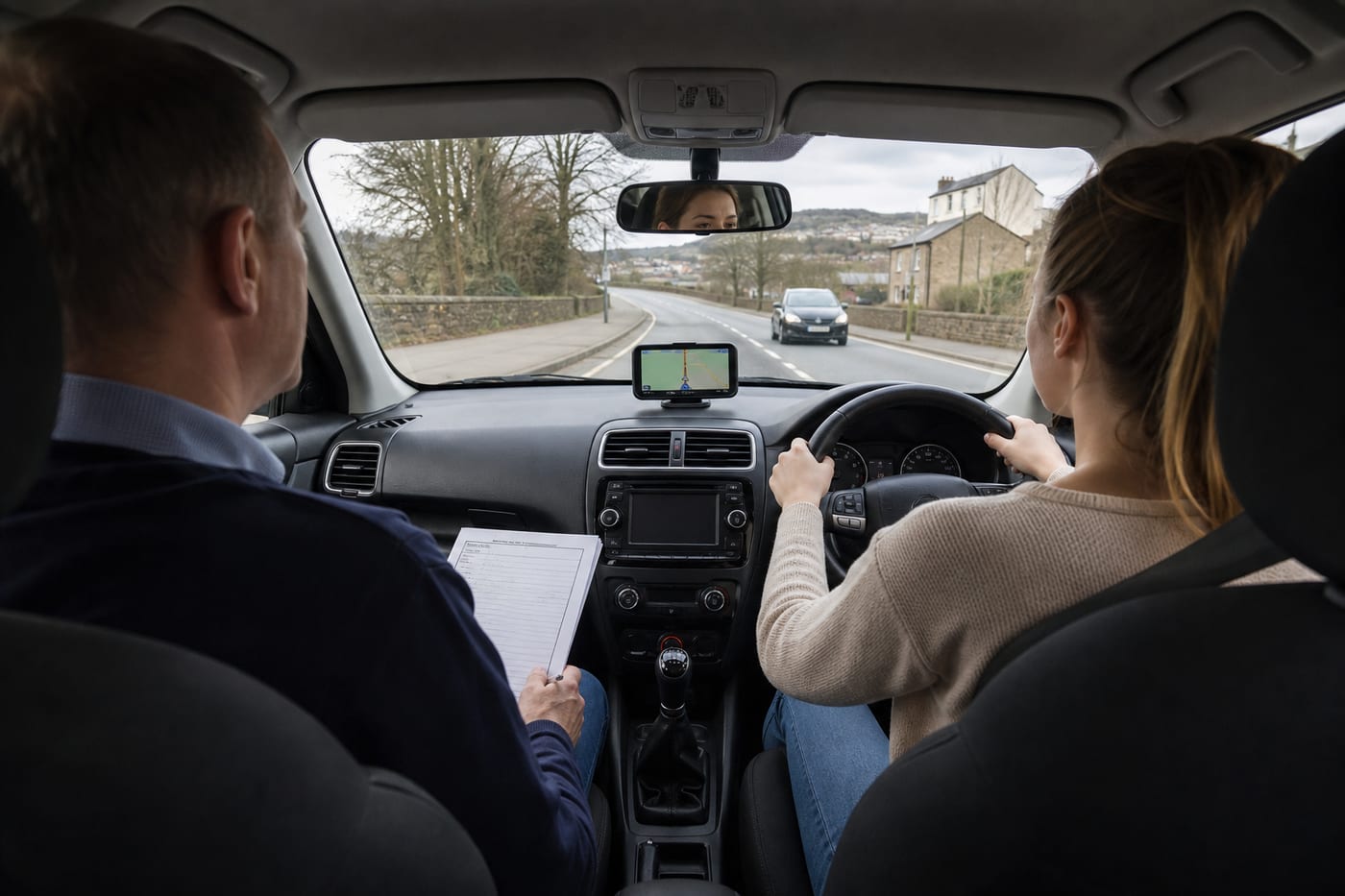
Independent driving assesses whether you can make safe decisions without being given constant step-by-step instructions. You may be asked to follow directions from a sat-nav supplied by the examiner or to follow traffic signs.
A longer independent section could allow an examiner to see how you deal with changing speed limits, junctions, rural roads and faster routes. It is not a navigation test. Taking a wrong turning should not, by itself, cause you to fail, provided you continue to drive safely and legally.
The best preparation is to practise on unfamiliar roads rather than memorising supposed test routes. Ask your instructor to include journeys that combine town traffic, roundabouts, dual carriageways and country roads where suitable.
Fewer stops would not reduce the need for good observation
During the current test, candidates can be asked to pull up safely and move away again. This allows the examiner to assess observation, control, signalling and awareness of other road users.
If fewer stops are included under a future format, moving off safely will remain an essential skill. Use effective all-round observation, check blind spots when needed and avoid signalling automatically when a signal would mislead someone.
Do not focus solely on the number of times a task might appear. Your examiner can assess observation and judgement throughout the drive.
Emergency stops will still matter
A trial involving fewer emergency-stop exercises does not make the skill unimportant. Every learner should be able to stop promptly and under control when instructed, while avoiding unnecessary risk.
Practise this exercise only with an approved instructor or suitable accompanying driver in a safe location. Never rehearse sudden stops where they could endanger following traffic or other road users.
The core practical test skills remain familiar
Even if a revised format is introduced, the fundamental standard is not expected to become a completely different kind of assessment. You will still need to demonstrate safe and responsible driving.
The car test currently includes an eyesight check, vehicle safety questions, general driving, independent driving and a reversing exercise. You may also be asked to carry out an emergency stop.
Examiners assess areas such as:
- Effective observation
- Appropriate speed and progress
- Control of the vehicle
- Safe positioning
- Use of mirrors and signals
- Response to signs, road markings and other road users
- Judgement at junctions and when meeting or overtaking traffic
These are transferable skills. A learner who can drive safely without prompting should be able to adapt whether independent driving lasts for 20 minutes or is extended under a future format.
Theory tests will continue to reflect practical road safety
Learners sometimes expect a theory test overhaul to mean an entirely new set of questions. In practice, official learning materials and the question bank can be updated without changing the basic purpose of the test.
The car theory test in Great Britain has two parts: multiple-choice questions and hazard perception. You must pass both parts at the same appointment. The multiple-choice section checks your knowledge and understanding, while hazard perception assesses how quickly you identify developing hazards.
Topics may evolve as vehicles, roads and safety guidance change. Modern preparation should therefore cover more than memorising answers. Make sure you understand:
- The Highway Code
- Vulnerable road users and the hierarchy of road users
- Safe following distances
- Motorway and smart motorway rules
- Vehicle safety and maintenance
- First aid and action after a collision
- Eco-safe driving
- Developing hazards
Use the latest official study materials. An old book or app may omit updated guidance even if the overall test structure appears unchanged.
Booking rules and access to tests are another focus
For many learners, the most noticeable overhaul may happen before they reach the test centre. Long waiting times and the resale or misuse of appointments have led to increased scrutiny of how practical tests are booked and managed.
Possible or introduced measures can involve cancellation and change rules, restrictions on booking services, account checks and action against automated booking activity. Exact arrangements can change, so rely on the terms displayed by the official service when making an appointment.
Protect yourself when booking
Book through the official GOV.UK driving test service in Great Britain. Be cautious about unofficial websites or individuals promising a guaranteed early appointment, especially if they request large additional fees or unnecessary personal information.
Before confirming a test:
- Check that your driving licence details are correct.
- Make sure your theory test pass will remain valid on the practical test date.
- Confirm that your instructor and suitable test vehicle are available.
- Read the current cancellation and rescheduling terms.
- Keep your booking confirmation secure.
Do not book a date simply because one appears if you are not likely to be ready. Moving appointments repeatedly can create extra cost and pressure, while taking the test too early may reduce your chance of passing.
Test routes could include a broader mix of roads
A greater emphasis on realistic driving means learners should be prepared for more than quiet residential streets near a test centre. Depending on the location, a route may include busy urban junctions, rural bends, higher-speed roads and complex roundabouts.
Build experience gradually with your instructor. You should understand how stopping distances, visibility and safe following gaps change with speed and weather.
Seasonal conditions also matter. Our festive winter driving advice explains how darkness, ice and poor weather can affect vehicle control and journey planning. For experience with longer, less familiar journeys, these UK holiday road trip safety tips cover checks, rest breaks and changing road conditions.
The objective is not to predict every road the examiner might choose. It is to become capable of handling any suitable route calmly and safely.
How to prepare for future test changes
You do not need to pause your lessons while waiting for announcements. Strong preparation is based on safe driving principles rather than a narrowly rehearsed test routine.
Learn to drive without constant prompts
Ask your instructor to reduce verbal support as you improve. Practise following a sat-nav and road signs while still noticing speed limits, pedestrians, cyclists and developing hazards.
Use unfamiliar routes
Driving only on familiar test-centre roads can create false confidence. Include different junction layouts, gradients, parking situations and traffic levels where appropriate.
Keep theory knowledge active
Continue revising after passing the theory test. Applying the Highway Code during lessons will help you understand why rules matter and reduce the risk of forgetting important details before your practical test.
Take mock tests
A realistic mock test can reveal whether you make safe decisions independently. It also helps you become comfortable with periods of silence, unfamiliar directions and recovering calmly from minor mistakes.
Check official updates near your appointment
Look at official guidance when booking and again shortly before the test. Your instructor should also be aware of any confirmed local trial, but the official appointment information should remain your primary reference.
Avoid preparing for rumours
Social media posts often claim that manoeuvres are being removed, tests are becoming much harder or every candidate will soon face a completely new route. Such claims may confuse a limited trial with a confirmed national policy.
Do not change your technique based on an unverified video or post. A driving fault does not become acceptable because a task might appear less often. Safe observation, control and judgement remain important on every journey.
Conclusion
UK driving tests are likely to keep evolving, particularly around independent driving, realistic routes and the booking process. However, trials and consultations are not the same as confirmed nationwide changes.
Prepare using current official guidance, gain experience on varied roads and learn to make safe decisions without prompts. That approach will put you in a strong position for both the present test and any future version.
Frequently asked questions
Is the UK practical driving test definitely changing?
The DVSA has trialled possible changes at selected test centres, but a trial does not guarantee national implementation. Continue preparing for the current test unless an official announcement says otherwise.
Will independent driving become longer?
A longer independent driving section has been included in trial arrangements. Check current DVSA guidance for confirmation of the format applying to your test centre and appointment.
Should I delay my test because of possible changes?
Usually, no. If you are ready and have an appropriate appointment, an unconfirmed future change is not a strong reason to delay. Safe, independent driving skills apply to any likely format.
Do DVSA test changes apply in Northern Ireland?
Not automatically. The DVSA administers tests in England, Scotland and Wales. Northern Ireland tests are managed by the DVA, so learners there should check the latest information through nidirect.