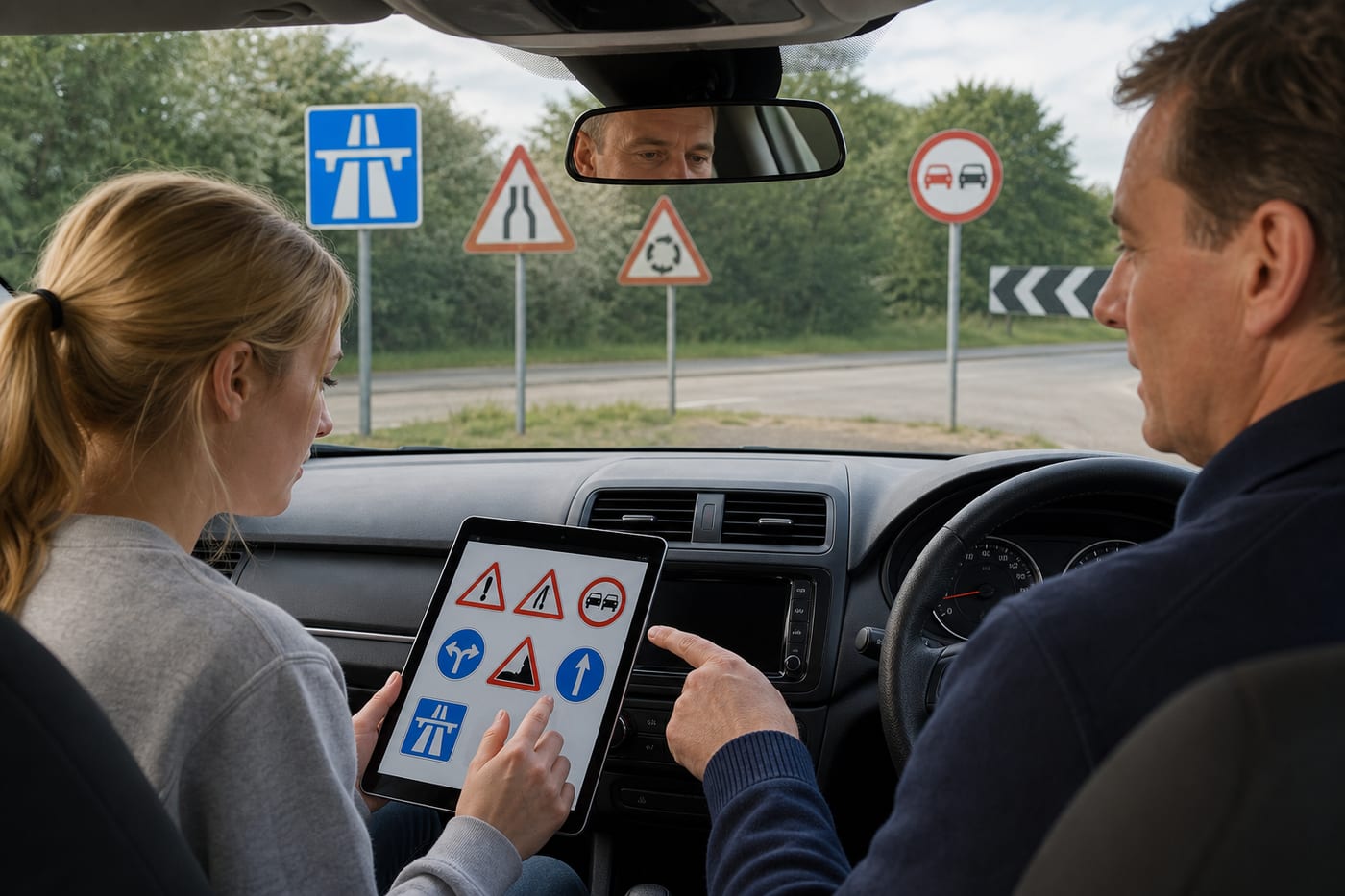
Road sign questions can look easy until two similar symbols appear among the possible answers. A single coloured line, arrow or border can completely change what a sign means, and the most difficult questions often test whether you can apply that meaning rather than simply recognise the picture.
The best way to prepare is to understand the visual system behind UK road signs. Shape, colour and accompanying plates all provide clues. Once you know what those clues mean, unfamiliar or easily confused signs become much easier to interpret.
Below are some of the hardest types of road sign questions you may face in theory test practice, along with the knowledge and reasoning needed to answer them confidently.
Why road sign questions can be difficult
Road sign questions become challenging for several reasons:
- Two signs may use almost identical colours and symbols.
- The correct answer may depend on an additional plate beneath the sign.
- A sign may impose a legal restriction rather than offer advice.
- Its meaning may change according to the type of road or vehicle.
- The question may show a sign in a realistic situation rather than ask for its definition directly.
For example, recognising the national speed limit sign is only the first step. You must also know that it does not always mean 70 mph. The applicable limit depends on the road and the vehicle you are driving.
If your basic recall needs work, begin with these techniques for improving your road sign knowledge, then return to the more easily confused examples below.
No waiting or no stopping?
These are among the most commonly confused restriction signs.
A blue circular sign with a red border and one red diagonal line means no waiting. A similar sign containing a red cross means no stopping.
The distinction matters. A no-waiting restriction generally prevents you from parking or waiting during the stated period, although limited exceptions may apply, such as allowing passengers to board or leave where it is safe and not otherwise prohibited. A no-stopping restriction is stricter.
Always examine any nearby time plate. Restrictions may apply continuously or only during specified periods.
Remember the road markings too
Yellow lines usually relate to waiting restrictions:
- A single yellow line applies during times shown on nearby signs or controlled-zone entry signs.
- Double yellow lines mean no waiting at any time.
- Short yellow marks on the kerb indicate loading restrictions, with nearby signs showing when they operate.
A difficult question may combine signs and road markings, so do not focus on one clue and ignore the others.
What does the national speed limit sign actually mean?
The national speed limit sign is a white circle crossed by a black diagonal stripe. Its meaning is not simply “drive at 70 mph”. It tells you that the national speed limit applies to that road and your category of vehicle.
For a car, unless a lower limit is signed, the national speed limit is generally:
- 60 mph on a single carriageway
- 70 mph on a dual carriageway
- 70 mph on a motorway
Different limits apply to certain vehicles, including cars towing trailers. Conditions may also make the signed maximum speed unsafe. A speed limit is a legal maximum, not a target.
A frequent trap is assuming that the number of lanes determines whether a road is a dual carriageway. It does not. A dual carriageway has a central reservation separating opposing traffic flows. A road with two lanes in each direction but no central reservation remains a single carriageway.
Minimum speed signs
Because most learners spend more time revising maximum limits, minimum speed signs can cause confusion.
A minimum speed is normally shown by a white number inside a blue circle. You must not travel below that speed unless it is necessary or unsafe to maintain it, such as because of traffic or road conditions.
The end of the minimum speed restriction is shown by the same symbol crossed by a diagonal red line.
Remember the general colour principle: a blue circle usually gives a positive instruction. It often tells you what you must do, such as turn in a particular direction or keep to one side.
Priority over oncoming traffic
Two signs involving opposing arrows are easy to mix up.
The circular sign with a red border tells you to give priority to vehicles coming from the opposite direction. You may encounter it where the road narrows and there is not enough room for traffic to pass safely in both directions.
The rectangular blue sign means that you have priority over oncoming vehicles. Its larger white arrow represents your direction, while the smaller red arrow represents opposing traffic.
However, priority never removes your responsibility to avoid a collision. If an approaching vehicle is already committed to the narrow section, wait rather than forcing your way through merely because a sign gives your direction priority.
No vehicles or no motor vehicles?
An empty white circle with a red border means that vehicles are prohibited. It is easy to mistake this for a general warning because it contains no central symbol, but the red circular border marks it as a prohibition.
A sign showing a motorcycle above a car inside a red circle means no motor vehicles. It does not simply mean no cars and motorcycles; the two pictures are used together to represent motor vehicles generally.
Questions may also include signs prohibiting particular road users, such as motorcycles, pedal cycles, pedestrians or horse riders. Look closely at which symbol appears inside the restriction circle rather than choosing an answer based only on its overall colour.
Width, height and weight restrictions
Restriction signs showing measurements are especially important for drivers of larger vehicles, but car learners can still be questioned about them.
A red circular sign may prohibit vehicles exceeding a displayed width, height, length, weight or axle weight. The type of measurement tells you what is restricted.
For example:
- Vertical arrows beside a measurement indicate a height limit.
- Horizontal arrows indicate a width limit.
- A weight shown in tonnes may indicate a maximum gross weight restriction.
- A weight shown with an axle symbol refers to an axle-weight restriction.
Do not confuse a red-bordered restriction with a warning sign. A triangular sign may warn that a height restriction is ahead, while the circular sign at the structure imposes the limit.
Junction warning signs that look alike
Triangular signs warn of hazards ahead, but junction diagrams can be hard to interpret quickly.
The thick line normally represents the road you are travelling on. Thinner branches show joining roads. The position and angle of each branch matter: they can warn of a side road, crossroads, T-junction or staggered junction.
When answering, imagine yourself travelling upwards from the bottom of the diagram. Then ask:
- Which line represents my road?
- Where can traffic join or cross it?
- Is the junction directly ahead or offset?
This prevents you from relying on a vague impression of the symbol.
Direction sign colours
Colour questions often become difficult because blue does not have only one meaning. Its significance depends partly on the sign’s shape and context.
As a broad guide:
- Blue rectangular signs are used for motorway directions and various information signs.
- Green direction signs are used on primary routes.
- White direction signs are used on local or non-primary routes.
- Brown signs guide road users to tourist attractions.
- Yellow signs are commonly used for temporary routes or roadworks diversions.
Route numbers and coloured panels can provide additional information. For example, a differently coloured panel within a direction sign may indicate that following a particular route will lead onto another class of road.
Avoid learning “blue means motorway” as an absolute rule. Blue circles commonly contain mandatory instructions, while blue rectangular signs can provide information in many settings.
The red X on motorways
A red X displayed above a motorway lane means that the lane is closed. You must not continue driving in it.
The closure may protect road workers, emergency services, people involved in an incident or an obstruction that is not yet visible. Move into an open lane safely when directed, using your mirrors and signalling as necessary. Never pass under a red X in the closed lane.
Do not confuse a red X with advisory information. A green arrow indicates that a lane is open, while speed limits shown in a red circle are mandatory.
Signs with supplementary plates
Some of the hardest questions cannot be answered from the main sign alone. A plate beneath it may specify:
- the distance to a hazard
- the length over which a restriction applies
- the times of operation
- an exception for certain vehicles
- the direction of a hazard or restriction
Be particularly careful with distance and length. A plate saying a hazard is a certain distance ahead is not the same as one saying the hazard continues for that distance.
Read every part of the image before looking at the answer choices. The plate is often included precisely because it changes or completes the sign’s meaning.
A reliable method for answering difficult sign questions
Use this sequence whenever you are uncertain.
1. Identify the shape
Ask whether the sign is circular, triangular or rectangular. Circles generally give orders, triangles warn, and rectangles usually provide information or directions. The octagonal STOP sign and inverted triangular GIVE WAY sign have distinctive shapes so they can be recognised even when partly obscured.
2. Check the border and colour
A red circle generally prohibits or restricts. A blue circle normally gives a positive instruction. Do not apply these principles without considering the shape.
3. Examine the central symbol
Look closely at arrows, vehicle types, measurements and diagonal lines. Small differences are often the entire point of the question.
4. Read any additional plate
Check times, distances, arrows and exceptions. Never assume the main sign tells the whole story.
5. Apply the safest accurate meaning
Eliminate answers that exaggerate or weaken the instruction. “No waiting” and “no stopping”, for example, are not interchangeable.
For broader help with this approach, use these methods for tackling difficult theory test questions.
How to revise road signs effectively
Do not revise by repeatedly scrolling through pictures. Active recall works better: cover the meaning, identify the sign, then explain how you should respond as a driver.
Group signs into related pairs, including:
- no waiting and no stopping
- maximum and minimum speed
- priority and give priority
- warning and restriction signs
- single and dual carriageway speed limits
Keep a mistake log containing the sign, your incorrect answer and the visual detail you missed. Revisit it regularly and use mixed mock questions so that you learn to interpret signs in context.
A realistic timetable can also prevent road signs being neglected in favour of other topics. This theory test study schedule explains how to organise revision and practice over several weeks.
Conclusion
The hardest road sign questions usually depend on small but meaningful differences. Focus on shape, colour, symbols, road context and supplementary plates rather than trying to memorise an image without understanding it.
Practise confusing signs side by side, explain their meanings aloud and review every mistake. That knowledge will help in the theory test and, more importantly, support safer decisions on the road.
Frequently asked questions
Do I need to memorise every UK road sign?
You should learn the signs, signals and road markings relevant to road users, but understanding the sign system is more reliable than memorising isolated pictures. Shape and colour can help you interpret signs you do not immediately recognise.
Are road sign questions based only on identifying pictures?
No. A question may ask what action to take, where a restriction applies or how a sign affects your vehicle. Practise applying meanings in realistic road situations rather than learning names alone.
What is the easiest way to remember circular and triangular signs?
Think “circles give orders; triangles give warnings”. Then use colour to narrow the meaning further: red circles commonly prohibit, while blue circles commonly instruct. Remember that unusual shapes such as STOP and GIVE WAY are deliberate exceptions.
What should I do if two theory test answers seem correct?
Reread the wording and inspect every detail of the sign, including any plate. Look for differences such as “waiting” versus “stopping”, or “ahead” versus “for the next distance”. Choose the answer that matches the complete legal or safety meaning.