Britain’s road signs are among the most recognisable in the world. Their combinations of shapes, colours and simple symbols allow drivers to understand instructions quickly, often without reading a single word.
However, road signs are not completely frozen in time. Designs can be refined, new symbols can be introduced and existing signs can gain permitted variations. These updates reflect changes in roads, vehicles and the risks drivers face.
For learner drivers, the important point is that an updated design does not normally mean abandoning the established signing system. Triangles still warn, circles usually give orders, and rectangular signs continue to provide information or directions. Understanding that visual language is much more useful than trying to memorise every sign as an isolated picture.
Why are classic road sign designs updated?
A road sign must communicate its message quickly and clearly. Drivers may see it in poor weather, darkness or heavy traffic, so there is little room for unnecessary detail.
Updates may be made for several reasons:
- New types of road use: Electric vehicles, cycle infrastructure and changing motorway layouts can require new information.
- Improved clarity: A symbol may be adjusted so that it is easier to recognise at a distance.
- New safety concerns: Authorities may need signs for hazards that were not previously covered clearly.
- Consistency: Designs can be standardised so that drivers receive the same message in different parts of the country.
- Modern sign production: New materials, lighting and reflective surfaces can improve visibility without changing a sign’s meaning.
Not every visible difference represents a new rule. A sign might look fresher because it has been replaced, use a permitted variation, or sit alongside a supplementary plate giving local details.
The foundations of modern British road signs
Much of the modern British signing system was developed by designers Jock Kinneir and Margaret Calvert during the late 1950s and 1960s. The objective was to create a consistent system that motorists could interpret at speed as Britain’s road network expanded.
Instead of relying on lengthy written instructions, the system uses strong silhouettes, standard colours and simple pictograms. It also introduced clear lettering designed for legibility on the road.
That underlying approach remains important today. Even when a symbol is updated, designers generally preserve the familiar visual rules so that the sign can still be understood quickly.
The classic shapes and colours that still matter
Learners should begin with sign families rather than attempting to remember hundreds of individual images. Shape and colour often reveal the type of message before you have identified the symbol.
Triangular signs give warnings
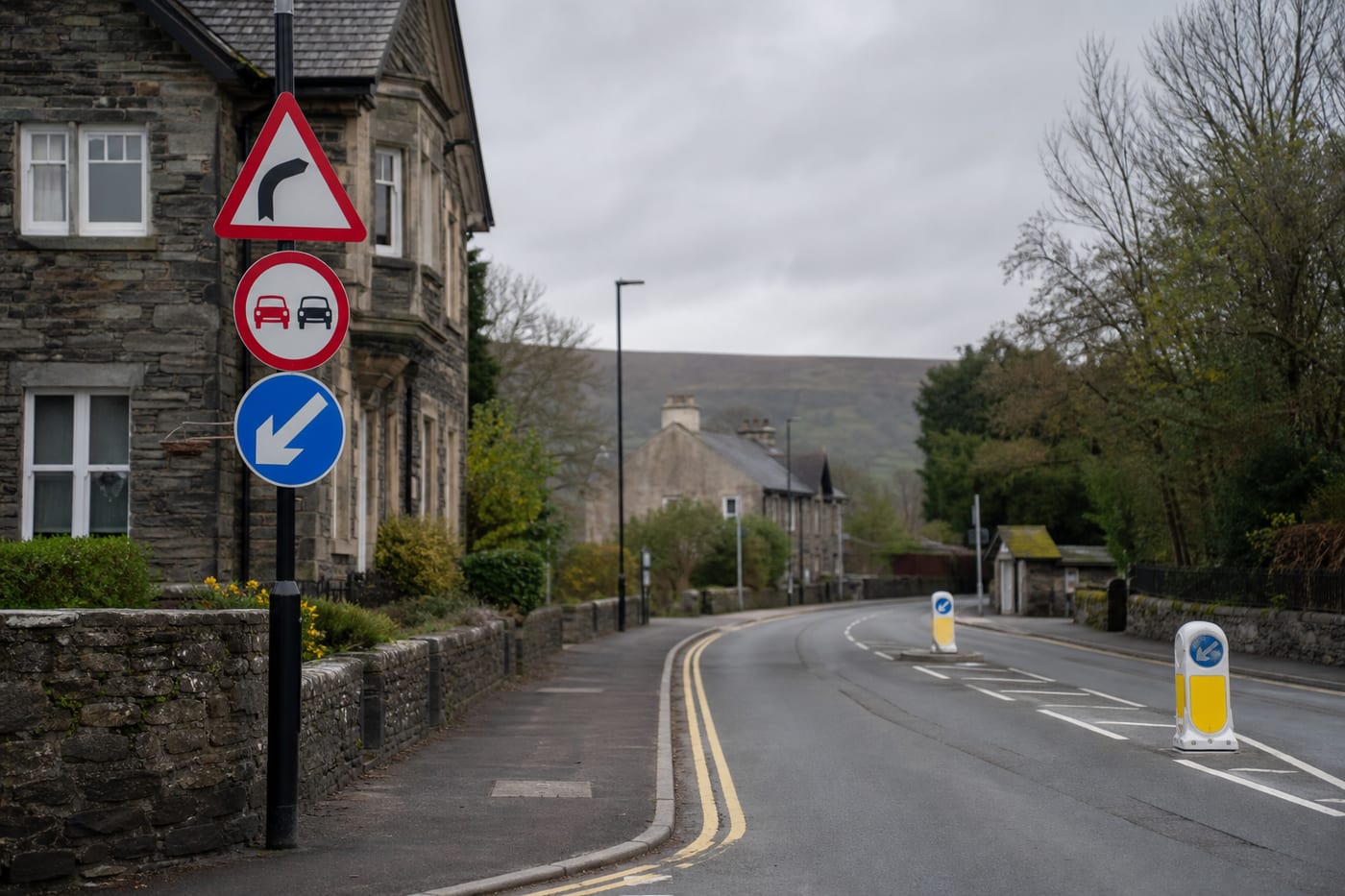
Most warning signs are triangles with a red border. They alert you to a hazard ahead, such as:
- A sharp bend
- A crossroads or roundabout
- Traffic signals
- Pedestrians or children
- Road works
- Animals in the road
- Slippery conditions
When you see a warning triangle, ask yourself what could change ahead and whether you need to reduce speed, increase the following distance or improve your observations.
Circular signs usually give orders
A circle often communicates a legal instruction.
Signs with a red border normally show a restriction or prohibition. Examples include speed limits, width limits and signs preventing certain vehicles from proceeding.
Blue circles normally give a positive instruction, such as passing on a particular side or following a specified direction.
Ignoring a circular regulatory sign may mean breaking the law, rather than simply overlooking advice.
Rectangles provide information and directions
Rectangular signs are commonly used for directions, route information, parking controls and road facilities. Their colour provides additional context.
For example, blue backgrounds are strongly associated with motorways and certain information signs. Green direction signs are used on primary routes, while brown signs direct road users to tourist destinations. White direction signs are common on local and non-primary routes.
Colours should always be considered with the sign’s shape, symbol and setting. A single feature rarely tells you everything.
Two distinctive shapes demand immediate recognition
The STOP sign has eight sides, while the Give Way sign is an inverted triangle. These unusual outlines allow drivers to recognise them even if the sign is partly obscured or viewed from behind.
The STOP sign requires you to stop at the line. At a Give Way sign, you must give priority as directed and be ready to stop if necessary. The instructions are not interchangeable.
What does an “updated” sign look like?
An updated design may involve a new pictogram, a revised layout or an additional version of an established sign. It does not necessarily mean that every older example will disappear immediately.
New symbols for changing transport needs
Road networks now need to communicate information about facilities and road users that were less common when the classic system was introduced. Signs may identify electric vehicle charging points, segregated routes, combined pedestrian and cycle routes, or access arrangements for particular vehicle types.
These designs still use familiar conventions. A service or facility is normally shown as information, while a restriction is presented in the appropriate regulatory format.
Signs for newly recognised hazards
New warning symbols can be introduced where there is a genuine need to alert drivers to a particular risk. One example is the warning sign depicting a hedgehog, used to indicate the possible presence of small wild animals.
The precise animal may be new to learners, but the red warning triangle is not. Even if you do not identify the silhouette immediately, the shape tells you to anticipate a hazard and proceed with care.
Modern motorway information
Motorway operation has also led to signs and signals for situations such as lane closures, emergency areas and changing speed restrictions.
A red X above a motorway lane means that the lane is closed. You must not drive in it. This is a legal signal, not a suggestion that the lane may become inconvenient further ahead.
Learners should distinguish these operational signals from ordinary direction signs. Motorway signs may respond to a live incident, obstruction or traffic-management requirement, so prompt compliance is essential.
Permitted variations and supplementary plates
Two signs with the same basic meaning may not be visually identical. A warning sign can be accompanied by a distance plate, while a restriction may apply only at particular times or to specified classes of vehicle.
The main sign and its supplementary plate should be read together. Recognising the central symbol but ignoring the plate can lead to the wrong decision.
Are old road signs automatically invalid?
A sign does not become meaningless simply because a slightly newer design exists elsewhere. Signs are installed, maintained and replaced by the relevant highway authority, and replacement programmes do not necessarily happen everywhere at once.
You may therefore encounter older and newer-looking signs during the same journey. Weathering, reflective materials, mounting arrangements and local conditions can also affect their appearance.
Concentrate on the legally significant features: the shape, border, colour, pictogram, numbers and any accompanying plate. Do not assume that a faded or unfamiliar-looking sign can be ignored.
If damage or vegetation makes a sign difficult to see, respond cautiously. Avoid making a sudden manoeuvre while trying to interpret it. Road markings, nearby signs and the surrounding road layout may provide additional information.
How updated signs could appear in the theory test
Theory test questions assess whether you understand signs and can apply them safely. You may be asked to identify a sign, explain a restriction or choose the safest response to a warning.
Images may also place signs in context. For example, you might need to interpret a triangular sign on approach to a bend or understand what a motorway signal requires you to do.
Do not rely on recognising only the most obvious feature. Similar signs can have very different meanings, especially where arrows, vehicle symbols or coloured borders differ.
For focused practice, use this guide to improving your road sign knowledge before the test. It explains how to revise using shapes, colours and active recall rather than repeatedly reading a list.
If you regularly confuse restrictions, clearways or motorway signals, review the hardest road sign questions learners encounter and check why each incorrect option is wrong.
A practical road sign revision method
Use the following routine when studying an unfamiliar or updated sign.
1. Identify the sign family
Look at the shape and dominant colour. Decide whether it is a warning, order, direction or information sign before examining the details.
2. Describe the symbol in plain English
Say what you can see without guessing its official meaning. For example: “red-bordered triangle containing an animal” or “blue circle with a white arrow pointing left”.
3. State the required response
Connect the sign to an action. Should you reduce speed, stop, avoid a lane, follow a direction or check whether a restriction applies to your vehicle?
4. Compare easily confused signs
Study similar signs side by side. Useful comparisons include minimum and maximum speed signs, no waiting and no stopping, or ahead-only and one-way signs.
5. Practise in real road settings
During lessons, identify signs early and explain what they mean before reaching them. Keep your attention on driving and do not stare at a sign for too long. Your instructor can confirm the meaning afterwards if necessary.
6. Use current official material
Revise from the current Highway Code and reputable theory test resources. Old photographs and unofficial online graphics may omit a plate, show an outdated variation or use a non-UK design.
A structured approach is more effective than last-minute memorisation. The effective revision strategies for the theory test can help you combine sign practice with mock questions and active recall.
Common mistakes involving redesigned or unfamiliar signs
One mistake is assuming that an unfamiliar symbol can be ignored. Its shape may already tell you whether it warns of danger or imposes an order.
Another is focusing on minor artistic details. Theory questions are about meaning and safe behaviour, not the history of graphic design.
Learners also sometimes confuse roadside signs with icons shown by sat-navs or mapping apps. In-car systems may help with navigation, but official signs, signals and road markings take priority.
Finally, never assume that a familiar route will remain unchanged. Temporary restrictions, road works and revised layouts can introduce different signs at short notice.
Frequently asked questions
Will redesigned road signs replace all classic UK signs?
Not necessarily. New signs and permitted variations can be added while the established system of shapes and colours remains. Existing signs may also stay in place until maintenance or replacement is required.
Do I need to learn old and new versions for the theory test?
Use current Highway Code and theory test materials. Focus on the meaning, sign family and required response. If two permitted versions exist, understanding their shared message is more valuable than memorising tiny design differences.
Who decides which road signs can be used?
Traffic signs used on public roads must follow the relevant legal framework and official guidance. Highway authorities cannot simply invent regulatory signs with their own colours and symbols.
What should I do if I see a sign I do not recognise?
Use its shape, colour and context to assess the likely message. Slow down smoothly if a hazard may be present, keep observing and avoid abrupt action. Never ignore a circular order or a warning sign simply because its central symbol is unfamiliar.
Conclusion
Classic UK road signs evolve because roads and transport needs change, but their core visual language remains remarkably consistent. Shapes, colours and clear symbols allow drivers to understand warnings and instructions quickly.
For theory test success, learn the sign families first, then connect each sign to the correct driving response. That approach will help you handle both familiar classics and newer designs safely and confidently.