Turning 17 is an exciting milestone for many young people because it is the age at which you can normally start driving a car on public roads in the UK. However, having a birthday does not automatically give you permission to get behind the wheel.
Before you begin, you need the correct provisional licence, suitable insurance, a legal vehicle and appropriate supervision. You will also need to understand the responsibilities that come with controlling a car, whether you are taking professional lessons or practising with a family member.
Here is what you need to know about driving at 17, from applying for your licence to preparing for your first independent journey.
Can you start driving as soon as you turn 17?
Most people can start learning to drive a car when they are 17. You can apply for a provisional driving licence from the age of 15 years and 9 months, but you cannot normally drive a car on public roads until your 17th birthday.
An exception may apply if you receive, or have applied for, the enhanced rate of the mobility component of Personal Independence Payment. In that situation, you may be able to start driving a car at 16. Check the current official eligibility rules before arranging lessons.
This article focuses on learning to drive a car. Different minimum ages, licensing requirements and training rules apply to mopeds and motorcycles.
What you need before your first lesson
You must hold a valid provisional driving licence before driving on a public road. You must also meet the minimum eyesight standard and disclose any relevant medical condition that could affect your ability to drive safely.
Your provisional driving licence
You can apply for a provisional licence online or by post. When applying, you will usually need proof of identity and details of the addresses where you have lived. Your National Insurance number may also be requested if you know it.
Use the official government service and be cautious of websites that imitate official booking or licensing pages. Some third-party services charge unnecessary fees or handle personal information in ways that may not be clear.
Check your licence carefully when it arrives. Make sure your name, address and other details are correct. You should also tell the licensing authority if your address changes.
Your eyesight and health
You must be able to read a modern vehicle number plate from 20 metres away, using glasses or contact lenses if necessary. This is checked at the beginning of the practical driving test, but the eyesight requirement applies whenever you drive.
If your licence requires you to wear glasses or contact lenses, you must use them during lessons, private practice and your test.
Certain medical conditions must be reported to the DVLA in Great Britain or the DVA in Northern Ireland. Our guide to medical conditions learner drivers may need to report explains why disclosure matters and what to do next.
Taking professional driving lessons at 17
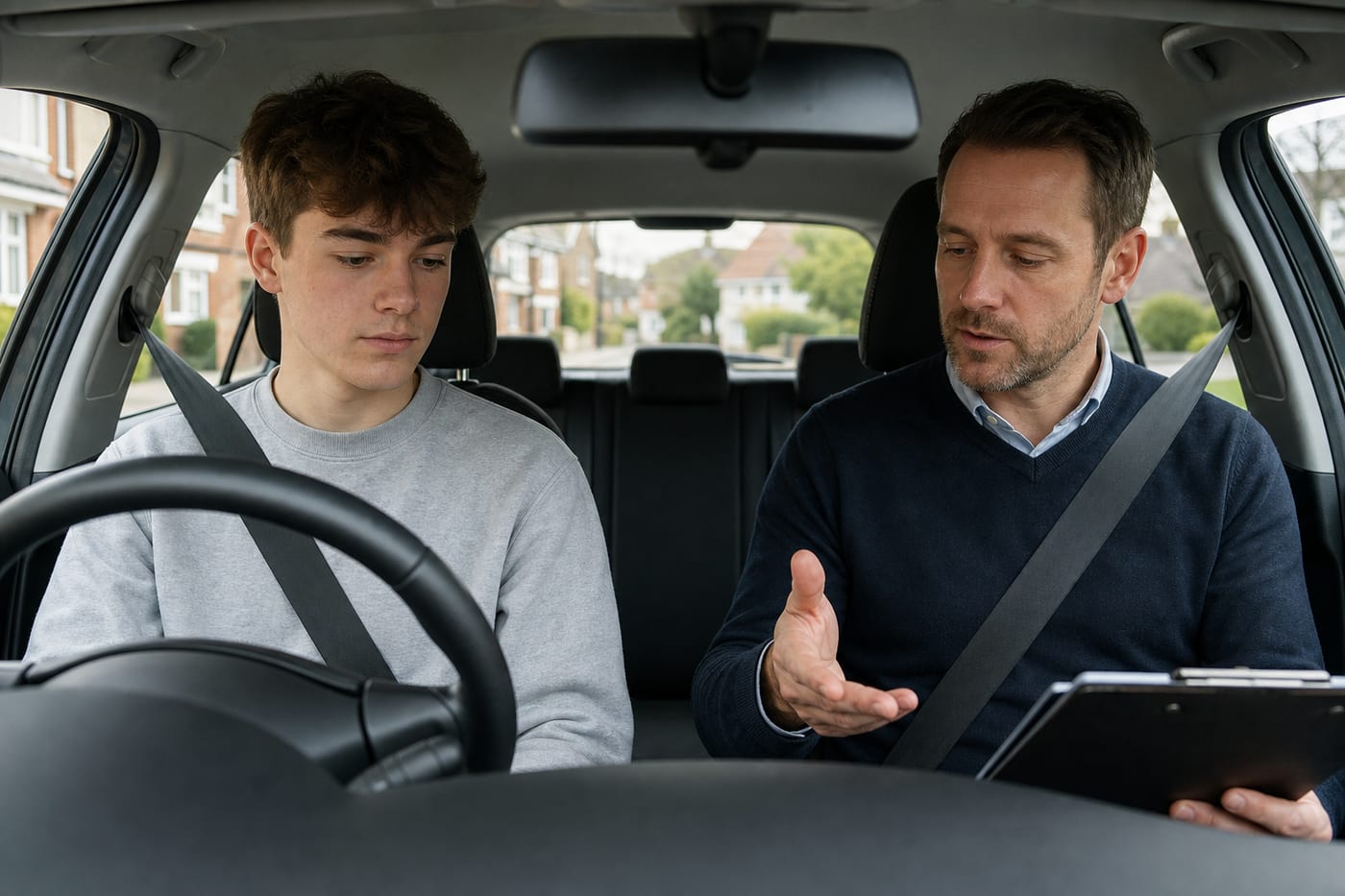
An approved driving instructor can introduce new skills in a structured order and provide a dual-control car. A good instructor should help you understand why routines and decisions matter rather than simply telling you what to do.
Before committing to a block of lessons, ask about the instructor's qualifications, availability, prices, cancellation policy and teaching style. These important questions to ask a driving instructor can help you make an informed choice.
There is no statutory minimum number of lessons you must complete before taking the practical test. Learners progress at different rates, so avoid comparing your lesson count with that of friends. What matters is whether you can drive safely, independently and consistently across different roads and conditions.
At the beginning, you are likely to cover:
- Cockpit checks and safe seating position
- Moving off and stopping
- Steering and use of controls
- Mirrors, signals and observations
- Junctions, roundabouts and pedestrian crossings
- Speed limits and safe following distances
- Manoeuvres and parking
- Independent driving and route planning
Building a consistent pre-drive cockpit safety routine will help you adjust the seat, mirrors and controls correctly before every journey.
Practising with a parent, relative or friend
Private practice can be valuable alongside professional lessons. It gives you more time behind the wheel and allows you to repeat skills between sessions with your instructor.
In Great Britain, the person supervising you must generally:
- Be at least 21 years old
- Be qualified to drive the type of vehicle you are using
- Have held the relevant full licence for at least three years
- Comply with road traffic law while supervising
For example, someone with an automatic-only licence cannot supervise you in a manual car. Insurers may also set a higher minimum age or additional conditions for supervising drivers, so check the policy carefully.
The supervisor must remain alert and able to take responsibility for the session. They must not use a handheld mobile phone while supervising and must not be under the influence of alcohol or drugs.
Rules can differ in Northern Ireland, so learners and supervisors there should check current DVA and nidirect guidance.
Insurance and vehicle requirements
You must be insured to drive the vehicle, even if you are only practising for a few minutes. Do not assume that the owner's policy automatically covers a learner. The policy documents or insurer must specifically confirm your cover.
The car must also:
- Be taxed, unless legally exempt
- Have a valid MOT where one is required
- Be roadworthy and safe to drive
- Display legal L plates at the front and rear
- Have working lights, tyres, brakes and seat belts
In Wales, learners may use D plates, although L plates remain valid. Northern Ireland has its own learner and newly qualified driver requirements.
Before private practice, agree on the route and the skills you intend to work on. Begin somewhere suitable for your ability rather than entering busy traffic before you are ready. The supervising driver should give calm, clear instructions and avoid introducing a different routine from the one taught by your instructor.
Can a 17-year-old learner drive on a motorway?
In England, Scotland and Wales, a learner car driver may have a motorway lesson only when accompanied by an approved driving instructor in a car fitted with dual controls. Motorway lessons are optional and should take place only when the instructor considers the learner ready.
You cannot drive on a motorway with a parent or other private supervisor, even if they are an experienced driver. Learner motorway rules differ in Northern Ireland, where learners are not permitted to use motorways.
You can still learn important high-speed road skills on suitable dual carriageways. These include joining via a slip road, maintaining safe separation, changing lanes correctly and planning well ahead.
Preparing for the theory test
The car theory test has two parts: multiple-choice questions and hazard perception clips. You must pass both parts in the same appointment.
Effective revision should cover the Highway Code, traffic signs, road markings, vehicle safety, vulnerable road users and safe driving behaviour. Avoid relying entirely on memorising practice answers. The real aim is to understand how to apply the rules in unfamiliar situations.
For hazard perception, look for situations that are beginning to require a driver to change speed or direction. Examples include a pedestrian approaching a crossing, a vehicle emerging from a side road or a cyclist moving around a parked car.
Once you pass, your theory test certificate is normally valid for two years. You must pass your practical test within that period or take the theory test again.
When should you book your practical test?
You can take the car practical test from the age of 17, provided you hold the correct provisional licence and have passed the theory test. Being legally eligible does not necessarily mean you are ready.
Before booking or attending, you should be able to:
- Drive without frequent prompts from your instructor
- Use mirrors and make observations consistently
- Deal safely with roads you have not previously used
- Judge speed and space without rushing
- Complete manoeuvres under control
- Respond appropriately to developing hazards
- Follow directions while continuing to make your own decisions
Test availability can influence when learners book, but it should not encourage you to take a test before you can drive safely and consistently. In Great Britain, use the official DVSA booking service. In Northern Ireland, use the official DVA service.
Responsibilities after passing at 17
Passing your test gives you greater independence, but it also removes the reassurance of having an instructor beside you. For the first few solo journeys, choose familiar routes and quieter times where possible. Gradually build experience of night driving, rural roads, faster roads and poor weather.
There is no general UK law preventing a newly qualified 17-year-old from carrying friends. However, passengers can be distracting. Set expectations before moving off, keep music at a sensible level and do not allow anyone to pressure you into speeding or taking risks.
New drivers are also covered by the Road Traffic (New Drivers) Act. If your licence is revoked after accumulating six or more penalty points within two years of passing your first driving test, you will normally need to apply for a new provisional licence and pass both tests again. Points received while learning can remain on your record and may contribute.
Insurance can be one of the largest costs for a young driver. Compare policies carefully and give insurers accurate information about the vehicle, where it is kept and how it will be used. A telematics or black-box policy may reduce the price for some drivers, but you should understand its mileage, monitoring and driving conditions before agreeing.
Northern Ireland also requires newly qualified drivers to display R plates for one year and observe the associated restricted speed limit. This does not apply to newly qualified drivers in England, Scotland or Wales.
Practical ways to stay safe at 17
Safe driving is based on habits, not confidence alone. Give yourself time to prepare and avoid driving when you feel angry, exhausted or pressured.
Keep your phone out of reach and do not interact with it while driving. Plan your route before setting off, but continue to follow road signs and respond to the conditions around you. If you take a wrong turning, carry on safely and find a suitable place to adjust the route.
Never drive after drinking alcohol or taking illegal drugs. Some medicines can also affect concentration or cause drowsiness, so check the label and ask a pharmacist or doctor if you are unsure.
Finally, remember that passing the test is the beginning of learning, not the end. Review difficult journeys, ask an experienced driver or instructor for help, and consider further training if you want support with motorways, night driving or unfamiliar roads.
Frequently asked questions
Can I own a car at 17?
Yes. However, you must insure, tax and register it correctly before using it on public roads. It must also be roadworthy and have an MOT if one is required. If you are still learning, it must display L plates and you must have suitable supervision.
Can I drive my parents' car with a provisional licence?
Yes, provided you are properly insured, the car is legal and roadworthy, L plates are displayed and an eligible person supervises you. Never rely on an assumption that your parents' insurance includes learner cover.
Can I drive alone immediately after passing my test?
Yes, once you have passed and have valid insurance that covers you as a full licence holder. Tell the insurer immediately because learner insurance may not continue after a pass. You must also follow any policy conditions.
Is an automatic car easier to learn in at 17?
An automatic removes the need to operate a clutch and change gears, which some learners find helpful. However, passing in an automatic normally restricts you to driving automatic vehicles. Passing in a manual allows you to drive both manual and automatic cars, subject to suitable insurance.
Conclusion
Driving at 17 can provide valuable independence, but it brings serious legal and personal responsibilities. Secure the correct licence and insurance, choose suitable supervision, prepare properly for both tests and build your experience gradually.
The safest young drivers are not those who rush to pass. They are the ones who develop good observations, sound judgement and responsible habits that continue long after the L plates come off.