Passing your driving theory test is not simply a matter of memorising hundreds of answers. You need to understand the rules, recognise how they apply on real roads and respond effectively under timed test conditions.
The good news is that effective revision does not have to mean spending every evening reading the same pages. A few clever study techniques can help you retain more, identify weak areas and approach both parts of the test with confidence.
Here is how to make your preparation focused, practical and easier to manage.
Know exactly what you are preparing for
Before revising, make sure you understand the structure of the car theory test. It has two parts:
- A multiple-choice section containing 50 questions
- A hazard perception section using video clips
For the multiple-choice section, you need at least 43 correct answers out of 50. For hazard perception, the pass mark is 44 out of 75. You must pass both parts at the same appointment to pass the theory test overall.
Understanding the format prevents you from concentrating on one section while neglecting the other. Our complete breakdown of the UK theory test explains the question formats, pass marks and test-day process in more detail.
Start with a diagnostic mock test
Taking a mock test before you have revised may feel uncomfortable, but it gives you valuable information. The aim is not to achieve a pass immediately. It is to discover what you already know and where your knowledge is weakest.
Afterwards, divide your results into three groups:
- Confident answers: Topics you understand and can explain.
- Uncertain answers: Questions you answered correctly but partly guessed.
- Incorrect answers: Topics requiring further study.
Do not treat a lucky guess as secure knowledge. Mark it for review just as you would an incorrect answer. This makes your revision plan more accurate and stops hidden gaps causing problems in the real exam.
Use short revision sprints
Long study sessions can become unproductive when your concentration drops. Try working in short, focused blocks instead.
For example, spend 20 to 30 minutes studying one topic, take a brief break and then test yourself without looking at your notes. One evening might focus on road signs, while another covers stopping distances, vulnerable road users or motorway rules.
A simple weekly plan could look like this:
- Monday: Road signs and markings
- Tuesday: Rules at junctions
- Wednesday: Vehicle safety and loading
- Thursday: Motorways and dual carriageways
- Friday: Hazard perception practice
- Weekend: A full mock test and review
Regular short sessions are generally easier to fit around lessons, work or education. For more help organising your study, use these effective theory test revision strategies.
Turn every mistake into a revision card
A wrong-answer log is one of the most useful tools you can create. Each time you make a mistake, write down the topic and the reason your answer was wrong.
Do not merely copy the correct answer. Record the underlying rule in your own words. For instance, if you misunderstand a road sign, note its shape, colour and purpose. If you get a question about following distance wrong, revise why a larger gap is necessary in poor conditions.
Turn these points into revision cards. Put a question or scenario on one side and the rule on the other. Revisit difficult cards frequently, while checking familiar ones less often.
This is a form of active recall: you are retrieving information rather than passively rereading it.
Explain the answer out loud
A useful test of understanding is whether you can explain a rule clearly without looking it up.
Imagine that a friend asks why your chosen answer is correct. Explain what you would do, why it is safer and which road user might be affected. If your explanation is vague, return to the source material.
This technique is particularly effective for topics such as:
- Priorities at junctions
- Safe overtaking
- Pedestrian crossings
- Warning signs
- Driving in poor weather
- Vehicle warning lights
Understanding the reason behind a rule makes it easier to answer unfamiliar questions that use different wording.
Connect theory to your driving lessons
The theory test should not feel separate from learning to drive. During lessons, actively look for the rules and signs you have studied.
When your instructor asks you to turn at a junction, notice the road markings, speed limit, pedestrian activity and potential hazards. If you see an unfamiliar sign, ask about it when it is safe and appropriate to do so.
You can also reverse the process. Before a lesson, choose one theory topic to observe in practice. This might be meeting traffic, following distances or mirror use. Real-world examples give abstract information context and make it easier to remember.
If you are practising vehicle safety topics, our guide to checking vital engine fluids safely can help connect test knowledge with basic car maintenance.
Learn sign families instead of isolated signs
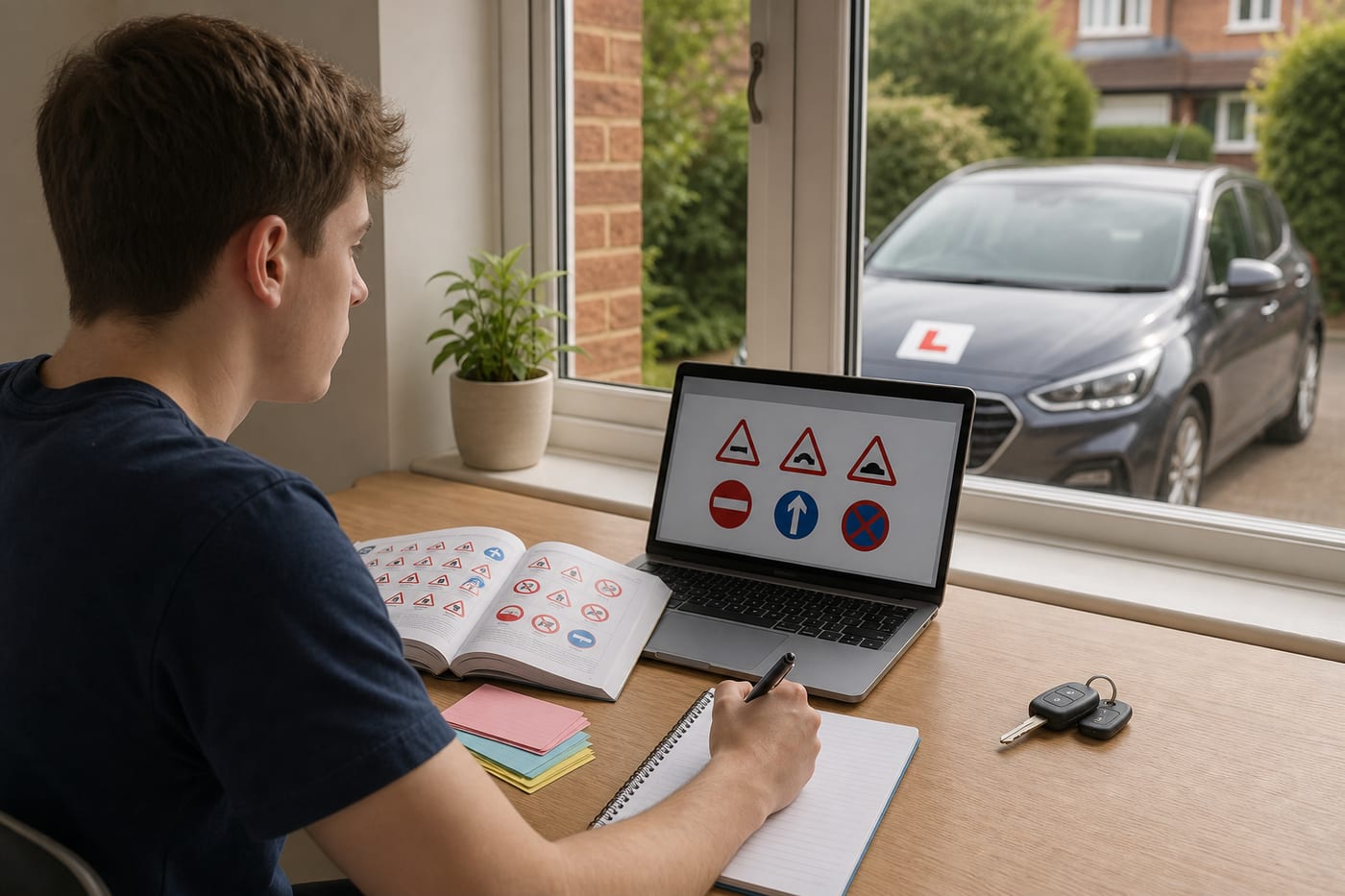
Trying to memorise every road sign as an unrelated picture creates unnecessary work. Learn the visual system used by UK signs:
- Red circles generally give prohibitions or restrictions
- Blue circles generally give positive instructions
- Triangles generally warn of hazards
- Rectangles generally provide information or directions
You will still need to learn individual meanings, and there are exceptions and additional details to understand. However, recognising sign families gives you a useful starting point when faced with a sign you find difficult.
Pay attention to road markings as well. Lines, arrows, hatched areas and words painted on the road can affect positioning, priority and permitted movements.
Revise similar rules side by side
Many errors happen because learners confuse two related rules. Study easily confused topics together so that the differences become clear.
Useful comparisons include:
- Pelican, puffin, toucan and zebra crossings
- Clearways and urban clearways
- Single and double yellow lines
- Motorways and dual carriageways
- Warning signs and mandatory signs
- Braking distance and overall stopping distance
Create a small comparison table containing the key features of each. This is more effective than studying each item several days apart and hoping you remember the distinction.
Practise hazard perception as a separate skill
Knowledge of road rules alone will not guarantee a good hazard perception score. You need to recognise a developing hazard—something that is starting to require a change of speed or direction.
Examples could include a pedestrian approaching a crossing, a vehicle emerging from a side road or a cyclist moving around an obstruction. Spotting something near the road is not always enough; you must identify when it begins to affect the developing situation.
Practise watching the whole scene rather than staring at the vehicle directly ahead. Scan junctions, pavements, parked vehicles and the distance ahead. Look for early clues such as brake lights, obscured entrances and changes in another road user’s position.
Click when you recognise that a hazard is developing. Do not click continuously or follow a repetitive pattern, as inappropriate clicking can result in no score for a clip. Equally, do not wait until emergency action would be necessary. Use approved practice clips to learn the timing while responding naturally to each situation.
Use mock tests properly
Mock tests are most useful when they reproduce real test conditions. Sit somewhere quiet, remove distractions and complete the test without checking notes or searching for answers.
After every mock, spend at least as much attention reviewing the result as taking the test. Ask:
- Which topics caused errors?
- Did I misunderstand the rule or misread the question?
- Did I change a correct answer without good reason?
- Was I rushing because of the timer?
- Were any correct answers guesses?
Avoid repeating the same small bank of questions until you remember their positions or wording. Your goal is to understand the subject well enough to answer a differently phrased question.
Read every question carefully
In the exam, slow down enough to identify exactly what is being asked. Small words can change the meaning of a question, particularly terms such as must, should, first, most and least.
Read all available options before selecting one. Some answers may sound reasonable but fail to address the safest or most appropriate response.
If you are unsure, rule out clearly unsuitable options and flag the question for review. Do not spend so long on one difficult item that you create unnecessary pressure later.
Prepare your test-day routine
Last-minute cramming is unlikely to repair weeks of missed preparation. On the evening before the test, complete only a light review of your weakest points, check your appointment details and prepare the correct photocard driving licence.
Plan your route to the test centre and allow enough time for delays. Check the current official instructions for what to bring and when to arrive. Personal belongings, including electronic devices, will need to be stored as directed at the centre.
During the test, use the on-screen instructions and tutorial to familiarise yourself with the system. Stay calm if a question seems unfamiliar. Use your knowledge, consider the safest response and move on if necessary.
A final readiness checklist
Before test day, you should be able to:
- Pass fresh mock tests consistently rather than occasionally
- Explain why answers are correct
- Recognise signs without relying only on their wording
- Identify developing hazards in practice clips
- Complete both sections under realistic conditions
- Review difficult questions without panicking
- Apply theory rules during driving lessons
A single mock pass is encouraging, but consistent performance is a better sign that you are ready.
Conclusion
The cleverest way to ace your theory exam is to revise actively rather than simply spending more time looking at information. Diagnose your weaknesses, study in short blocks, explain rules aloud and learn from every mistake.
Combine this with realistic mock tests and regular hazard perception practice. When you understand the principles instead of memorising isolated answers, you will be better prepared for the exam and for safer driving afterwards.
Frequently asked questions
How long should I revise for the theory test each day?
There is no fixed daily requirement. Short, regular sessions of around 20 to 30 minutes can be more manageable than occasional lengthy sessions. Adjust your plan according to your existing knowledge and mock test results.
Should I memorise theory test questions and answers?
No. Practice questions are useful, but memorising wording can leave you unprepared when the real test presents a different scenario. Learn the underlying rules using reliable, current resources such as The Highway Code and official DVSA materials.
When am I ready to book my theory test?
You should understand all major topic areas and pass a range of fresh mock tests consistently under timed conditions. You should also practise hazard perception regularly rather than assuming that your multiple-choice knowledge will be enough.
What should I do if I fail the theory test?
Use the result to guide your next revision plan. Identify which section and topics need improvement, return to reliable study materials and practise before booking another attempt. Official waiting periods and booking rules can change, so check the latest information on GOV.UK before arranging a new test.