

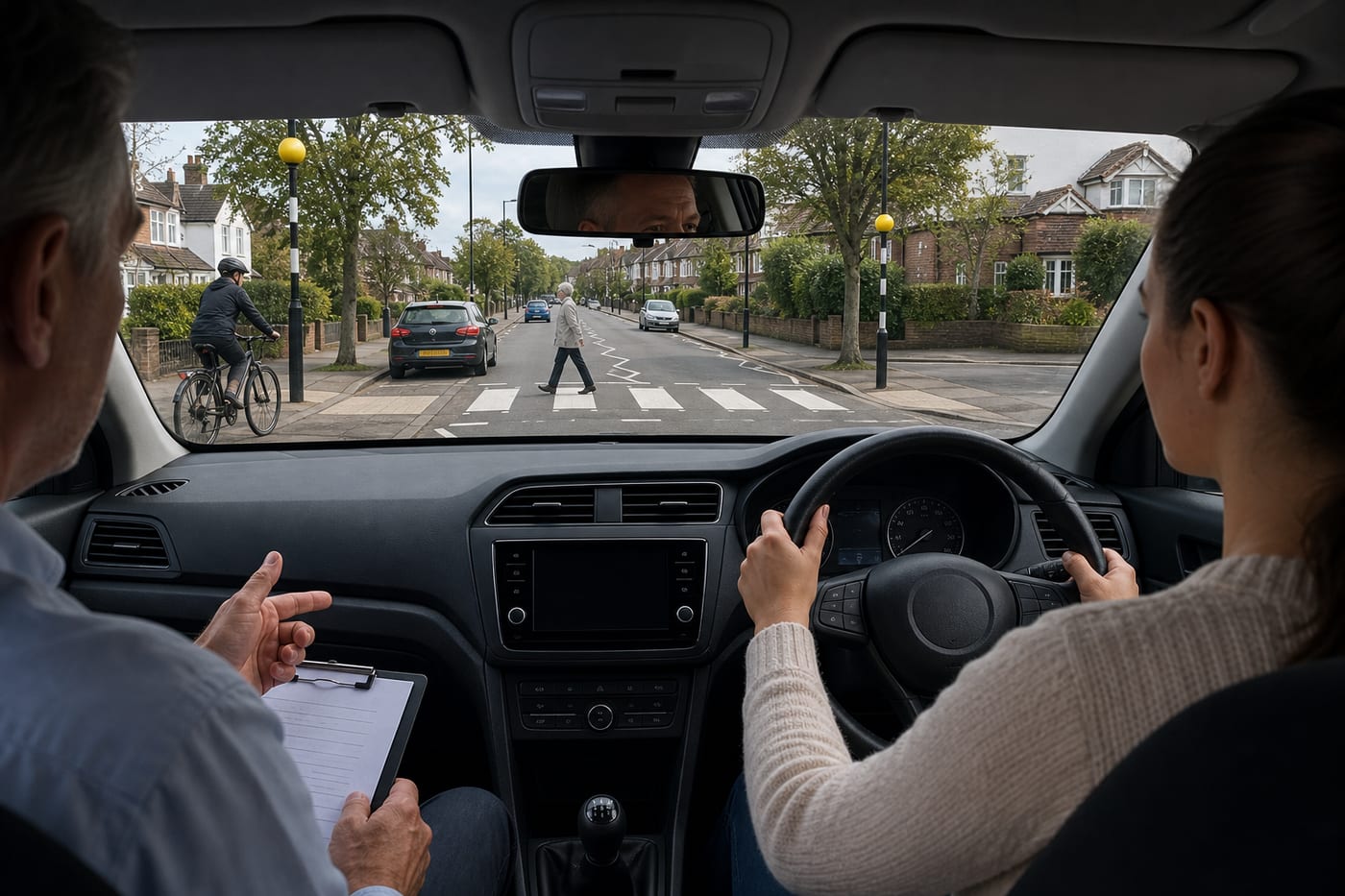
A hazard in the hazard perception test is anything that could make you change your speed or direction. However, the most important hazards for scoring are developing hazards: situations that are beginning to require action from you as the driver.
Recognising that difference is essential. A parked car, pedestrian or side road may be worth monitoring, but it does not always require an immediate response. You need to notice when the situation changes and starts to affect your planned path.
This guide explains what counts as a hazard, how a potential hazard becomes a developing hazard and how to respond without clicking too early, too late or in an unacceptable pattern.
What is a hazard when driving?
A hazard is something that presents a possible danger or could affect how you drive. It may eventually require you to slow down, stop, steer safely around it or alter your road position.
Hazards can include:
- Other vehicles and road users
- Pedestrians, cyclists and motorcyclists
- Junctions, crossings and roundabouts
- Parked or stopped vehicles
- Roadworks and temporary obstructions
- Poor weather or reduced visibility
- Changes in the road surface
- Animals near or on the road
Not every hazard will develop into a situation requiring action. For example, a pedestrian walking along a pavement is something to observe, but they may continue safely without approaching the road.
The skill being tested is your ability to monitor possible risks and identify when one starts to develop.
Potential hazards and developing hazards
Understanding these two stages will make hazard perception clips much easier to interpret.
What is a potential hazard?
A potential hazard is something that might affect your driving but is not yet requiring you to act.
Imagine that you are driving along a residential street and see a parked car ahead. It could remain stationary, so at first it is only a potential hazard. You should notice it and consider what could happen, but it may not yet justify clicking.
Other potential hazards include:
- A child standing safely on the pavement
- A cyclist travelling steadily in a cycle lane
- A vehicle waiting at a side-road junction
- A bus stopped at a bus stop
- A horse and rider in the distance
- A pedestrian near a crossing
Good drivers continuously notice these situations. They do not panic or react sharply to every possible risk, but they remain prepared.
What is a developing hazard?
A developing hazard is a situation that has started to require you to take action. That action could involve changing speed or direction.
The parked car becomes a developing hazard if it begins to move away from the kerb into your path. Warning signs might include:
- An indicator switching on
- Brake lights going off
- The front wheels turning outwards
- A visible driver looking in their mirror
- The vehicle starting to move
At this point, you may need to ease off the accelerator, brake or adjust your position. This is the stage at which the test expects you to recognise the hazard and click.
For a broader explanation of the clips and marks available, see our guide to how the hazard perception test works.
A simple way to define a developing hazard
Ask yourself:
“Is this situation now likely to make me change my speed, direction or road position?”
If the answer changes from “possibly later” to “yes, I need to respond”, the hazard is developing.
You do not need to wait for an emergency. In real driving, leaving your response until a pedestrian is directly in front of the car would be dangerous. The aim is to recognise the situation early enough to make a smooth, controlled adjustment.
Hazard perception is therefore about anticipation rather than last-second reactions.
Common developing hazard examples
Test clips contain ordinary road situations rather than obscure tricks. Learning to recognise the progression in each scenario is more useful than trying to memorise individual videos.
A pedestrian approaching the road
A person walking on the pavement is a potential hazard. They become a developing hazard if they turn towards the road, step off the kerb or approach a crossing in a way that is likely to affect you.
Be especially alert near schools, shops, bus stops and parked vehicles that restrict your view.
A vehicle emerging from a junction
A car waiting at a side road is initially a potential hazard. It develops if the vehicle begins moving towards the main road or continues creeping out when your path is not clear.
Look at its movement rather than assuming the driver has seen you.
A cyclist changing position
A cyclist ahead may be travelling normally. The situation develops if they signal, look over their shoulder, move around a parked vehicle or drift towards your lane.
You may need to reduce your speed and leave more space rather than attempting to pass immediately.
A vehicle braking ahead
Traffic in front is always worth monitoring. A leading vehicle becomes a developing hazard when its brake lights illuminate and the distance between you begins to close.
The reason for the braking may initially be hidden. Responding early gives you more time to slow down smoothly.
A bus moving away from a stop
A stationary bus is a potential hazard because it may move off or hide pedestrians. It becomes a developing hazard when it signals and starts pulling into your path, or when a pedestrian emerges from in front of it.
An obstruction in your lane
A skip, roadworks barrier or broken-down vehicle may force you to alter course. It becomes a developing hazard as you approach the point where you must slow down, check for oncoming traffic or change position.
Animals near the road
An animal behind a secure boundary may simply need monitoring. If it moves towards the carriageway, escapes control or enters the road, the risk develops and may require immediate speed reduction.
Warning signs that a hazard is developing
Strong hazard perception depends on looking for clues. A developing hazard rarely appears without any warning.
Useful clues include:
- Movement towards your path
- Indicators or brake lights
- Wheels changing direction
- A person turning their head or changing course
- A vehicle creeping beyond a give-way line
- A gap in parked cars where someone could emerge
- A ball rolling into the road
- Traffic bunching or slowing ahead
- Temporary signs, cones or workers in the road
- Reflections or shadows revealing something hidden
Try to consider what could happen next. A ball in the road, for example, may be followed by a child. A delivery van with its hazard warning lights on may hide a person or open door.
This does not mean clicking at everything you see. It means building a complete picture so that you can react when a specific risk begins to affect you.
When should you click?
Click when you recognise that a potential hazard is becoming a developing hazard. The earlier you respond within the scoring window, the more points you can receive, with a maximum of five points for each scored hazard.
Clicking as soon as an object first appears may be too early because it has not started developing. Waiting until the danger is unavoidable may be too late.
If you are unsure whether the hazard has started developing, a sensible technique is to click when you first see a genuine change, then click once more if the situation clearly continues or intensifies. Your clicks should reflect the development you are observing rather than follow a fixed rhythm.
Do not click repeatedly, continuously or in a pattern. The test is designed to detect unacceptable clicking behaviour, and this can result in no score for that clip.
Our guide to timing hazard perception clicks correctly explores this important skill in more detail.
How the hazards are scored
In the car theory test, you watch 14 hazard perception video clips. There are 15 scored developing hazards because one clip contains two.
Each developing hazard is worth up to five points. You score more by identifying it promptly after it begins to develop. The maximum score is 75, and the car hazard perception pass mark is 44.
You must pass both the multiple-choice and hazard perception sections to pass the theory test overall. A strong performance in one section does not compensate for failing the other.
Remember that the test is assessing recognition, not your physical driving response. You click to show that you have seen the developing hazard; you do not need to describe what you would do.
How to practise identifying hazards
Effective practice should teach you to recognise changes, not simply become familiar with a set of clips.
Narrate what you see
During suitable practice videos, quietly describe the scene:
- “Parked van ahead.”
- “Pedestrian near the crossing.”
- “Car waiting at the junction.”
- “The pedestrian is turning towards the road.”
- “The car is beginning to emerge.”
This helps separate general observations from the moment a risk develops.
Review why you missed a hazard
After each practice session, ask whether you:
- Failed to notice the potential hazard
- Saw it but did not recognise the change
- Clicked before it began developing
- Reacted after the required action had become obvious
- Focused too closely on one part of the scene
Reviewing your decisions is more valuable than completing large numbers of clips without reflection.
Scan the whole road scene
Do not stare only at the vehicle immediately ahead. Check the distance, pavements, junctions, parked vehicles and road edges. Use a broad visual search, just as you should during real driving.
For additional strategies, use these tips for scoring highly in hazard perception.
Apply the skill during lessons
Ask your instructor to discuss developing hazards during lessons when it is safe to do so. Connecting practice clips with real roads can improve both your test preparation and your everyday planning.
Common mistakes to avoid
One common mistake is clicking whenever any potential hazard appears. Busy roads contain many things worth monitoring, but the test rewards recognition of development.
Another is waiting for dramatic danger. If a vehicle has already pulled directly across your path, the best scoring opportunity may have passed.
Learners can also become fixated on an obvious road user and miss a separate hazard elsewhere. Keep scanning even after noticing something important, particularly because one clip contains two scored hazards.
Finally, do not try to beat the system with constant clicking. Watch the scene naturally and respond to meaningful changes.
Conclusion
For the hazard perception test, a hazard is something that could affect your driving, while a developing hazard is one that is starting to require action. Look for changes in movement, position, signals and behaviour, then click when the risk begins to develop.
Regular, thoughtful practice will help you identify hazards earlier and respond more confidently—both in the theory test and on real roads.
Frequently asked questions
Is every pedestrian a developing hazard?
No. A pedestrian safely walking along the pavement may only be a potential hazard. They become a developing hazard when their movement suggests they may enter or affect your path, such as turning towards a crossing or stepping off the kerb.
Should I click as soon as I see a possible hazard?
Not necessarily. You should notice possible hazards immediately, but the scoring opportunity relates to the point at which a hazard begins developing. Look for a meaningful change that is likely to require you to alter speed or direction.
Can I click more than once for the same hazard?
You can click again if the situation genuinely continues to develop and you are unsure whether your first response was early. However, avoid repeated, continuous or patterned clicking, which may cause you to score nothing for the clip.
What makes a hazard easy to miss?
Hazards can be missed when they begin at the edge of the scene, are hidden by parked vehicles or develop while you are concentrating elsewhere. Scan broadly and look for early clues such as wheel movement, brake lights, changing body language and vehicles creeping at junctions.