Identifying road hazards early is one of the most important skills a driver can develop. It allows you to adjust your speed, position and following distance before a situation becomes dangerous, rather than reacting suddenly when your options are limited.
Hazard awareness is also central to the UK driving theory test. However, it is not simply a test-day technique. The same observation and anticipation skills will help you during lessons, on your practical test and throughout your driving life.
What is a road hazard?
A road hazard is anything that could cause you to change speed, direction or position. It may already be affecting your progress, or it may have the potential to do so.
For example, a parked car is not necessarily an immediate problem. If its driver’s door begins to open, however, it becomes a developing hazard because you may need to slow down or move away from it.
It helps to distinguish between two types of hazard:
- Potential hazard: something that could become a problem, such as a child standing near the kerb.
- Developing hazard: something that is beginning to affect your driving, such as that child stepping into the road.
This distinction is particularly important in the hazard perception section of the theory test. Our guide to what counts as a hazard in the perception test explains the difference in more detail.
Why early hazard identification matters
The earlier you notice a risk, the more time you have to make a calm decision. You may be able to ease off the accelerator, increase the gap ahead, change your road position or prepare to stop.
Late detection often leads to harsh braking, sudden steering or rushed decisions. These reactions can create additional danger for you and other road users.
Good hazard awareness involves looking beyond the vehicle directly ahead. You should observe the wider scene, including pavements, side roads, road signs, crossings and the movement of other traffic.
Common road hazards to look for
Hazards can appear anywhere, but certain situations deserve particular attention.
Pedestrians and vulnerable road users
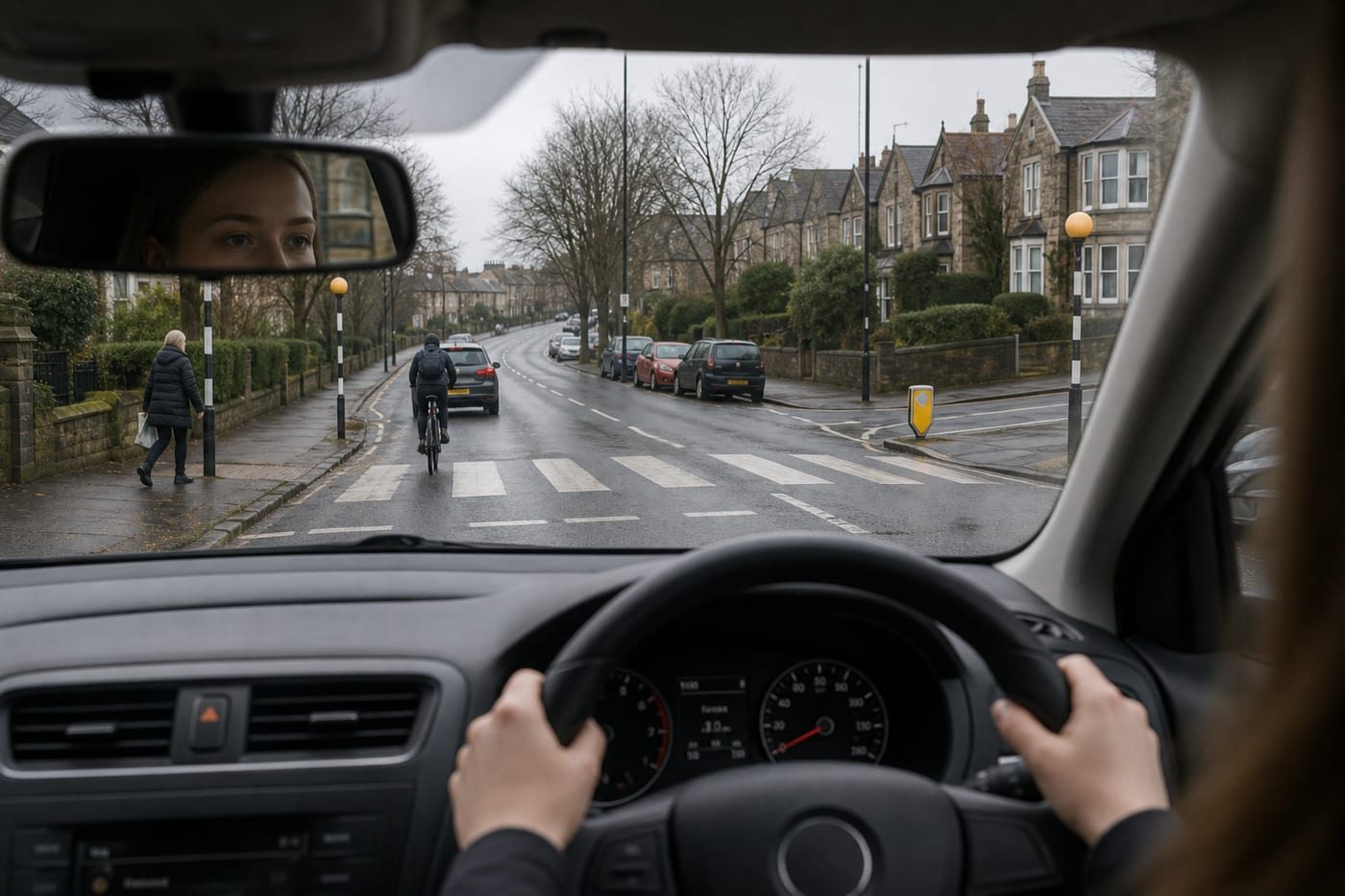
Pedestrians can change direction unexpectedly, particularly near crossings, bus stops, schools, shops and parked vehicles. Watch for people approaching the kerb, looking across the road or becoming hidden behind an obstruction.
Take particular care around children, older people and disabled pedestrians. Children may be difficult to see between parked cars and may not judge your speed accurately. Some pedestrians may need more time to cross or may be unable to see or hear approaching traffic clearly.
Cyclists, motorcyclists and horse riders are also vulnerable. Give them time and space, expect them to move around drains or rough surfaces, and avoid assuming they will continue in a perfectly straight line.
Junctions and side roads
At a junction, another road user may emerge, turn across your path or fail to notice you. Look for clues such as the front wheels of a waiting vehicle beginning to turn, a driver looking in the opposite direction or a vehicle approaching too quickly to stop smoothly.
Your view may be restricted by buildings, hedges, parked cars or large vehicles. If you cannot see whether the route is clear, reduce your speed and be prepared for something to appear.
Turning itself can introduce several hazards at once. A driver turning right, for example, must consider approaching traffic, vehicles behind, pedestrians crossing the side road and cyclists travelling alongside. The correct observation and positioning sequence is covered in our guide to turning right safely off a main road.
Parked vehicles
Parked vehicles can hide pedestrians, cyclists and junctions. They can also begin moving with little warning.
Look for signs of activity, including:
- brake lights or reversing lights;
- illuminated indicators;
- exhaust fumes;
- moving wheels;
- occupants inside the vehicle;
- an opening door;
- a pedestrian walking towards the driver’s side.
Leave enough room when passing and reduce your speed if the available space is narrow. Be especially cautious around vans and other tall vehicles because they can block your view of the pavement and oncoming traffic.
Changing traffic conditions
A queue forming ahead may indicate traffic lights, roadworks, a collision or congestion. Brake lights appearing in sequence are an early warning that you may need to slow down.
Large vehicles can restrict your view. Rather than following closely to see around them, increase your following distance. This improves your view ahead and gives you more time to react.
Be alert when traffic in another lane slows unexpectedly. A vehicle may be stopping for a pedestrian, an obstruction or another road user you cannot yet see.
Road surface hazards
Your tyres have less grip on wet, icy or contaminated surfaces. Hazards may include standing water, mud, loose gravel, diesel spills, potholes, wet leaves and road repairs.
Look for changes in the colour or texture of the road. A shiny surface may be wet or icy, while spray from vehicles ahead indicates standing water. Mud near a farm entrance and loose material near roadworks should also prompt you to reduce speed smoothly.
Avoid sharp braking or steering when grip is reduced. Slow down in good time and increase the distance between you and the vehicle ahead.
Weather and visibility
Rain, fog, snow, low sun and darkness can make hazards more difficult to detect. They may also increase stopping distances and make other road users harder to see.
Adjust your speed so that you can respond safely within the distance you can see to be clear. Keep your windows, mirrors and lights clean, and use the appropriate lights for the conditions.
Low sun can temporarily obscure traffic lights, pedestrians and brake lights. A wet road may produce glare as well as reducing grip. Anticipate these problems before entering a shaded bend, cresting a hill or driving towards the sun.
Animals
Animals can behave unpredictably. Watch for warning signs, farm entrances and movement at the roadside. Slow down near horse riders and follow any signals they give.
If an animal enters the road, avoid swerving automatically. Sudden steering could take you into opposing traffic or onto the pavement. Reduce speed under control while considering vehicles around you.
How to scan the road effectively
Hazard identification depends on a consistent observation routine. Avoid staring at one fixed point or concentrating only on the car in front.
Look well ahead
Scan as far along the road as you can. This may reveal changing traffic lights, roadworks, a sharp bend or a queue before it affects you.
Then bring your attention back towards the middle and near distance. This creates a continuous picture of what is happening rather than a series of last-second surprises.
Check the sides of the road
Hazards often begin on the pavement, at a driveway or in a side road. Briefly scan entrances, crossings, parked vehicles and gaps between buildings without losing awareness of the road ahead.
Use your mirrors regularly
Mirrors tell you how your actions could affect traffic behind or beside you. Before slowing down, changing direction or altering position, check the relevant mirrors whenever it is safe to do so.
Mirror information also influences your response. If a vehicle is following closely, for example, earlier and gentler braking can give its driver more warning.
Look for clues, not just objects
Strong hazard awareness involves interpreting behaviour. A football rolling into the road may be followed by a child. A bus signalling at a stop may pull out. A driver edging forwards at a junction may not have seen you.
Road signs, markings and the shape of the road provide clues too. Warning signs can alert you to bends, crossings, animals or other risks before they become visible.
How to respond when you identify a hazard
Spotting a hazard is only useful if you respond appropriately. Your exact action will depend on the situation, but a safe response commonly involves:
- Checking your mirrors to understand the traffic around you.
- Easing off the accelerator to create more time.
- Adjusting your position where necessary and safe.
- Covering or using the brake if the risk is developing.
- Preparing to stop if the situation could block your path.
Avoid treating every potential hazard as an emergency. Braking sharply whenever you see a pedestrian near the road may confuse or endanger traffic behind. The aim is to recognise risk early enough to respond progressively.
Never let hazard avoidance create a second danger. For example, do not steer around a pothole without checking for cyclists, oncoming vehicles or traffic beside you.
Practising hazard awareness during driving lessons
Ask your instructor to help you use commentary driving. This involves saying what you can see and what might happen, such as: “Parked van ahead, view of the crossing is restricted, so I’m easing off.”
Commentary can reveal whether you are scanning far enough ahead and whether you understand which clues matter. It also encourages you to connect observation with a suitable response.
As a passenger, you can practise identifying potential hazards without controlling the vehicle. Watch the road ahead and predict when the driver may need to slow down. Do not allow this exercise to distract whoever is driving.
Identifying hazards in the theory test
In the hazard perception test, you watch video clips and identify developing hazards. You should respond when a potential risk begins to develop and would cause a driver to take action.
Do not wait until an incident is unavoidable. Equally, clicking as soon as you see every possible risk may be too early because the hazard may not yet be developing.
A sensible technique is to click when you first recognise genuine development. If the situation clearly continues to develop, a further click can help show your recognition of that progression. Avoid clicking continuously, rhythmically or in a pattern, as inappropriate clicking can prevent you from scoring on a clip.
For a fuller explanation of the format and scoring principles, see our guide to how the hazard perception test works.
Common hazard awareness mistakes
Learner drivers often make hazard identification harder by:
- watching only the vehicle immediately ahead;
- approaching junctions too quickly;
- ignoring pavements and side roads;
- following large vehicles too closely;
- reacting to hazards without checking mirrors;
- assuming another road user has seen them;
- driving too fast for visibility or surface conditions;
- focusing on one hazard and missing another.
The solution is not to drive nervously. Instead, develop a calm routine of scanning, predicting and creating space.
Conclusion
Identifying road hazards is about noticing clues before they become emergencies. Look well ahead, scan the sides of the road, use your mirrors and consider what other road users might do next.
With regular practice, these habits become more natural. They will improve your hazard perception test performance while helping you make safer, smoother decisions on real roads.
Frequently asked questions
What is the difference between a potential and developing hazard?
A potential hazard could affect your driving but is not doing so yet. It becomes a developing hazard when the situation begins to require action, such as slowing down, changing position or stopping.
Are parked cars always hazards?
Parked cars are potential hazards because they can hide pedestrians or begin moving. They become more urgent when you notice clues such as an opening door, reversing lights or a person stepping out from behind them.
Should I brake whenever I see a hazard?
Not necessarily. Depending on the risk, easing off the accelerator, increasing your following distance or adjusting your position may be enough. Brake progressively when the hazard is developing, and always consider the traffic around you.
How can I improve my hazard perception skills?
Practise scanning well ahead, use commentary during lessons and review hazard perception clips. Focus on the moment a situation changes from a possibility into something that could require a driving response.