A dual carriageway is defined by the way opposing traffic flows are separated—not simply by how many lanes the road has. This distinction regularly causes confusion among learner drivers and can lead to mistakes involving speed limits, lane discipline and road signs.
Dual carriageways range from busy high-speed routes with several lanes to short urban sections with only one lane in each direction. Learning how to recognise and navigate them will help you answer theory test questions and drive more confidently during lessons.
What defines a dual carriageway?
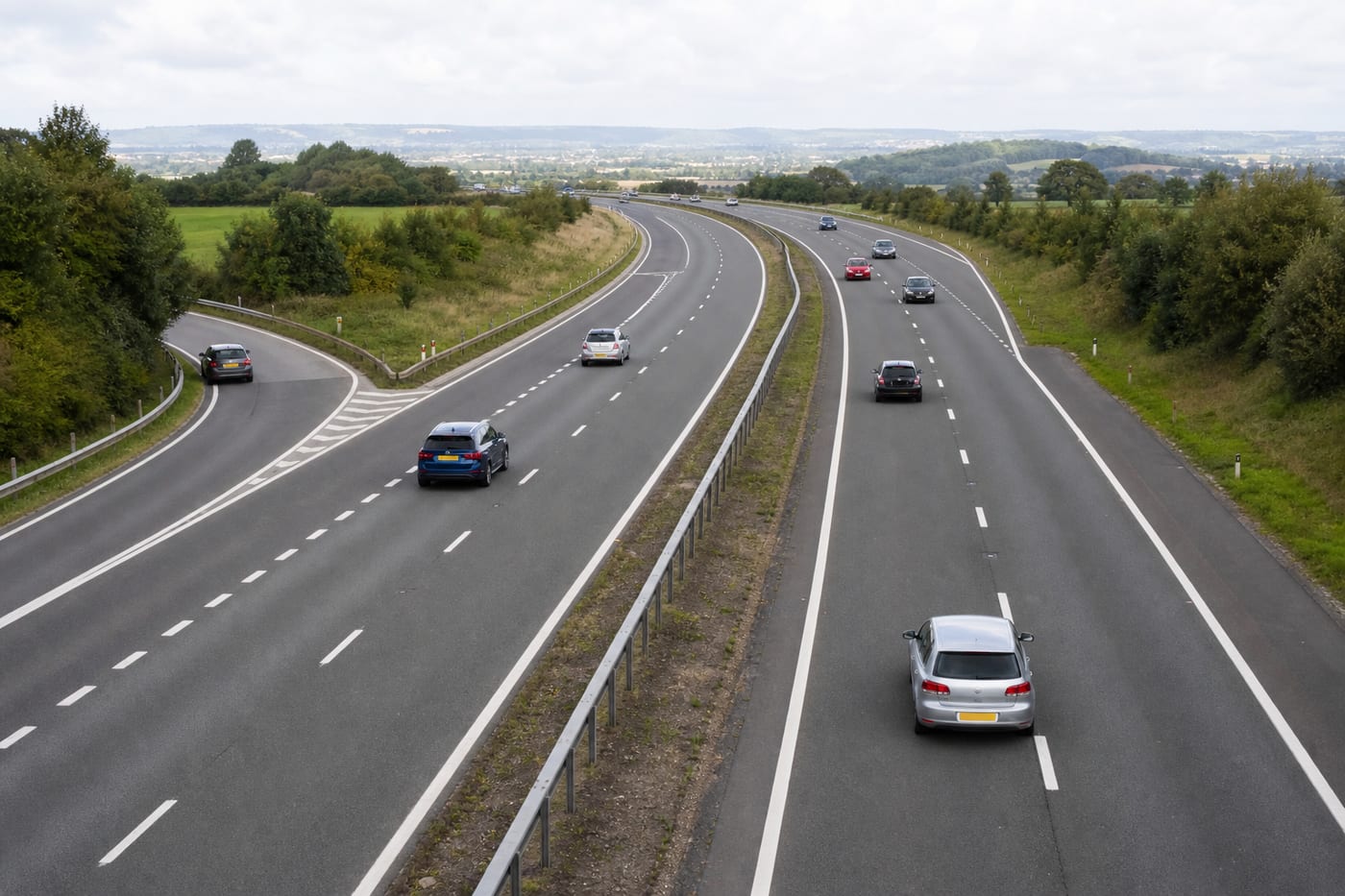
A dual carriageway is a road on which traffic travelling in opposite directions is separated by a central reservation. The reservation may be a metal or concrete barrier, a raised kerb, or a wide strip of grass.
Each side of the reservation is a separate carriageway carrying traffic in one direction. This physical separation is the defining feature.
The number of lanes does not determine whether a road is a dual carriageway. A road with two lanes in each direction but no central reservation is still a single carriageway. Conversely, a road can have only one lane in each direction and still be a dual carriageway if a central reservation separates the two sides.
Painted lines or hatched markings between opposing traffic streams do not usually create two separate carriageways by themselves. Look for a physical division rather than counting lanes.
How to recognise a dual carriageway
The central reservation is the clearest clue, but you should also look for:
- Traffic on your side travelling in one direction only
- Direction signs showing the road layout ahead
- Signs marking the start or end of a dual carriageway
- Breaks in the central reservation for junctions or authorised turning points
- Slip roads leading onto or away from faster sections
- Multiple lanes marked with broken white lines
Do not assume every broad or fast-looking road is a dual carriageway. Equally, do not assume a dual carriageway must resemble a motorway. Our guide to the differences between motorways and dual carriageways explains the main identifying features in more detail.
Dual carriageway speed limits
For a car, the national speed limit on a dual carriageway is 70 mph. However, that does not mean you may always drive at 70 mph.
A lower limit may be shown by signs, particularly on urban dual carriageways, near junctions or through roadworks. If another limit is displayed, you must follow it. Roads with a system of street lighting may also be subject to a lower restricted-road limit unless signs indicate otherwise.
Different national speed limits apply to some vehicle classes. For example, a car towing a caravan or trailer is limited to 60 mph on a dual carriageway. Drivers should know the limit for their particular vehicle and circumstances.
Remember that a speed limit is a maximum, not a target. You may need to travel more slowly because of:
- Heavy traffic
- Rain, fog, ice or strong winds
- Poor visibility
- Roadworks
- Sharp bends or junctions
- Pedestrians, cyclists or slow-moving vehicles
Theory test questions may show a dual carriageway carrying a lower signed limit. Always use the signs and road conditions in the question rather than automatically choosing 70 mph.
Joining a dual carriageway safely
Many high-speed dual carriageways are entered using a slip road. Use the slip road to build up an appropriate speed and find a safe gap in the traffic.
Check your interior and right-hand mirrors early. Look over your right shoulder when necessary to check the blind spot, and signal if it will help other road users understand your intentions.
Traffic already on the main carriageway has priority. You must not force another driver to brake or change lanes so that you can join. Adjust your speed to enter a suitable gap while remaining prepared to slow down if necessary.
Drivers on the main carriageway may move into the right-hand lane to create space, but you must never rely on them doing so. They may be overtaking, unable to move over or unaware of your position.
Where you join directly from a side road rather than a slip road, judge the speed and distance of traffic carefully. Faster vehicles can reach you sooner than expected.
Choosing the correct lane
On a two-lane dual carriageway, you should normally drive in the left-hand lane. Use the right-hand lane for overtaking or when signs and markings direct you into it for a turn or destination.
After overtaking, return to the left when it is safe. Staying in the right-hand lane unnecessarily can obstruct traffic and encourage unsafe behaviour from other drivers.
On a road with three or more lanes, the same basic principle applies: keep to the left unless overtaking or following lane directions. Move across one lane at a time, checking mirrors and blind spots before each change.
In slow-moving congestion, it can be safer to remain in your lane rather than continually switching. One lane may temporarily move faster than another, but that does not justify weaving between gaps.
Lane arrows, solid lines and hatched areas can affect where you should position the car. Revise the meaning of these features with our complete guide to UK road markings.
Overtaking on a dual carriageway
Before overtaking, ask whether the manoeuvre is legal, safe and necessary. Use the mirrors–signal–manoeuvre routine and check that the right-hand lane is clear far enough behind and ahead.
Build speed smoothly without exceeding the limit. Leave plenty of room when passing, particularly around large vehicles, motorcycles and cyclists. Large vehicles can restrict your view and may create turbulence in windy conditions.
Do not cut back into the left lane too soon. Wait until you can see the overtaken vehicle in your interior mirror, then move back gradually when there is a safe gap.
Avoid overtaking near junctions, bends or other places where traffic may change direction unexpectedly. Never use an exit lane simply to pass vehicles before cutting back into the main carriageway.
Following distances and high-speed hazards
Higher speeds require a much larger gap. In dry conditions, use at least the two-second rule: choose a fixed point and make sure at least two seconds pass between the vehicle ahead reaching it and your car reaching it.
Allow at least double the normal gap on wet roads and increase it substantially in icy conditions. Leave more room whenever visibility or grip is reduced.
A safe gap gives you time to react to sudden braking, debris, queues or vehicles entering from a junction. It also improves your view past large vehicles. You can revise the relevant principles in our guide to maintaining safe stopping distances.
Potential hazards on dual carriageways include:
- Traffic joining from slip roads or side roads
- Vehicles braking for queues or traffic lights
- Drivers changing lanes without enough warning
- Cyclists, pedestrians or animals where they are not prohibited
- Tractors and other slow-moving vehicles
- Breakdowns where there is no hard shoulder
- Strong crosswinds on exposed sections
- Spray from large vehicles in wet weather
Scan well ahead rather than concentrating only on the car directly in front.
Turning right across a dual carriageway
Some dual carriageways have gaps in the central reservation for right turns. These junctions require careful judgement because you may need to cross fast-moving traffic in both directions.
First, wait for a safe gap in traffic approaching from your right. Whether you can pause in the central reservation depends on the space available.
If the central reservation is wide enough to contain your vehicle fully, you may be able to treat each carriageway as a separate road. Cross the first side, wait safely in the middle, then assess traffic approaching from the left.
If your vehicle would stick out into either carriageway, do not stop in the centre. Wait until you can complete the entire crossing safely without blocking traffic.
Never use a central reservation opening that is closed, prohibited or intended only for emergency or authorised vehicles. Follow all signs, signals and road markings.
Leaving a dual carriageway
Read direction signs early so that you know which lane you need. If the exit is on the left, move into the left-hand lane in good time rather than making a late lane change.
Check your mirrors, signal at an appropriate point and enter the exit lane when the markings allow. Avoid slowing significantly while you are still in the main traffic lane unless conditions require it. Use the slip road to reduce speed progressively.
Your sense of speed can become distorted after travelling quickly. Check the speedometer and look ahead for bends, queues, roundabouts or traffic lights at the end of the slip road.
Some exits use dedicated lanes that separate from the main carriageway. Road markings and overhead signs will show whether you need to leave the main flow or whether your current lane becomes the exit.
Can learner drivers use dual carriageways?
Yes. Learner drivers may drive on dual carriageways when they meet the normal legal requirements for learning on public roads, including suitable supervision and insurance.
This differs from motorway access, where a learner car driver must be accompanied by an approved driving instructor in a car fitted with dual controls. Dual carriageway experience can therefore be introduced during ordinary lessons when your instructor considers you ready.
Practising on suitable dual carriageways can help you develop joining, overtaking, lane-changing and forward-planning skills. Start on quieter routes and build up gradually rather than attempting a busy high-speed road before you can control the car confidently.
What if you break down?
If the vehicle develops a problem, try to leave the dual carriageway or pull into a lay-by. If that is impossible, stop as far to the left as you safely can and switch on the hazard warning lights.
If it is safe, occupants should leave through a door away from moving traffic and wait behind a safety barrier or well away from the carriageway. Do not attempt repairs next to fast traffic. Contact a breakdown provider and use the emergency services if there is immediate danger.
Many dual carriageways do not have hard shoulders, so early warning signs such as unusual noises, warning lights or loss of power should never be ignored.
Common theory test mistakes
Learners often make the mistake of identifying a dual carriageway by its lane count. Remember: central reservation, not number of lanes.
Other common errors include:
- Assuming the limit is always 70 mph
- Forgetting that towing changes the national speed limit
- Remaining in the right-hand lane after overtaking
- Expecting main-road traffic to make space at a slip road
- Misjudging whether a car can fit in the central reservation
- Treating dual carriageways as roads reserved only for motor vehicles
Pay close attention to the signs, vehicle type and weather described in each theory question.
Frequently asked questions
Is a road with two lanes in each direction always a dual carriageway?
No. It is only a dual carriageway if a central reservation physically separates opposing traffic flows. Without that separation, it remains a single carriageway regardless of the number of lanes.
Is the speed limit always 70 mph on a dual carriageway?
No. The national speed limit for a car is 70 mph, but a lower signed limit may apply. Your vehicle type, towing status and road conditions can also require a lower maximum or safer travelling speed.
Should I use the right-hand lane on a dual carriageway?
Use it mainly for overtaking or when signs and markings require it for your route. Return to the left when it is safe after completing an overtake.
Are cyclists and pedestrians allowed on dual carriageways?
They may use many dual carriageways unless signs prohibit them. Their presence can be especially hazardous where traffic is fast, so identify them early, reduce speed where necessary and leave plenty of space.
Conclusion
A dual carriageway is defined by its central reservation, not its width or number of lanes. Recognising this helps you apply the correct speed limits, choose safe lanes and answer theory test questions accurately.
When driving, keep left unless overtaking, plan lane changes early and maintain a generous following distance. Treat junctions, central-reservation gaps and slip roads with particular care, as traffic may be approaching much faster than it first appears.