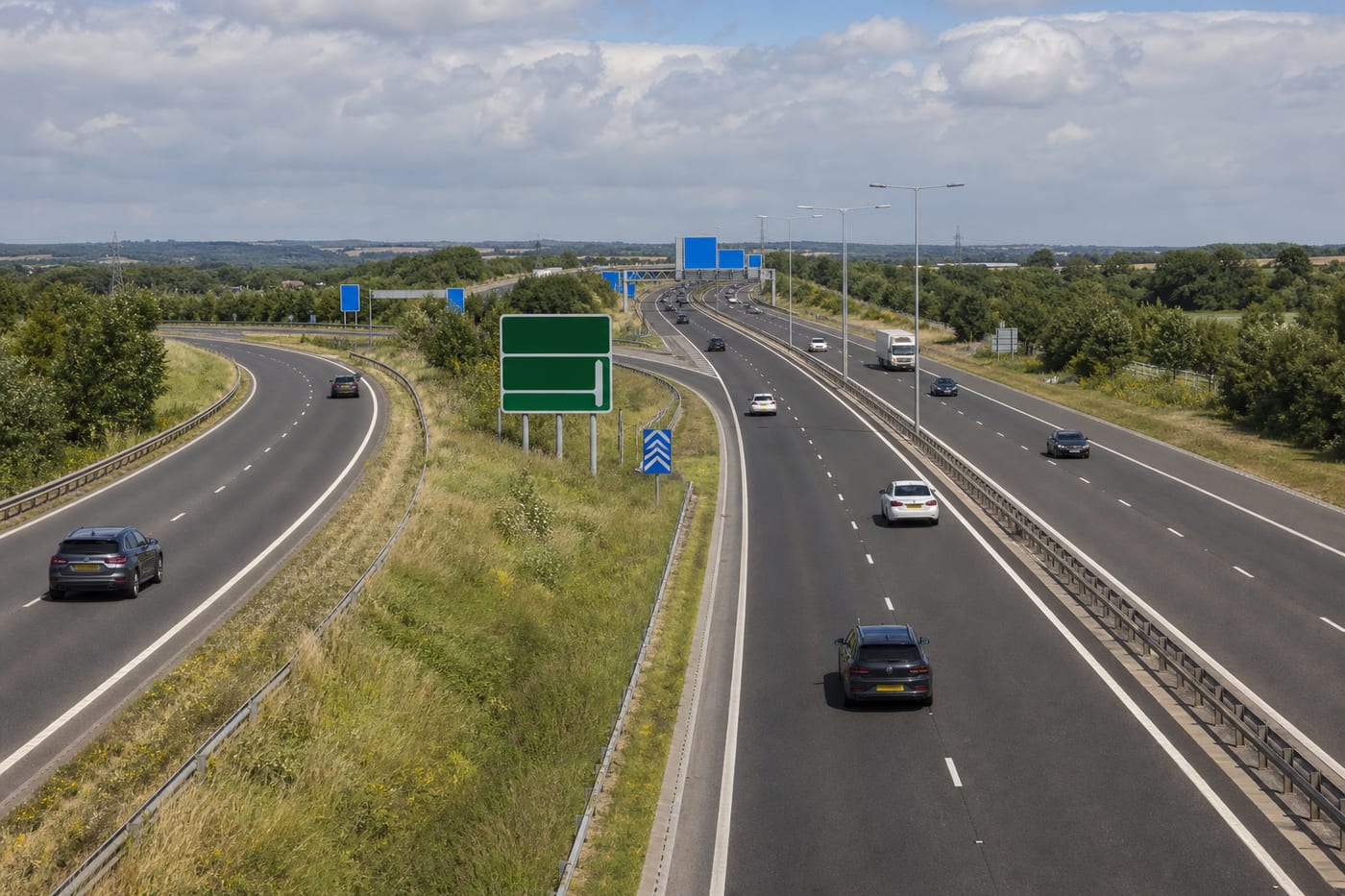
Motorways and dual carriageways can look remarkably similar. Both may have several lanes, a central barrier and a 70 mph speed limit for cars. However, they are not the same type of road, and relying on appearance alone can lead to mistakes in the theory test and on real journeys.
The fundamental difference is that a dual carriageway has separate carriageways for opposing traffic, divided by a central reservation. A motorway is a specially classified road with its own entry restrictions, signs and rules.
Learning to recognise each road type helps you apply the correct speed limit, anticipate junctions and understand which road users may be present.
What is a dual carriageway?
A dual carriageway is a road on which traffic travelling in opposite directions is separated by a central reservation. That reservation may contain a grass strip, concrete barrier, metal safety barrier or another physical divider.
The number of lanes does not determine whether a road is a dual carriageway. Each direction might have one, two, three or more lanes. Conversely, a road with two lanes in each direction is still a single carriageway if there is no central reservation separating opposing traffic.
This distinction is particularly important in speed-limit questions. You cannot identify a dual carriageway simply by counting lanes.
Dual carriageways are often A-roads, such as sections of the A1, A30 or A14. Depending on their location, they may include:
- Roundabouts and traffic lights
- Side-road junctions
- Lay-bys and bus stops
- Gaps in the central reservation
- Right-turn lanes
- Pedestrian crossings
- Farm or property entrances
- Slow-moving vehicles and vulnerable road users
Some modern dual carriageways closely resemble motorways, with grade-separated junctions and limited roadside access. They remain dual carriageways unless they have formally been classified as motorways.
What is a motorway?
A motorway is a road reserved for permitted motor vehicles and governed by motorway-specific rules. It is not defined simply by its width, number of lanes or central barrier.
Motorways normally use route numbers beginning with M, such as the M1, M4 or M25. A-road numbers followed by “(M)”, such as the A1(M), also identify motorway sections. Motorway rules apply on these sections even though the route number begins with an A.
You will usually enter a motorway through a slip road and see a blue motorway sign showing that motorway regulations begin. Direction signs on motorways have blue backgrounds.
Motorways generally have:
- No ordinary crossroads or roundabouts on the main carriageway
- No direct entrances from homes or businesses
- No pedestrian crossings
- Junctions reached through slip roads
- Restrictions on certain road users and vehicles
- Emergency areas, a hard shoulder or other emergency provisions, depending on the road layout
- Motorway signals controlling lanes and speeds
For a broader explanation of joining, lane discipline and emergencies, see our complete guide to safe motorway driving.
The quickest ways to tell them apart
Look at the road signs
Signs provide the most reliable clues.
Motorway direction signs normally have a blue background with white symbols and lettering. At the entrance, the motorway symbol indicates that motorway regulations are starting.
Direction signs on primary A-roads usually have a green background, while signs on non-primary local routes generally have a white background with dark lettering. A green sign therefore often indicates an A-road rather than a motorway.
There can be coloured panels within signs. For example, a sign on an A-road may contain a blue panel directing traffic towards a motorway. Focus on the road you are entering, not merely one coloured patch on a sign.
You should also recognise motorway signals, including variable speed limits and red X lane closures. Our guide to UK motorway signs and signals explains these in more detail.
Check the route number
Route numbers are another strong clue:
- M1, M5 or M62: motorway
- A1(M): motorway section of an A-route
- A1, A14 or A30: A-road, which may be single or dual carriageway
- B-road number: not a motorway
Do not assume that every section of one named route has the same classification. The A1 includes ordinary A-road sections as well as A1(M) motorway sections. Watch for signs showing where motorway restrictions begin or end.
Consider the junction layout
Motorway traffic normally joins and leaves using slip roads. You should not encounter an ordinary T-junction, a property entrance or a signal-controlled pedestrian crossing on the motorway carriageway.
Dual carriageways can have motorway-style junctions, but they may also contain roundabouts, traffic lights and direct side-road access. These features are a warning that traffic may slow, stop or cross your path.
Layout is useful supporting evidence, but signs and road classification remain more dependable.
Think about the road users present
Motorways prohibit several categories of road user, including pedestrians, cyclists, horse riders and motorcycles under 50cc. Certain slow-moving vehicles are also restricted.
On an ordinary dual carriageway, you may encounter cyclists, pedestrians, tractors or other slow vehicles unless signs impose a specific restriction. Their presence should affect your observation, speed and overtaking decisions.
Never assume that somebody must not be there and therefore ignore them. If you encounter an unexpected vulnerable road user, reduce risk by creating space and responding safely.
Speed limits on motorways and dual carriageways
For a car that is not towing, the national speed limit is normally 70 mph on both motorways and dual carriageways. This similarity is one reason learners confuse the two.
However, 70 mph is a maximum, not a target. A lower signed limit takes priority, and you must drive more slowly when traffic, weather, visibility or road conditions make the maximum unsafe.
Different limits apply to some vehicles. For example, a car towing a trailer is limited to 60 mph on both motorways and dual carriageways. Many goods vehicles also have lower limits on dual carriageways than on motorways.
In theory test questions, first identify:
- The type of road
- The vehicle being driven
- Whether it is towing
- Whether a lower limit is shown
Also remember that a road with street lights will generally have a 30 mph limit unless signs indicate otherwise. Do not choose an answer based only on how wide or open the road appears.
Hard shoulders, emergency areas and lay-bys
A hard shoulder is traditionally associated with motorways, but it should not be your only method of identification.
Some motorways have a continuous hard shoulder. Others have sections where emergency areas are provided instead. A hard shoulder may also be temporarily used as a running lane when signs specifically permit it. You must never drive in a lane showing a red X.
Dual carriageways commonly have a verge and occasional lay-bys rather than a motorway hard shoulder. Nevertheless, road designs vary, so the presence of a wide strip beside the carriageway does not prove that you are on a motorway.
Use the signs, route number and entry point to confirm the road type.
Different hazards to expect
Hazards on dual carriageways
A dual carriageway may require you to deal with hazards that would not normally appear on a motorway, including:
- Traffic turning across or joining the carriageway
- Vehicles emerging from minor roads
- Queues approaching roundabouts or traffic lights
- Cyclists and slow-moving agricultural vehicles
- Pedestrians near crossings or bus stops
- Vehicles using short acceleration lanes
Scan well ahead and look beyond the vehicle directly in front. Central-reservation gaps, warning signs and brake lights can give early notice of a developing hazard.
Hazards on motorways
Motorway hazards often develop at higher speeds and may include:
- Vehicles merging from slip roads
- Sudden congestion
- Lane closures or incidents
- Drivers changing lanes without enough space
- Debris or broken-down vehicles
- Large vehicles creating restricted views or spray
Longer observation distances are essential because a small change ahead can quickly become serious. Maintain a safe following gap and react early to signals and brake lights.
Learner drivers and motorway access
In Great Britain, a learner car driver may drive on a motorway only when accompanied by a DVSA-approved driving instructor and using a car fitted with dual controls. A learner cannot practise there with an ordinary supervising family member or friend.
Dual carriageways do not have that motorway-specific learner restriction. Learners may use them when they meet the normal legal requirements for supervised driving.
This does not mean every learner is ready for a fast dual carriageway. Your instructor or supervisor should introduce higher-speed roads when you can control the car confidently, judge gaps and plan well ahead. The motorway rules for learner drivers provide further guidance on supervised motorway lessons.
Common theory test traps
“Two lanes each way means dual carriageway”
Not necessarily. The defining feature is the central reservation, not the number of lanes.
“A central barrier means motorway”
Incorrect. Many A-road dual carriageways have substantial concrete or metal barriers.
“The speed limit tells you the road type”
A 70 mph limit may apply to both roads for cars. Lower signed limits can also apply on either.
“All motorway-like roads are motorways”
Some A-roads have motorway-standard layouts but remain dual carriageways. Look for the motorway symbol, blue signs and an M or (M) route number.
“A blue panel means the current road is a motorway”
A coloured panel may only indicate a route reached from the current road. Interpret the full sign and direction arrow.
A practical recognition routine
When entering an unfamiliar high-speed road, use this simple routine:
- Read the approach signs. Note their colour, symbols and destination panels.
- Check the route number. Look for M, (M) or A classification.
- Notice any start-of-motorway sign. This confirms that motorway restrictions apply.
- Observe the layout. Look for slip roads, roundabouts, side access and central-reservation gaps.
- Confirm the speed limit. Follow the displayed limit rather than making assumptions.
- Anticipate likely road users. On an A-road, be especially alert for slower and vulnerable traffic.
This process should become part of your normal forward planning rather than a last-second check.
Conclusion
A dual carriageway is defined by having separate carriageways divided by a central reservation. A motorway is a specially classified road with motorway signs, access restrictions and dedicated rules.
Do not judge by lane count, speed or appearance alone. Use the signs, route number and entry point together. Recognising the road correctly will help you answer theory test questions and prepare for the hazards ahead.
Frequently asked questions
Can a dual carriageway have only one lane in each direction?
Yes. If opposing traffic flows are separated by a central reservation, it can still be a dual carriageway even when each direction has only one lane.
Is the speed limit always 70 mph on a dual carriageway?
No. For a car not towing, the national speed limit is 70 mph, but a lower signed limit may apply. Vehicle type, towing and road conditions must also be considered.
Is an A-road ever a motorway?
A section marked with “(M)”, such as the A1(M), is a motorway and motorway rules apply. An ordinary A-road number without “(M)” does not by itself indicate a motorway.
Do all motorways have a hard shoulder?
No. Motorway layouts vary, and some sections use emergency areas or other arrangements rather than a continuous hard shoulder. Signs and route classification are more reliable identifiers.