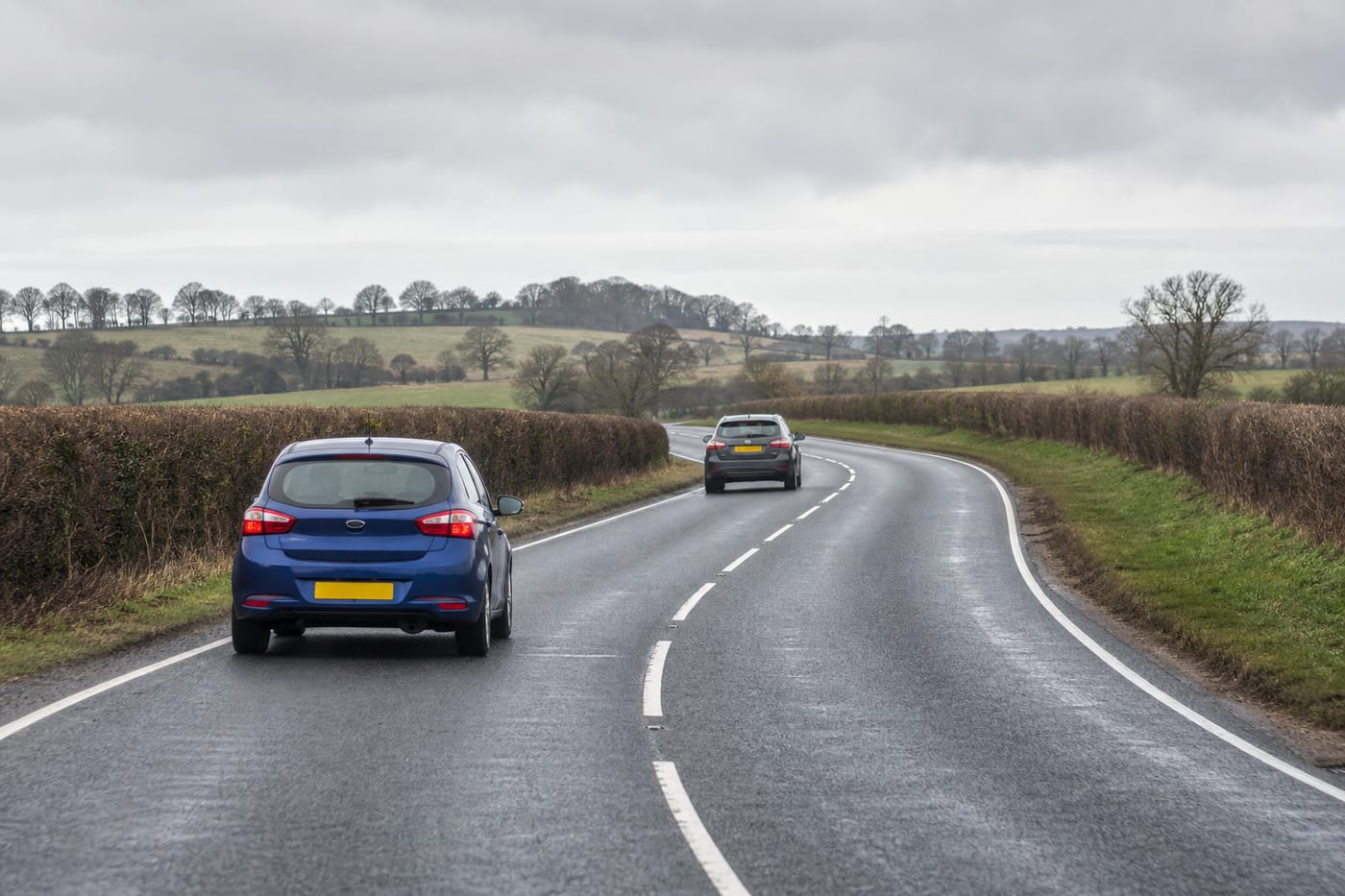
Stopping distances matter every time you drive. If the vehicle ahead brakes suddenly, a pedestrian steps into the road or traffic is stationary around a bend, the space in front of you determines whether you can stop safely.
For learner drivers, it is important to understand both the stopping distances used in the UK theory test and how to apply safe following gaps on real roads. The figures are useful reference points, but safe driving also requires you to adjust for rain, ice, visibility, road surface, vehicle condition and your own alertness.
What is a stopping distance?
A vehicle’s total stopping distance is made up of two parts:
- Thinking distance: how far the vehicle travels between the driver noticing a hazard and beginning to brake.
- Braking distance: how far the vehicle travels after the brakes are applied until it stops.
Together, these form the overall stopping distance.
Thinking distance increases with speed, but it can also be affected by tiredness, distraction, alcohol, drugs and anything else that slows your reactions. Braking distance depends on factors including speed, weather, tyre grip, brake condition, the road surface and the vehicle’s weight.
This distinction is important. Even a car with excellent brakes continues travelling while its driver recognises the danger and reacts.
Typical UK stopping distances
The Highway Code gives the following typical stopping distances for cars in normal conditions:
| Speed | Thinking distance | Braking distance | Overall stopping distance | |---|---:|---:|---:| | 20 mph | 6 metres | 6 metres | 12 metres | | 30 mph | 9 metres | 14 metres | 23 metres | | 40 mph | 12 metres | 24 metres | 36 metres | | 50 mph | 15 metres | 38 metres | 53 metres | | 60 mph | 18 metres | 55 metres | 73 metres | | 70 mph | 21 metres | 75 metres | 96 metres |
These are typical minimum figures for a car in good conditions. They are not targets that guarantee a safe stop in every situation. Actual distances can be much longer when conditions are poor.
At 70 mph, the typical overall distance is 96 metres. That is nearly the length of a full-size football pitch. This helps put into perspective how much clear road a fast-moving vehicle needs.
If you find the figures difficult to recall, use a structured method for memorising stopping distances for the theory test rather than trying to learn the table in one sitting.
Stopping distance and following distance are not identical
Stopping distance is the total space your car needs to stop from a particular speed. Following distance is the gap you maintain behind another road user.
The two are closely connected, but a following gap is easier to judge using time rather than metres. Drivers are generally not good at estimating exact road distances while moving, whereas counting seconds provides a practical check.
You must also be able to stop within the distance you can see to be clear. On a narrow road, for example, you should be able to stop within half the distance you can see to be clear because another vehicle may be approaching from the opposite direction.
How to use the two-second rule
In dry conditions, leave at least a two-second gap between your vehicle and the one ahead. This applies on faster roads and in tunnels where visibility may be reduced.
To check your gap:
- Choose a fixed point ahead, such as a bridge, tree or lamp post.
- Wait until the vehicle in front passes it.
- Say, “Only a fool breaks the two-second rule.”
- If you reach the point before finishing the phrase, ease off and increase the gap.
Do not stare at the reference point or repeatedly look away from the road. It is a quick check carried out while maintaining your normal observations.
Two seconds is a minimum for good, dry conditions. It is not an appropriate gap in every situation.
Increase the gap in wet or icy weather
In wet weather, your stopping distance will be at least double what it would be on a dry road. A simple practical response is to leave at least a four-second gap.
On icy roads, stopping distances can be up to ten times greater than on dry roads. You need a much larger gap, a very low speed and gentle use of the controls. Even if a road appears clear, shaded sections, bridges and exposed areas may remain icy.
Our festive winter driving advice explains how to prepare for ice, snow, darkness and other seasonal risks.
Why speed makes such a large difference
A small increase in speed can cause a much larger increase in braking distance. The relationship is not simply proportional: if speed doubles, the braking distance can be around four times greater under the same conditions.
This is why approaching a hazard slightly too quickly can have serious consequences. At a lower speed, you have more time to assess what is happening, and your vehicle needs less space to stop.
Reducing speed early is especially important when approaching:
- Pedestrian crossings and school areas
- Junctions and roundabouts
- Bends and hill crests
- Queues or temporary traffic lights
- Roadworks
- Areas with parked vehicles
- Cyclists, horse riders and motorcyclists
- Mud, standing water, loose gravel or damaged surfaces
Looking well ahead allows you to ease off the accelerator rather than relying on sudden braking.
Factors that increase stopping distances
Poor weather and road surfaces
Rain reduces tyre grip and can make road markings, drain covers and smooth surfaces slippery. Standing water may also cause a loss of steering control if the tyres cannot disperse it effectively.
Snow, ice, mud, wet leaves and loose material can reduce grip further. Adjust before reaching the hazardous section by lowering your speed and increasing the gap.
Worn or poorly maintained tyres and brakes
Tyres provide the contact between the vehicle and the road. Incorrect pressure, damage or insufficient tread can affect grip and braking performance. Faulty or worn brakes can also increase the distance required to stop.
Carry out regular vehicle checks and act promptly if the steering, tyres or brakes feel unusual. Checking the brake fluid is only one part of vehicle care; this guide to checking vital engine fluids safely explains the correct basic routine.
Tiredness and distraction
A longer reaction time means a longer thinking distance. Looking at a mobile phone, adjusting controls, reaching for an item or becoming distracted by passengers can prevent you from noticing a hazard promptly.
Tired drivers may react slowly or fail to recognise danger altogether. Take proper breaks on long journeys and do not begin driving if you are struggling to stay alert.
Vehicle weight and type
A heavily loaded car may respond differently when braking. Large vehicles and vehicles towing trailers generally require more room to stop, so avoid moving into the gap they have deliberately left.
When following a large vehicle, leave enough space to see ahead. If you drive too closely, the vehicle blocks your view of hazards, signs and changing traffic conditions.
Downhill gradients
Gravity can increase the distance needed to slow or stop when travelling downhill. Reduce your speed early, select an appropriate gear and extend your following gap.
Do not wait until a steep descent to begin controlling your speed. Braking harshly or continuously can make the journey less stable and place unnecessary demand on the brakes.
Maintaining a safe gap in everyday traffic
In towns and cities
Urban speeds may be lower, but hazards can develop quickly. Pedestrians may emerge between parked cars, doors can open and cyclists may need to change position.
Avoid following closely simply because traffic is moving slowly. Leave enough room to stop and, when stationary, maintain sufficient space to move around the vehicle ahead if necessary.
On motorways and dual carriageways
Higher speeds require much greater stopping distances. Scan several vehicles ahead rather than watching only the car immediately in front. Brake lights, warning signs and changing lane speeds can give early notice of a queue.
Do not use another vehicle’s rear lights as your sole guide in poor visibility. Keep within the distance you can see to be clear and use an appropriate gap for the conditions.
Near vulnerable road users
Children, older pedestrians, horse riders, cyclists and motorcyclists may need extra space. Do not assume they will continue at the same speed or in a perfectly straight line.
A safe gap provides time to respond calmly if a cyclist avoids a pothole, a horse reacts to noise or a child moves unexpectedly.
What to do if another driver is following too closely
Being tailgated can feel intimidating, but do not speed up beyond a safe or legal speed and never brake sharply to punish the other driver.
Instead:
- Remain calm and concentrate on the road ahead.
- Increase the gap between you and the vehicle in front.
- Brake earlier and more gradually when slowing.
- Allow the following driver to pass when it is legal and safe.
- Avoid gestures, confrontation or sudden changes in speed.
Increasing your forward gap gives you more time to slow gently, reducing the risk of the vehicle behind colliding with you.
Building good stopping-distance habits
During lessons, practise checking your following gap on different types of road. Ask your instructor to help you judge how rain, gradients and restricted views should change your speed.
Make a habit of looking far ahead and checking mirrors regularly. Early hazard recognition gives you time to respond smoothly. It is also central to the theory test’s hazard perception section, where you must identify situations that are developing into hazards.
When revising, learn the official figures but connect them to realistic situations. Ask yourself why a larger gap is needed and what you would do if conditions changed. Understanding is more useful than remembering numbers without context.
Frequently asked questions
What is the safe following distance in dry conditions?
Leave at least a two-second gap on faster roads and in tunnels when conditions are dry and good. Increase it whenever visibility, grip or your ability to react is reduced.
How much space should I leave in the rain?
Stopping distances are at least doubled on wet roads, so leave at least a four-second gap. Slow down further if there is heavy rain, standing water or poor visibility.
Do I need to memorise every stopping distance for the theory test?
You should understand the typical Highway Code stopping distances and be able to apply them to questions. Learning the figures alongside the difference between thinking and braking distance makes them easier to remember.
Why should I leave more room behind a large vehicle?
Large vehicles can block your view and may need extra room to stop or manoeuvre. Leaving a generous gap improves your view of the road and avoids occupying the safety space their driver has created.
Conclusion
Proper stopping distance is not just a table of theory test figures. It is the space that allows you to identify danger, react and bring the vehicle to a controlled stop.
Use at least a two-second gap in good, dry conditions, extend it substantially in poor weather and always drive at a speed that lets you stop within the clear road ahead. With regular observation and early planning, maintaining a safe gap becomes a natural part of everyday driving.