Road markings help drivers understand where to position their vehicles, when they must stop and which parts of the road are restricted. They can warn of hazards, separate opposing traffic, control parking and guide you through complicated junctions.
For learner drivers, recognising a marking is only the first step. You must also understand whether it gives an instruction, indicates a legal restriction or simply provides guidance. This guide explains the principal UK road markings and how to respond to them safely.
Why road markings matter
Road markings communicate information without requiring you to look away from the carriageway for long. They often work alongside upright signs, traffic lights and road layout features.
You are likely to encounter questions about them in the driving theory test. They also matter during practical lessons because incorrect positioning or ignoring a restriction can create danger and lead to driving test faults.
Do not study markings in isolation. A yellow line, bus lane or parking bay may have an accompanying sign that gives operating times or exemptions. Improving your wider UK road sign knowledge will help you interpret the complete instruction.
White centre lines
Short broken white lines
Broken white lines commonly divide traffic travelling in opposite directions. You should normally keep to the left of the line unless you need to overtake, turn or pass an obstruction and can do so safely.
Do not treat a broken line as permission to overtake automatically. Before crossing it, check that you have a clear view, enough space and no approaching traffic or other hazards.
Longer warning lines
As you approach a hazard, the broken lines may become longer while the gaps between them become shorter. These warning lines can appear near junctions, bends, brows of hills and other places where extra care is required.
Their purpose is to encourage you to assess the situation early. Check your mirrors, adjust your speed and avoid starting an unnecessary overtaking manoeuvre.
Double white lines
A double white line system controls crossing and overtaking where visibility or road layout makes these actions particularly risky.
If the line nearest you is broken, you may cross it to overtake or turn, provided it is safe and you can complete the manoeuvre before reaching a solid line on your side.
If the line nearest you is solid, you must not cross or straddle it except in the limited circumstances allowed by the Highway Code. These include entering adjoining premises or a side road, passing a stationary vehicle, or overtaking a pedal cycle, horse or road maintenance vehicle travelling at 10 mph or less, when it is safe.
Never follow another driver across a solid line simply because they have chosen to cross it. Assess the marking and situation for yourself.
Lane lines and directional arrows
Broken white lane lines separate streams of traffic moving in the same direction. On a multi-lane road, stay within your lane and use the mirrors–signal–manoeuvre routine before changing lanes.
Directional arrows tell you which routes particular lanes serve. They are often placed before roundabouts and signal-controlled junctions so drivers can select the correct lane in good time.
If you realise that you are in the wrong lane, do not make a sudden change. Follow the lane safely and find another route if necessary. A missed turning is far safer than cutting across traffic.
A curved arrow may warn you to return to the left because an overtaking lane is ending or you are approaching a solid white line system. Respond early rather than waiting until the available space disappears.
Stop and give-way markings
Stop lines
A solid white line across your lane is used at traffic signals or with a STOP sign. At a STOP sign, you must stop behind the line even if the road appears clear. At traffic lights, stop behind the line when the signal requires you to do so.
Positioning over the line can obstruct pedestrians, cyclists or crossing traffic. Approach at a speed that allows you to stop smoothly.
Give-way lines
Double broken white lines across the road mark a place where you must give way to traffic on the major road. A white triangle may appear on the approach as an additional warning.
At a roundabout, the broken give-way line marks the point where you must give priority as required. Look early, control your speed and avoid assuming that another road user will follow the expected route.
Yellow lines and kerb markings
Yellow lines generally control waiting at the side of the road. They apply to the carriageway, pavement and verge on that side.
Single yellow lines
A single yellow line means waiting is prohibited during the times shown on nearby signs or controlled-zone entry signs. Restrictions can vary by location and time, so always check the relevant signage.
Stopping briefly to pick up or set down passengers may be permitted unless another restriction applies. Loading may also be allowed unless kerb markings or signs prohibit it.
Double yellow lines
Double yellow lines mean no waiting at any time. A separate upright sign is not normally needed to show this restriction.
Do not assume that double yellow lines always prohibit every form of stopping. However, you must check for additional loading restrictions, stopping restrictions and any rules applying to your particular vehicle or situation.
Yellow kerb marks
Short yellow marks painted on the kerb indicate loading restrictions:
- A single kerb mark prohibits loading during the times shown on a sign.
- Double kerb marks prohibit loading at any time.
Loading restrictions generally include collecting or setting down goods. Always read nearby signs rather than relying on the road marking alone.
Parking bays and restricted areas
White lines may mark individual parking spaces or a larger parking area. Signs explain who may use the bay, when it operates, how long vehicles may stay and whether payment or a permit is required.
Some bays are reserved for specific users, such as Blue Badge holders, residents, motorcycles, electric vehicle charging or loading. Never assume an empty bay is available without checking its sign.
Keep the whole vehicle within the bay where possible. Poor positioning can inconvenience other drivers and may leave part of the vehicle exposed to passing traffic.
Pedestrian crossing zigzags
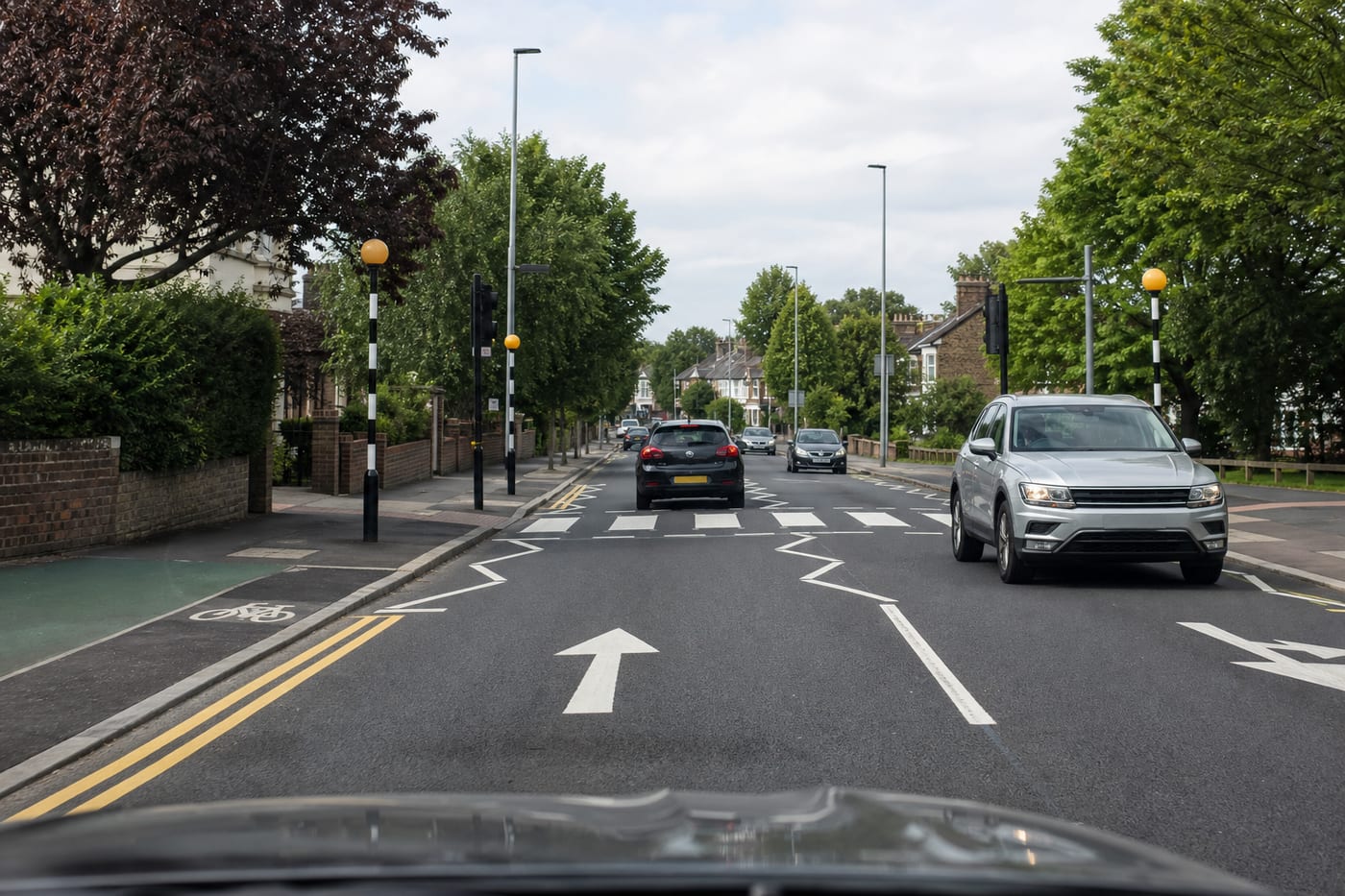
White zigzag lines appear on the approaches to zebra, pelican, puffin and other pedestrian crossings. They preserve visibility so drivers and pedestrians can see one another.
You must not park on the crossing or within the area covered by the zigzags. You must also obey the restrictions on overtaking near crossings, including not overtaking the vehicle nearest the crossing when it has stopped to give way.
Approach crossings with particular care. Look for pedestrians near the kerb, people emerging from behind parked vehicles and anyone who may need longer to cross. These are useful examples of how markings can help you identify developing road hazards.
Yellow zigzags are usually found outside schools. Their purpose is to keep the entrance clear and improve visibility. An accompanying sign shows when a stopping prohibition is legally in force. Even outside those times, stopping there could block sight lines and place children at risk.
Yellow box junctions
A yellow box is designed to keep a junction clear and prevent queuing traffic from blocking other routes.
You must not enter a box junction unless your exit road or lane is clear. Wait before the box until there is enough room for your vehicle to leave it completely.
There is an exception when you want to turn right. You may enter and wait in the box if your exit is clear but you are prevented from turning only by oncoming traffic or other vehicles waiting to turn right.
Look beyond the vehicle immediately ahead before entering. If traffic is slow, leave enough space rather than assuming it will continue moving.
Hatched areas and chevrons
White diagonal stripes or chevrons separate traffic lanes, protect turning traffic and provide space around hazards.
Where the area has a broken white border, you should not enter it unless it is necessary and you can see that doing so is safe. Where it has a solid white border, you must not enter except in an emergency.
Hatched areas are not convenient overtaking lanes or waiting spaces. They may be positioned where drivers need separation from opposing traffic or roadside hazards.
Bus lanes and cycle lanes
Bus lanes are usually separated from general traffic by a thick white line. Signs show their operating times and which vehicles may use them. If no times are shown, the restriction may operate continuously.
Do not enter an operating bus lane unless the signs permit your vehicle to use it. When it is not operating, other traffic may normally use it, but you must still check signs and look carefully for buses, cyclists and taxis where permitted.
Cycle lanes may have solid or broken white boundaries. You must not drive or park in a cycle lane marked by a solid white line during its period of operation. A broken boundary marks an advisory lane; avoid entering it unless necessary and safe.
Before crossing a cycle lane to turn, check your mirrors and blind spot and give way to cyclists travelling straight ahead where required. Never rely only on a brief mirror check.
Motorway markings and reflective studs
On motorways, white lines separate lanes while a solid white line marks the edge of the hard shoulder or carriageway. Motorway studs provide additional guidance, especially in darkness or poor visibility:
- White studs separate traffic lanes.
- Red studs mark the left edge of the carriageway.
- Amber studs mark the central reservation side.
- Green studs appear at slip roads and lay-bys.
- Green and yellow studs can indicate temporary lane layouts, such as at roadworks.
Use these colours to understand your position, but continue following signs, signals and temporary traffic management. Never use the hard shoulder as an ordinary traffic lane unless signs or signals specifically direct traffic to do so.
Words and symbols painted on the road
Road surfaces may carry warnings and instructions such as lane arrows, speed limit roundels and advance notice of hazards. A painted speed limit roundel reinforces the restriction shown by signs; it does not replace the need to identify the applicable limit correctly.
Markings such as SLOW warn you to assess an upcoming hazard. Adjust your speed according to visibility, traffic, weather and road layout rather than treating the word as a target speed instruction.
KEEP CLEAR markings ask drivers to avoid blocking an access point or part of a junction. Even where a marking is advisory, following it can prevent congestion and allow emergency or local access.
How to revise road markings effectively
Group markings by purpose instead of trying to memorise one long list. Useful categories include lane control, parking, junctions, pedestrian safety and motorway guidance.
Use photographs or video clips and ask three questions:
- What does the marking mean?
- Is it giving guidance or imposing a restriction?
- Is there a sign, signal or traffic condition that changes how I should respond?
During lessons, say the meaning of unfamiliar markings aloud when it is safe to do so. Connecting theory knowledge with real roads makes it easier to recall. You can also practise with challenging road sign and restriction questions before taking full mock tests.
Conclusion
UK road markings organise traffic, protect vulnerable road users and warn you about hazards ahead. Learn their shapes, colours and legal significance, but always consider nearby signs and the developing road situation as well.
The safest response is usually to observe early, choose the correct position and avoid last-second changes. That approach will support both your theory test preparation and your everyday driving.
Frequently asked questions
What is the difference between single and double yellow lines?
A single yellow line prohibits waiting during times shown on local signs or controlled-zone signs. Double yellow lines prohibit waiting at any time. Separate kerb marks indicate loading restrictions.
Can I cross a solid white centre line?
Only in limited circumstances allowed by the Highway Code and when it is safe, such as entering adjoining premises or passing certain slow-moving road users travelling at 10 mph or less. You may also pass a stationary vehicle where necessary and safe.
Can I enter a yellow box when turning right?
You may enter an ordinary box junction to turn right if your exit is clear and you are prevented from completing the turn only by oncoming traffic or other vehicles waiting to turn right.
Do painted road arrows have to be followed?
Lane arrows guide drivers into the appropriate position and may work with signs that set mandatory lane movements. Select your lane early and follow all associated signs. If changing lanes would be unsafe, continue in your current lane and adjust your route.