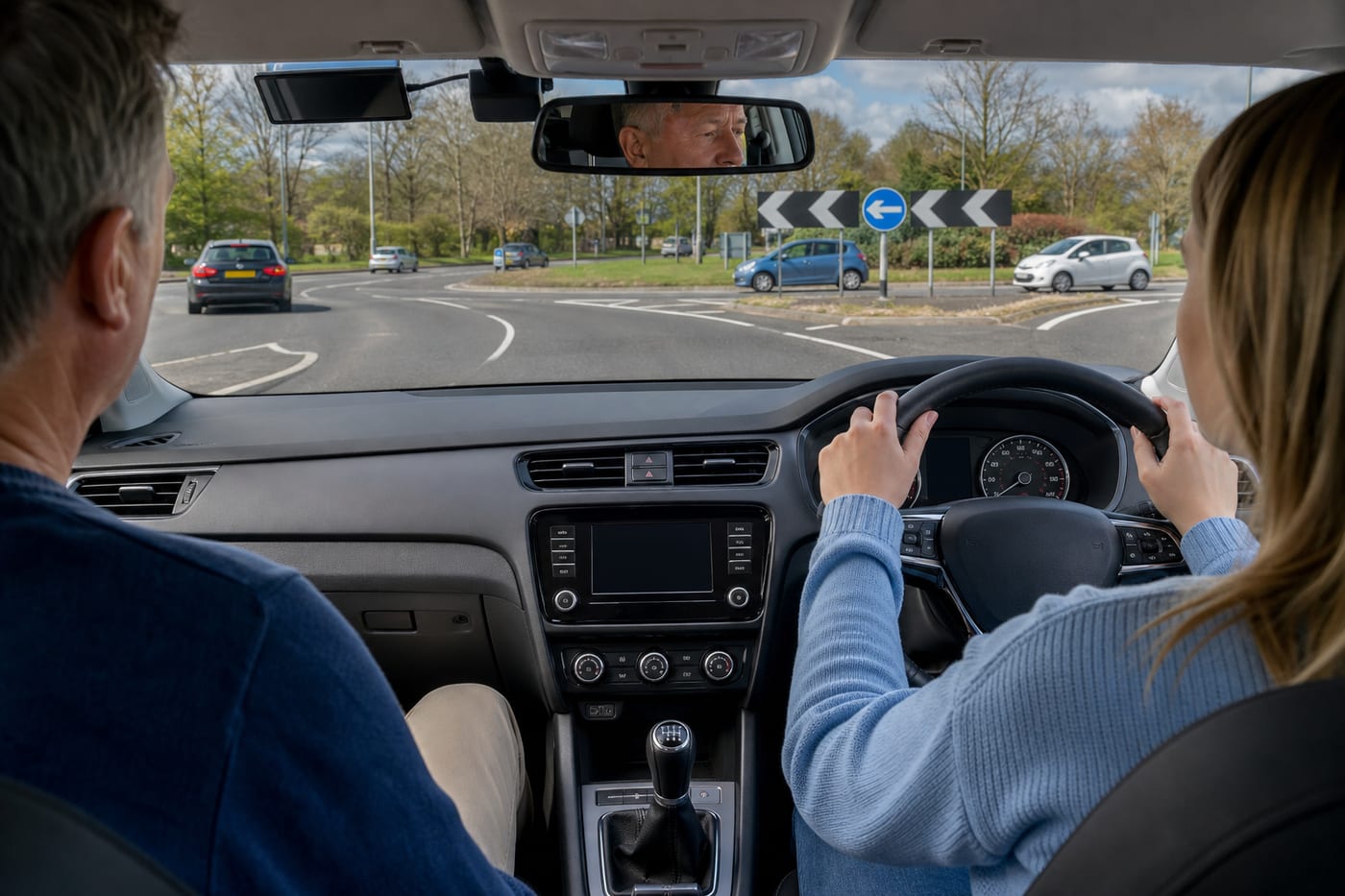
Roundabouts can feel intimidating when you are learning to drive. You may need to judge traffic, select a lane, control your speed, steer accurately and signal correctly within a few seconds. With a reliable routine, however, roundabouts become much easier to understand.
The key is to prepare early rather than make every decision at the give-way line. Look for signs and road markings, choose the correct lane, reduce your speed and assess the traffic before you arrive. This guide explains how to deal with UK roundabouts safely and confidently, from simple mini-roundabouts to busy multi-lane layouts.
What is a roundabout?
A roundabout is a junction where traffic usually travels clockwise around a central island. On approach, you should normally give priority to traffic coming from your right unless signs, road markings or traffic lights tell you otherwise.
Not all roundabouts look the same. You may encounter:
- Standard single-lane roundabouts
- Multi-lane roundabouts
- Mini-roundabouts marked by a painted central circle
- Traffic-light-controlled roundabouts
- Spiral or lane-guided roundabouts
- Double roundabouts, which must be treated as separate junctions
The layout may alter which lane you need, so avoid relying only on general rules such as “left lane for left and right lane for right”. Signs and markings for the particular junction take priority.
Use a consistent approach routine
Many instructors teach the mirrors, signal, position, speed and look routine. Applying these stages early gives you time to understand the junction without rushing.
Mirrors
Check your mirrors as you approach. You need to know whether another road user is close behind or alongside before changing speed, position or lane.
Your interior mirror is usually followed by the relevant door mirror. For example, check the left mirror before moving into a left lane and the right mirror before moving into a right lane.
Signal
Signal when it will help other road users understand what you intend to do. Avoid signalling so early that people could mistake your intention for turning into another road before the roundabout.
Your signal does not give you priority. You must still make effective observations and wait for a safe opportunity to enter.
Position
Select the appropriate lane in good time. Use direction signs, lane arrows and destination markings rather than changing lanes at the last moment. Our guide to UK road markings and what they mean can help you recognise the instructions used on more complicated approaches.
Speed
Reduce your speed progressively so that you can stop at the give-way line if necessary. The suitable speed depends on visibility, traffic, weather and the shape of the junction.
Approaching too quickly leaves little time to observe. Crawling unnecessarily towards a clear, open roundabout can also disrupt traffic, so aim for a controlled speed that lets you make a safe decision.
Look
Look to the right for circulating traffic, but do not stare in one direction. Check ahead, assess the route through the roundabout and look for pedestrians, cyclists, motorcyclists and vehicles changing lanes.
Poor visibility requires extra caution. Bushes, signs, buildings or the roundabout’s central island may hide approaching traffic.
Choosing the correct lane
Always follow signs and lane markings. When no specific instructions are provided, the usual approach is:
- Turning left: normally use the left lane.
- Turning right or going all the way around: normally use the right lane.
- Taking an intermediate exit: choose the appropriate lane for the exit, taking account of the signs, markings and layout.
On a simple two-lane roundabout, the left lane is often appropriate for going ahead, but this is not universal. Some junctions allocate the right lane to a particular straight-ahead destination, while others have lanes that spiral out towards different exits.
If you realise that you are in the wrong lane, do not cut across traffic or make a sudden correction. Follow the lane safely and take an alternative route where necessary. A wrong turn is safer than an unsafe lane change.
When to signal at a roundabout
Correct signals help drivers, cyclists and pedestrians predict where you are going.
Taking the first exit to the left
Signal left on approach and normally use the left lane, unless signs or markings direct you differently. Keep the signal on as you leave.
Taking an exit to the right or going all the way around
Signal right on approach and normally use the right lane, unless directed otherwise. Keep to the correct lane around the roundabout. After passing the exit immediately before yours, check your mirrors and signal left to leave.
Taking an intermediate exit
You do not normally need to signal on approach unless the signs or layout make your intention unclear. Stay in the appropriate lane. After passing the exit before the one you want, check your mirrors and signal left.
Timing matters. Signalling left too soon may suggest that you intend to take an earlier exit. Signalling too late gives others little warning.
Deciding when to enter
As you reach the roundabout, give priority to traffic approaching from your right unless signs, road markings or signals state otherwise. Enter only when you have a safe opportunity.
Try to assess both the position and speed of circulating vehicles. A vehicle may appear some distance away but still reach you quickly. Motorcycles can be particularly difficult to judge because of their smaller size.
Do not assume that a vehicle will leave because it is signalling. Its signal may be late, misleading or left on accidentally. Wait until its speed and position confirm the driver’s intention.
You should also avoid moving simply because the car in front has started to go. Make your own observation before crossing the give-way line. The available gap may close before it is your turn.
Driving around and leaving the roundabout
Once you enter, follow your lane at a controlled speed. Avoid driving over lane markings or drifting towards another vehicle.
Keep looking ahead while using your mirrors to monitor traffic around you. Pay particular attention to cyclists and motorcyclists, who may be harder to see and could be travelling alongside your car. Give cyclists plenty of room, as they may need to remain in the left-hand lane even when continuing around the roundabout.
Before leaving:
- Check the interior and left door mirrors.
- Signal left after passing the exit before yours.
- Watch for road users on your left.
- Follow your lane into the exit without cutting across others.
- Cancel the signal if it does not cancel automatically.
- Build speed smoothly when it is safe and legal.
Look for pedestrians near the exit, particularly where a crossing is provided. Your attention should not remain fixed on vehicles behind you while you approach someone crossing the road.
How to handle mini-roundabouts
Mini-roundabouts follow many of the same priority and signalling principles as standard roundabouts. Their small size means events happen more quickly, so approach slowly enough to observe properly.
Vehicles should pass around the central marking unless their size or the layout makes that physically impossible. Do not treat the painted circle as something you can casually drive straight over. Avoid making a U-turn at a mini-roundabout.
At some mini-roundabouts, vehicles arrive from several directions at almost the same time. Do not try to force your way through. Make eye contact where possible, keep observing and proceed only when you are satisfied that it is safe.
A double mini-roundabout should be treated as two separate roundabouts. Apply the observation and priority routine at each one rather than viewing the whole layout as a single junction.
Traffic lights and spiral roundabouts
At a signal-controlled roundabout, obey the traffic lights controlling your lane. A green light allows you to proceed only if the route ahead is clear; it is not permission to enter a blocked junction.
Spiral roundabouts use road markings to guide traffic gradually towards the correct exit. Choose the lane shown for your destination and follow it. You may not need to make a conventional lane change because the marked lane itself leads outwards.
Look well ahead for arrows and destination markings. If you are still building confidence with junction signs, revise how to improve your road sign knowledge before practising unfamiliar routes.
Common learner mistakes at roundabouts
Approaching too quickly
Excess speed reduces your observation time and may result in harsh braking at the give-way line. Slow down early and select a suitable gear before entering.
Looking only to the right
Traffic from the right is important, but hazards can appear ahead and to the left. These include pedestrians, cyclists, stopped traffic and vehicles using the wrong lane.
Hesitating when there is a safe opportunity
Caution is essential, but repeatedly missing clear gaps can inconvenience other road users. With your instructor, practise judging the speed and direction of circulating traffic rather than waiting for the roundabout to become completely empty.
Following another vehicle without checking
The driver ahead may have enough time to enter while you do not. Always make an independent decision.
Choosing a lane too late
Late lane changes create unnecessary risk. Read signs early, reduce distractions and position in good time.
Cutting across lanes when exiting
Follow the lane markings and check the left mirror before leaving. Never assume that another road user will move out of your way.
Trusting signals without supporting evidence
Treat another vehicle’s signal as useful information, not a guarantee. Confirm its intended path by watching its speed, wheels and road position.
Practical ways to improve
Begin with quiet, open roundabouts where you have good visibility. Once your observations, speed control and signalling become consistent, progress to busier and more complex layouts with your instructor.
Before moving off, ask yourself which exit you need and whether signs assign a particular lane. Saying the routine quietly can help: mirrors, signal, position, speed and look.
You can also study roundabouts as a passenger. Identify signs, predict which lane is required and watch for developing risks. This supports the observation skills covered in our guide to identifying road hazards.
If you take the wrong exit during a lesson or test, stay calm. Continue safely and follow new directions. The unsafe response—such as braking sharply or swerving across lanes—is much more serious than a navigational mistake.
Frequently asked questions
Who has priority at a UK roundabout?
You should normally give priority to traffic approaching from your right unless signs, road markings or traffic lights tell you otherwise. Never assume priority without checking the individual junction.
Which lane should I use for going straight ahead?
Use the lane indicated by signs and road markings. Where there are no specific instructions, the left lane is often appropriate, but the correct choice depends on the roundabout’s layout and the exit you need.
Should I stop at every roundabout?
No. You must be prepared to stop and should give way when required, but you may continue if the roundabout is clear and it is safe to enter. Your approach speed must allow enough time for proper observations.
What should I do if I miss my exit?
Stay calm and follow the lane safely. Depending on the layout, you may be able to continue around or take another exit and find a safe alternative route. Do not reverse, stop suddenly or cut across lanes.
Conclusion
Safe roundabout driving depends on early planning, correct positioning, controlled speed and effective observations. Follow signs and road markings, give priority where required and never rely solely on another driver’s signal.
With structured practice, the separate tasks begin to feel like one smooth routine. Prioritise safety over taking the perfect route, and roundabouts will become far more manageable in lessons, on your practical test and after you pass.