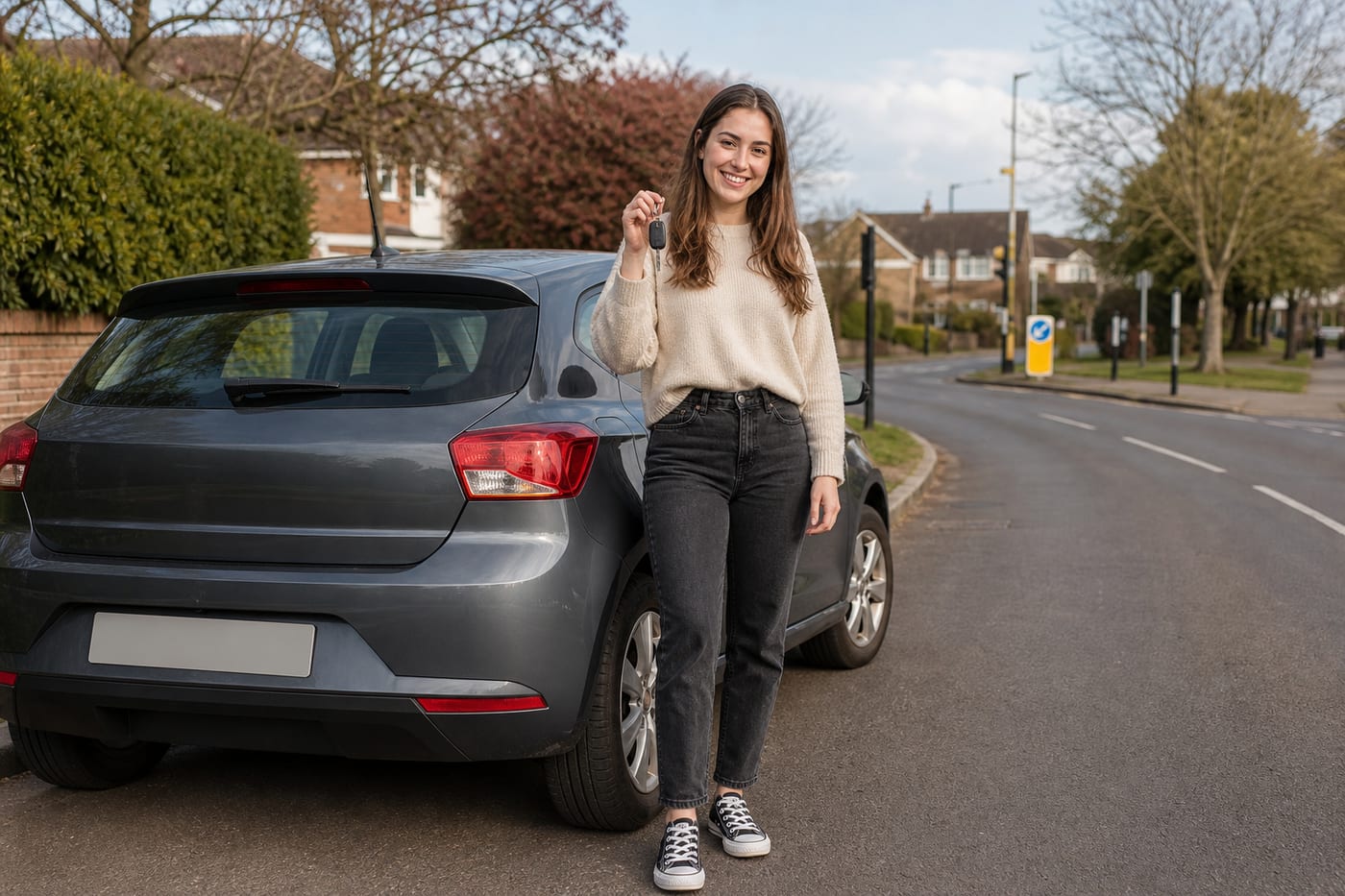
Passing your practical driving test is a major achievement, but it is also the beginning of learning to drive independently. Without an instructor beside you, every decision—from choosing a safe gap to dealing with poor weather—is yours.
Before setting off alone, make sure your licence, insurance and vehicle are all in order. It is also worth understanding the stricter consequences that apply to newly qualified drivers during their first two years.
This guide explains what to do after passing your UK driving test and how to build confidence safely.
What happens to your driving licence after you pass?
In most cases, the driving examiner will take your provisional photocard and arrange for the DVLA to send your full driving licence. You do not normally need to wait for the new photocard before driving, provided you have passed, are insured correctly and meet all other legal requirements.
Keep your driving test pass certificate safe until your full licence arrives. If it has not arrived within three weeks, contact the DVLA.
If the examiner cannot arrange your full licence—for example, because your details have changed—you may need to apply yourself using form D1. You must claim your full licence within two years of passing or you will normally have to take both tests again.
When the photocard arrives, check that your name, address, driving categories and personal details are correct. You must tell the DVLA when your address changes. Your driving licence also needs to be renewed when required, so take note of the photocard expiry date.
Update your insurance before driving alone
Do not assume that learner driver insurance will automatically cover you after passing. A provisional policy may end or change as soon as you qualify because you are now driving without supervision.
Contact your insurer before your first solo journey and tell them that you have passed. Give accurate information about:
- Your full licence status and test pass date
- Where the vehicle is kept overnight
- Your expected annual mileage
- Your occupation and how the car will be used
- Any modifications to the vehicle
- Other people who will drive the car
Giving incorrect information could invalidate the policy. Driving without valid insurance is illegal and can result in penalty points, a fine and the vehicle being seized.
New drivers often face higher premiums. Compare policies carefully rather than looking only at the price. Check the excess, permitted use, mileage restrictions and whether a telematics or black-box policy has conditions covering speed, journey times or driving style.
Understand the six-point new driver rule
Newly qualified drivers face special consequences under the Road Traffic (New Drivers) Act 1995. In Great Britain, if you accumulate six or more penalty points within two years of passing your first driving test, your licence can be revoked.
Revocation is not the same as a temporary driving ban. You will have to apply for a new provisional licence and pass both the theory and practical tests again before regaining a full licence.
Penalty points received while you held a provisional licence can remain relevant after you pass. If you already have points, take particular care to understand how further offences could affect your new licence.
Common offences that may lead to points include:
- Speeding
- Using a hand-held mobile phone while driving
- Driving without valid insurance
- Failing to comply with traffic signs or signals
- Careless or inconsiderate driving
- Driving a vehicle with defective tyres
The safest approach is simple: treat speed limits, signs and vehicle rules as essential requirements rather than targets or suggestions.
Make sure your vehicle is legal and roadworthy
Whether you own a car or borrow one, the driver is responsible for ensuring it is safe to use. Before driving, confirm that the vehicle has valid insurance, vehicle tax and an MOT where required.
Vehicle tax does not transfer when a car is sold. If you buy a used car, you must tax it before driving it on public roads. You should also check its MOT history and arrange insurance in advance.
Carry out regular basic checks, including:
- Tyre pressure, tread and visible damage
- Engine oil and coolant levels
- Windscreen washer fluid
- Headlights, brake lights and indicators
- Windscreen and wiper condition
- Mirrors and number plates
- Warning lights on the dashboard
The legal minimum tyre tread depth for most cars is 1.6mm across the central three-quarters of the tyre and around its entire circumference. Do not wait until tyres reach the legal limit if their condition is causing concern.
Learn how your particular car operates before entering busy traffic. Adjust the seat, head restraint and mirrors, and find the controls for the lights, demisters, wipers and hazard warning lights.
Consider displaying green P plates
Green P plates are optional in England, Scotland and Wales. They show other road users that you have recently passed, although they do not give you extra legal priority or change the rules you must follow.
You can use P plates for as long as you find them helpful. They may encourage some drivers to allow more space, but you should never depend on this. Continue to make safe observations and decisions.
Rules for newly qualified drivers differ in Northern Ireland, where restricted drivers must display R plates and follow the applicable restrictions. Check the current official requirements for the part of the UK in which your licence was issued.
Plan your first solo journeys carefully
Your first drive without an instructor can feel unusually quiet. Start with a familiar route at a quieter time of day rather than immediately attempting a congested city centre or complicated motorway journey.
Before leaving:
- Set the seat, mirrors and steering position.
- Put your phone away or set navigation before moving.
- Check the route and likely parking arrangements.
- Allow enough time so that you do not feel rushed.
- Remove loose items that could move around the cabin.
Avoid filling the car with friends on your first few journeys. Passengers can be distracting, particularly if they are noisy or encourage you to take risks. As the driver, you decide how the vehicle is driven.
If you make a wrong turn, continue safely and find somewhere suitable to change direction. Sudden lane changes are far more dangerous than arriving a few minutes late.
Driving on motorways after passing
Once you hold a full licence and have valid insurance, you can drive on motorways. However, a first motorway trip can be demanding because of higher speeds, joining traffic and changing lanes.
Consider practising with an approved driving instructor or an experienced, calm driver. Choose good weather and quieter traffic if possible.
Remember to use the left-hand lane unless overtaking or following signs for a different route. Check mirrors regularly, leave a safe following distance and plan lane changes early. Never stop on a motorway unless there is an emergency or you are directed to do so.
If you feel tired, leave at the next suitable exit or service area and take a proper break. Our holiday road trip safety tips provide additional advice on longer journeys, rest breaks and vehicle preparation.
Avoid distractions and impairment
Using a hand-held mobile phone while driving is illegal, including when you are stationary in traffic. The rules also cover using the device for functions such as messaging, taking photographs or choosing music.
A hands-free device can still distract you. Set up navigation and music before moving, keep conversations brief and stop somewhere safe if a task needs your attention.
Never drive while impaired by alcohol or drugs. Alcohol limits differ in Scotland from those in England, Wales and Northern Ireland, and it is difficult to judge how long alcohol remains in your body. The safest option is not to drink at all when you plan to drive, including early the next morning.
Tiredness, some medicines and medical conditions can also affect driving. Read medicine warnings and seek professional advice if you are unsure. Certain conditions must be reported to the DVLA; our guide to medical conditions you must disclose to the DVLA explains the key responsibilities.
Keep improving after your test
Passing proves that you met the required standard on the day. It does not mean that you have experienced every road, weather or traffic situation.
Consider additional professional tuition for areas such as motorways, rural roads, night driving or parking. Pass Plus is a voluntary practical training course intended to develop driving experience after the test, although availability and any insurance benefit can vary.
Build experience gradually. Practise in rain, darkness and heavier traffic only when you feel ready, and avoid combining several unfamiliar challenges at once. Before colder months, review this festive winter driving advice for guidance on darkness, ice, snow and seasonal vehicle checks.
Good drivers continue using the routines learned during lessons. Check mirrors before changing speed or direction, maintain a safe gap and keep scanning well beyond the vehicle in front. If another driver behaves aggressively, do not respond or compete. Create space and let them go.
Keep essential records up to date
Your responsibilities continue throughout your driving life. Tell your insurer about relevant changes and update the DVLA when required. Depending on your circumstances, this may include changes to your address, name or a notifiable medical condition.
If you receive official correspondence about your vehicle, licence or an alleged offence, do not ignore it. Respond within the stated deadline and seek appropriate advice if you do not understand what is required.
You should also know when your MOT, insurance and tax are due. Setting calendar reminders can help prevent an accidental lapse.
Frequently asked questions
Can I drive immediately after passing my practical test?
Yes. You can normally drive straight away without waiting for your full photocard, provided the vehicle is roadworthy, you are properly insured as a full licence holder and you meet all other legal requirements. Keep your pass certificate until your full licence arrives.
Do I have to display P plates after passing?
Green P plates are optional in England, Scotland and Wales. You may display them for as long as you find them useful. Northern Ireland has separate requirements for restricted drivers, including compulsory R plates.
What happens if I get six penalty points in my first two years?
Under the new driver rules in Great Britain, your licence can be revoked if you accumulate six or more points within two years of passing your first test. You would need to obtain another provisional licence and pass the theory and practical tests again.
Can I drive someone else’s car after passing?
Only if you are correctly insured to drive that specific vehicle and have the owner’s permission. Do not assume your own policy automatically covers other cars, as many policies do not include this benefit, especially for younger or newly qualified drivers.
Conclusion
Your first months as a full licence holder are an opportunity to turn test skills into safe, consistent habits. Check your insurance and licence details, understand the six-point rule, keep the vehicle roadworthy and build experience gradually.
There is no need to prove yourself by driving faster or attempting difficult journeys too soon. Calm decisions, good observation and careful planning will help you become a safer and more confident driver.