Roundabouts come in several forms, from a small painted circle on a residential street to a large junction controlled by traffic lights. Although the basic principles are similar, each design requires you to interpret signs, road markings, lanes and surrounding traffic carefully.
For learner drivers, recognising the type of roundabout early makes the junction much easier to manage. It gives you more time to select a lane, adjust your speed, make effective observations and signal correctly.
This overview explains the main types of UK roundabout, how they differ and what you should do when approaching them.
Rules that apply to most roundabouts
Before looking at individual designs, it helps to understand the routine used at most roundabouts.
As you approach, check your mirrors, read the direction signs and look for lane arrows or destination markings. Reduce your speed early enough to enter the junction under control. Choose the appropriate lane and avoid changing position suddenly.
At the give-way line, you will normally need to give priority to traffic approaching from your right. However, signs, road markings or traffic signals may alter the usual arrangement, so never rely on the general rule without checking the junction itself.
You should also watch for cyclists, motorcyclists and horse riders. They may remain in the left-hand lane while travelling further around the roundabout, and they can be harder to see than larger vehicles. Give them time and space rather than trying to pass closely.
The usual signalling approach is:
- Turning left: signal left on approach and keep to the left, unless signs or markings direct otherwise.
- Turning right or going all the way around: signal right on approach, use the appropriate lane, then signal left after passing the exit before yours.
- Taking an intermediate exit: normally select the suitable lane without signalling on approach, unless signs, markings or the layout suggest otherwise. Signal left after passing the exit before the one you want.
These are general principles rather than substitutes for reading the road. Our complete guide to using roundabouts covers the full approach, entry and exit routine in more detail.
Standard single-lane roundabouts
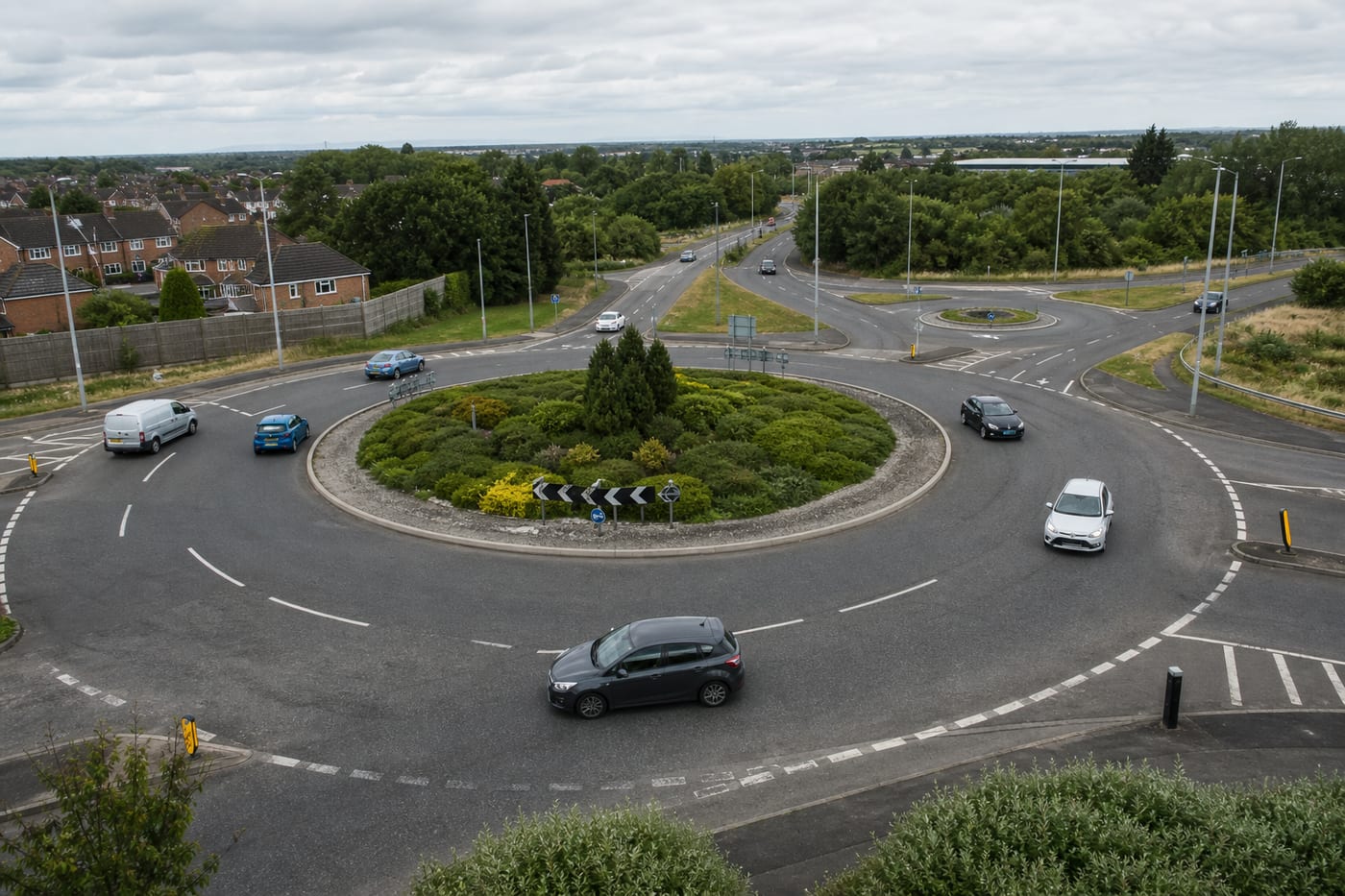
A standard single-lane roundabout has one circulating lane and usually a raised central island. You may find this type at the meeting point of local roads or on quieter main roads.
Because there is only one circulating lane, lane selection is relatively simple. You still need to position correctly on approach, follow any road markings and give priority where required.
Do not assume that a single-lane roundabout is risk-free. Vehicles may enter without looking, take an unexpected exit or fail to signal. Keep your speed low enough to respond if another road user makes a mistake.
When leaving, check your left mirror and signal left at the appropriate time. Pay particular attention to cyclists who may be continuing around near the outside edge.
Conventional multi-lane roundabouts
Larger roundabouts often have two or more approach and circulating lanes. These allow traffic heading in different directions to use the junction at the same time, but they demand earlier planning.
Direction signs before the roundabout may show the exits and route numbers. Lane arrows, destination names or route numbers painted on the road then help you choose a lane.
As a general guide, the left lane is commonly used for a left turn, while a right-hand lane is normally appropriate when turning right. For an intermediate exit, the correct lane depends on the signs and markings at that particular junction.
Once you have selected a lane, follow it around without drifting across lane lines. Check mirrors and blind spots before moving into another lane, and do not cut across traffic to reach an exit. If you cannot leave safely, continue around where the layout allows or follow your lane to a safe route and find somewhere suitable to turn around later.
Understanding UK road markings and lane arrows can make these junctions far less intimidating.
Mini-roundabouts
A mini-roundabout is identified by a circular white marking in the centre and a blue circular sign with white arrows. It is often used where there is not enough space for a conventional raised central island.
You should approach slowly and give way as directed, normally to traffic from the right. All vehicles must pass around the central marking, except large vehicles that are physically incapable of doing so. You should not simply drive over it because the road appears clear.
Mini-roundabouts leave little time between observation, decision and entry. Look at every arm of the junction and be prepared for another driver to misjudge your intentions.
Avoid making a U-turn at a mini-roundabout. Its restricted size makes the manoeuvre difficult and potentially dangerous. If you need to change direction, continue ahead and find a safer place.
Signalling should be clear but practical. On a very small roundabout, there may be little time to change from a right signal to a left signal before leaving. Maintaining control and making effective observations remain essential.
Double mini-roundabouts
A double mini-roundabout consists of two mini-roundabouts close together. They may appear complicated at first because several roads meet within a small area.
Treat each mini-roundabout as a separate junction. After negotiating the first, reassess the second and give way again where required. Do not assume that entering the first roundabout automatically gives you priority through the whole layout.
Keep your speed particularly low. A vehicle waiting at the second roundabout may block your route, while traffic can appear from directions that are not immediately obvious. Avoid entering unless there is enough space to proceed without obstructing another part of the junction.
Signal-controlled roundabouts
Some busy roundabouts use traffic lights to control one or more entry points or sections of the circulating carriageway. These signals regulate when you may proceed and can create gaps for traffic joining from heavily used roads.
Obey the lights and stop at the correct stop line when required. Once the signal turns green, continue to follow the lane arrows and road markings. A green light allows you to proceed, but it does not remove the need to watch for pedestrians, cyclists, blocked exits or vehicles still clearing the junction.
There may be another set of signals after you enter the roundabout. Look well ahead and avoid accelerating simply because the first light was green. If traffic is queuing beyond the stop line, make sure you can move forward without blocking the junction.
Spiral roundabouts
Spiral roundabouts use lane markings that guide traffic gradually towards the outside as it approaches an exit. They are often found at larger, busier junctions where clearly defined lanes can reduce last-second weaving.
The key is to choose the correct lane before entering. Follow the destination or route number marked in your lane and allow the spiral markings to guide your position. You should not need to force your way across several lanes immediately before your exit.
Keep checking your mirrors because other drivers may drift between lanes or realise too late that they have chosen the wrong one. If your lane takes you somewhere unexpected, follow it safely rather than making a sudden correction.
Some layouts described informally as turbo roundabouts also use strongly separated or guided lanes. Whatever name is used locally, the signs and markings tell you how to proceed.
Ring junctions and linked roundabout systems
A ring junction consists of several smaller roundabouts arranged around a larger central area. The best-known examples are sometimes called “magic roundabouts”, although that is not a formal description of every such junction.
These systems can look confusing on a map, but they are negotiated as a sequence of individual junctions. Plan your route from the advance signs, slow down and deal with one give-way line at a time.
Do not try to understand every traffic movement at once. Concentrate on the next roundabout, the traffic relevant to it and the lane needed for your route. Staying calm and proceeding methodically is safer than rushing because another driver is waiting behind you.
Grade-separated roundabouts
At some major junctions, a main road passes over or beneath a roundabout. Slip roads connect the main route to the roundabout, allowing through traffic to avoid the circulating junction.
If you are leaving the main road, reduce speed on the slip road and look for signs showing the correct lane and exit. The roundabout itself may be multi-lane or signal-controlled, so be ready for a significant change in speed and road layout.
When joining a faster road from the roundabout, use the slip road to build an appropriate speed and merge only when there is a safe gap. Never assume another driver must move over to let you join.
Compact and unusual roundabout layouts
Not every junction fits neatly into one category. You may encounter roundabouts with more than four exits, offset entries, partially signal-controlled sections, dedicated left-turn lanes or roads passing through the central area.
A dedicated left-turn lane may bypass the circulating carriageway entirely. Follow its own signs, markings, crossings and give-way instructions rather than applying the rules for the main roundabout automatically.
On any unfamiliar layout, your priorities should be to:
- Read advance direction signs as early as possible.
- Reduce speed without braking suddenly.
- Choose a lane from the signs and road markings.
- Observe traffic, cyclists and pedestrians carefully.
- Follow your lane rather than making a risky correction.
- Signal in good time before leaving where appropriate.
Knowledge of sign shapes and symbols is equally important. You can strengthen this area with these road sign revision techniques.
Common learner mistakes at different roundabouts
One common error is concentrating entirely on traffic from the right. Although this is important, you must also look ahead for queues and left for cyclists, pedestrians or vehicles positioned alongside you.
Other frequent problems include approaching too quickly, choosing a lane too late, entering when the available gap is too small and failing to signal left before leaving. On multi-lane roundabouts, learners may also steer across lane markings instead of following the curve of their chosen lane.
Practise identifying the roundabout type before you reach it. Say the process quietly to yourself if it helps: signs, mirrors, speed, lane, observations and decision. With experience, this becomes a natural routine rather than a rushed series of separate tasks.
Conclusion
UK roundabouts range from simple painted mini-roundabouts to large signal-controlled and spiral layouts. The safest approach is not to memorise one rigid routine, but to combine the general rules with the signs, signals and markings at each junction.
Plan early, approach at a controlled speed and never make a sudden lane change simply to avoid missing an exit. A wrong turn is inconvenient; an unsafe correction can put several road users at risk.
Frequently asked questions
Do you always give way to traffic from the right at a roundabout?
You normally give priority to traffic approaching from your right, unless signs, road markings or traffic signals indicate otherwise. Always assess the specific junction rather than relying on the general rule alone.
Can you drive over the centre of a mini-roundabout?
You must pass around the central marking unless your vehicle is physically incapable of doing so. The fact that the centre is painted rather than raised does not mean car drivers may cut across it.
Which lane should you use for going straight ahead?
There is no single answer for every roundabout. Follow advance signs, lane arrows and destination markings. Where there are no specific instructions, use the layout and general roundabout guidance to select a suitable lane without obstructing other traffic.
What should you do if you are in the wrong lane?
Follow your lane safely. Do not cut across another vehicle, stop unexpectedly or force your way towards an exit. Continue along the permitted route and find a safe place to correct your journey afterwards.