Pedestrian crossings are designed to help people cross roads safely, but each type has different signals, markings and rules. As a learner driver, you need to recognise these crossings early, understand who may use them and know when you must stop.
Crossings are also common locations for developing hazards. A pedestrian may approach quickly, a cyclist may emerge from behind an obstruction or traffic ahead may stop unexpectedly. This guide explains the main types of pedestrian crossing in the UK and how to deal with them safely in your theory and practical tests.
Why recognising crossings matters
Your first task is to identify a crossing early enough to respond smoothly. Look for traffic lights, flashing beacons, push-button units, zigzag lines, tactile paving and people waiting near the kerb.
Never focus only on the crossing itself. Check pavements on both sides, entrances to nearby shops, parked vehicles and traffic behind you. Children, older people and disabled pedestrians may need extra time, while someone looking at a phone may step out without checking properly.
Crossings should therefore be treated as potential hazards even when they appear empty. Understanding how to identify road hazards early will help you anticipate when a pedestrian’s movement is likely to require action.
Zebra crossings
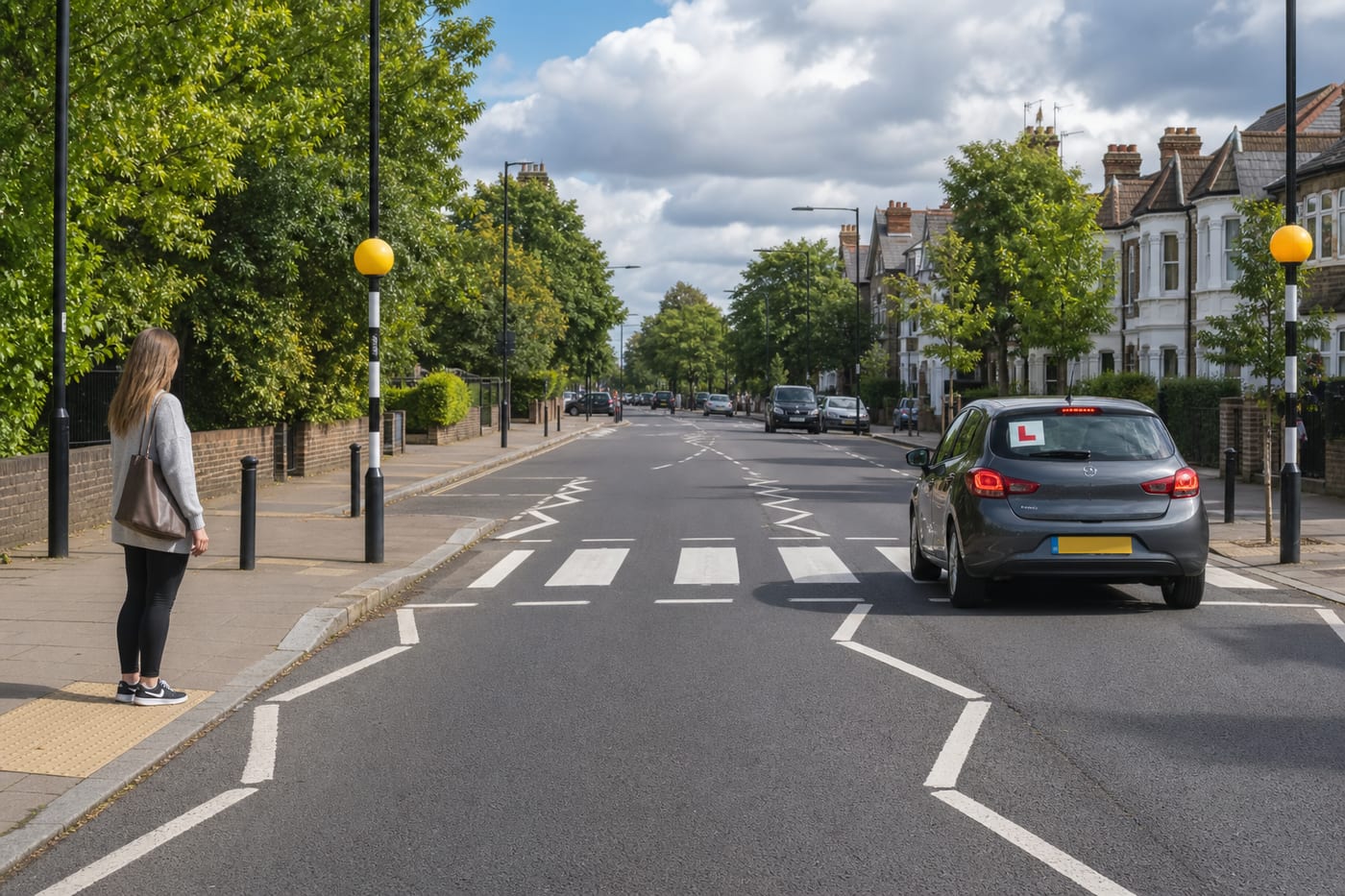
A zebra crossing has alternating black and white stripes across the road. It is normally marked by flashing amber Belisha beacons and zigzag lines on each approach. Unlike signal-controlled crossings, it does not use red and green traffic lights to control vehicles.
You should approach at a speed that allows you to stop safely. Look carefully for pedestrians near either end of the crossing, particularly anyone who appears ready to step onto it.
You should give way to pedestrians waiting to cross. You must give way when a pedestrian has moved onto the crossing. Do not sound your horn or try to hurry them, and do not move until they have cleared your path safely.
If a zebra crossing has a central island, each side is treated as a separate crossing. However, you should still remain cautious because a pedestrian may continue without pausing or may misunderstand what approaching traffic intends to do.
Some locations have parallel crossings. These place a cycle crossing beside a zebra crossing, allowing cyclists to ride across on their marked section. Drivers should approach with particular care because cyclists may reach the crossing faster than pedestrians.
Pelican crossings
A pelican crossing is controlled by traffic lights and is intended for pedestrians. Pedestrians usually press a button and wait for the green figure displayed on the opposite side of the road.
For drivers, the normal red, red-and-amber, green and amber light sequence applies, with one important difference: pelican crossings have a flashing amber phase.
At a steady amber light, you must stop unless you have already crossed the stop line or are so close that stopping could cause a collision. At a flashing amber light, you must give way to any pedestrian still on the crossing. If the crossing is completely clear, you may proceed carefully.
Do not move simply because another vehicle begins moving. Check the whole crossing yourself, including areas hidden by vans, buses or queuing traffic.
Puffin crossings
Puffin crossings are also controlled by traffic lights, but they work differently from pelican crossings. The pedestrian signals are normally positioned on the same side of the road as the person waiting, rather than across the carriageway.
Sensors detect whether someone is waiting and may also monitor pedestrians while they cross. This can help the crossing operate according to whether people are still using it.
For drivers, a key identifying feature is that puffin crossings do not have the flashing amber phase used at pelican crossings. You follow the standard traffic-light sequence and wait for the appropriate signal before moving.
Even when your light turns green, check that nobody remains in the road. A green light gives permission to proceed only when the route is clear and it is safe to do so.
Toucan crossings
A toucan crossing is designed for both pedestrians and cyclists—the name is often remembered as “two can cross”. Cyclists may ride across rather than having to dismount and push their cycles.
You may see red and green pedestrian and cycle symbols on the signal units. Toucan crossings are often found where cycle routes meet busy roads.
Because cyclists travel faster than pedestrians, scan cycle paths and nearby pavements well before reaching the stop line. A cyclist who appears some distance away can arrive at the crossing quickly.
Drivers must obey the traffic signals and remain behind the stop line while the light is red. When the light changes, make sure the crossing is clear before proceeding. Be especially careful if turning across a toucan crossing, as people crossing may be less visible in your mirrors or windscreen pillars.
Equestrian crossings
Equestrian crossings—sometimes called horse crossings or Pegasus crossings—are designed for horse riders as well as pedestrians. They can have higher-mounted push buttons so riders can operate them without dismounting, and their signal displays may include horse symbols.
Treat horses with patience. Avoid revving your engine, sounding the horn or passing too closely. Horses can be startled by sudden noise or movement, even if they appear calm.
Wait behind the stop line while the signals require you to stop. After the signal changes, allow the horse and rider to clear the crossing fully before moving away gently.
School crossing patrols
A school crossing patrol is not a permanent crossing type in the same sense as a zebra or puffin crossing, but it carries an important legal instruction.
A patrol officer displays a circular stop sign when entering the road to help children and other pedestrians cross. Drivers must stop when shown this sign and remain stopped until the patrol has returned to the pavement and it is safe to continue.
Reduce your speed near schools and expect unpredictable movement. Children may run, change direction or emerge from between parked cars. Never wave a child across unless you are certain the whole road is safe; another vehicle may be approaching from a direction the child cannot see.
Pedestrian refuges and informal crossings
A pedestrian refuge usually consists of a central traffic island where people can wait between traffic streams. It may have bollards and dropped kerbs, but it does not necessarily give pedestrians the same priority as a zebra or signal-controlled crossing.
Nevertheless, drivers must remain prepared to slow down or stop. Someone may misjudge a gap, step beyond the island or have difficulty judging your speed.
You may also encounter dropped kerbs, raised tables or paving that suggests a common crossing point without being a formal marked crossing. Treat these areas cautiously, particularly near junctions. Under the Highway Code, drivers should give way to pedestrians crossing or waiting to cross a road into which or from which the driver is turning.
Zigzag markings and prohibited behaviour
White zigzag lines protect the approaches and exits of zebra and signal-controlled crossings. They improve visibility and reduce the risk of pedestrians being hidden by parked or overtaking vehicles.
You must not park on the crossing or in the area covered by the zigzag lines. You must also not overtake the moving vehicle nearest the crossing, or a vehicle that has stopped nearest to the crossing to give way to pedestrians.
These restrictions matter because a stopped vehicle may be concealing someone in the road. The markings are among the key features covered in this complete guide to UK road markings.
A safe routine for approaching any crossing
Use a consistent approach every time:
- Identify the crossing early. Look for beacons, signal poles, zigzag markings, islands and waiting pedestrians.
- Check your mirrors. Know what is behind you before changing speed, but do not avoid necessary braking merely because another vehicle is close.
- Ease off the accelerator. Adjust your speed early rather than braking harshly at the last moment.
- Scan both sides. Look for pedestrians, cyclists and horse riders approaching from either direction.
- Obey signals and priority rules. Stop smoothly before the line where required.
- Wait patiently. Give people enough time and space to finish crossing.
- Check again before moving. Make sure the crossing and your route beyond it are clear.
Leave enough space behind the vehicle ahead. If it stops for a pedestrian, a safe following distance gives you more time to react. Our guide to maintaining proper stopping distances explains how speed, weather and road conditions affect the space you need.
Common learner-driver mistakes
One frequent mistake is approaching a zebra crossing too quickly because nobody is yet on the stripes. A person waiting at the kerb may step out, so reduce speed and be ready to give way.
Another error is moving as soon as a traffic light turns green. Always check that the crossing is clear first, especially if an older person, child or disabled pedestrian needs more time.
Learners may also concentrate on the person directly ahead and miss someone approaching from the opposite side. Keep scanning the entire width of the road.
Finally, do not gesture impatiently, edge forward or rev the engine. This can pressure or confuse pedestrians. Calm, predictable driving is safer and demonstrates good judgement during a practical test.
FAQ
Do pedestrians always have priority at a zebra crossing?
Drivers should give way to pedestrians waiting to cross and must give way once a pedestrian has moved onto the crossing. Approach slowly enough to stop safely and never pressure someone to hurry.
What is the difference between pelican and puffin crossings?
A pelican crossing has pedestrian signals on the opposite side of the road and includes a flashing amber phase for drivers. Puffin crossings generally use near-side pedestrian signals and sensors, and they do not have a flashing amber phase.
Can cyclists ride across every pedestrian crossing?
No. Cyclists can ride across toucan crossings and the cycle section of parallel crossings. At a pedestrian-only crossing, they should not assume they can ride across with pedestrian priority.
What should I do if my light turns green while someone is still crossing?
Wait until the person has safely cleared your path. A green signal does not mean you should drive into an occupied crossing. Check carefully, then proceed only when it is safe.
Conclusion
Recognising UK pedestrian crossings is about more than memorising names. You must identify who may use each crossing, understand its lights or markings and anticipate vulnerable road users before they enter your path.
Approach every crossing at a controlled speed, scan both sides and never move until the route is genuinely clear. That routine will help you answer theory test questions correctly and make safer decisions during lessons, your practical test and everyday driving.