T-junctions are among the most common situations you will meet during driving lessons, the practical test and everyday journeys. Although the layout appears simple, dealing with one safely requires several skills at once: reading signs and markings, controlling your speed, observing in both directions and judging when it is safe to proceed.
The correct approach is never simply to reach the line, look quickly and go. You need a planned routine that gives you enough time to identify hazards and respond without rushing. This guide explains how to approach and use UK T-junctions confidently, whether you are emerging onto a main road or turning into a side road.
What is a T-junction?
A T-junction is where one road ends as it meets another, forming a shape similar to the letter T. You may approach along the road that ends and turn left or right, or travel on the continuing road and turn into the side road.
T-junctions vary considerably. Some provide a wide, clear view in both directions. Others are restricted by parked vehicles, buildings, hedges, bends or the brow of a hill. Signs, traffic lights and road markings may control the junction, while some minor junctions have few obvious instructions.
Never treat two T-junctions as identical. Your speed, observations and final decision must reflect the view and conditions at the junction in front of you.
Who has priority at a T-junction?
When emerging from a road that ends, you will normally need to give way to traffic on the road you are joining. Look for signs and road markings confirming what you must do.
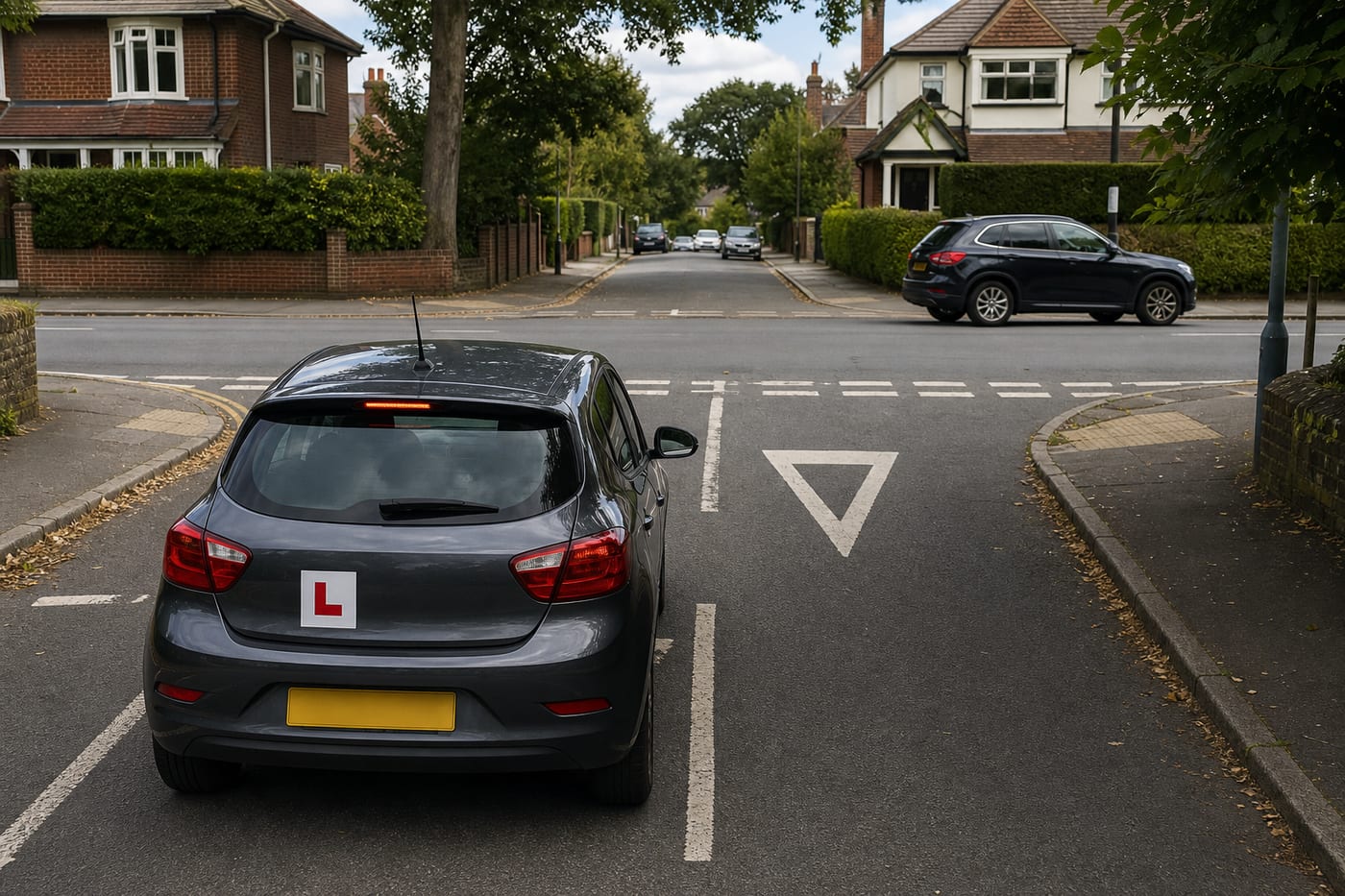
A broken double white line across your lane indicates that you must give way. An inverted triangular road marking may also warn you of the junction. You do not always have to stop at a give-way line, but you must slow sufficiently and only continue if you can do so safely without causing traffic on the other road to change speed or direction.
A solid white line accompanied by a stop sign means you must stop behind the line, even if the road appears clear. After stopping, make effective observations before moving.
At an unusual or unmarked junction, reduce your speed and do not assume that another road user will give way. Look at the road layout, signs and markings, and be prepared to stop. The safest decision is more important than trying to claim priority. For a wider explanation, see our guide to UK right of way rules at junctions.
Remember that priority does not guarantee safety. A driver on the main road could be speeding, signalling incorrectly or hidden from view. Always confirm that the road is safe before proceeding.
Use the mirror–signal–position–speed–look routine
A consistent routine helps you process a T-junction in manageable stages. Many instructors teach mirror–signal–position–speed–look, often shortened to MSPSL.
Mirrors
Check your mirrors early enough to understand what is behind and around you. Normally, this means checking the interior mirror followed by the relevant side mirror for the direction you intend to turn.
This information may affect how gradually you slow down. It could also reveal a cyclist, motorcyclist or vehicle attempting to pass. A mirror check should inform your actions rather than becoming a mechanical glance.
Signal
Signal left or right when it will help other road users understand your intentions. Give the signal in good time, but not so early that it could be mistaken for a different turning.
A signal does not give you priority or remove the need for observation. Keep monitoring the junction, especially if another road user may act on your signal.
Position
For a left turn, maintain an appropriate position towards the left without getting dangerously close to the kerb. Watch for cyclists on your nearside and avoid squeezing them.
For a right turn, position closer to the centre of your side of the road where appropriate, while remaining on your side. Do not cut the corner when you turn, as this could place you in the path of an approaching vehicle.
Speed
Reduce your speed early and progressively. Your aim is to reach the junction at a speed that matches your available view and allows you to stop smoothly if necessary.
In a manual car, select a suitable gear once you have reduced your speed. Avoid coasting with the clutch held down because this reduces control. If you are still developing this skill, our guide to smooth and safe manual gear changes explains how to coordinate braking, gears and clutch control around junctions.
Look
Look in both directions before emerging. A useful pattern is right, left, right, because vehicles approaching from your right will generally reach your side of the road first when you turn left. However, this is not a substitute for continuing observations.
Check repeatedly while waiting and immediately before moving. Look for vehicles, cyclists, motorcyclists, pedestrians and horse riders, not just cars. Also assess how quickly they are approaching.
Open and closed T-junctions
An open junction gives you a useful view of the adjoining road before you reach the give-way line. You may be able to continue at a very low speed if the road is clearly safe and the markings do not require you to stop.
A closed junction has a restricted view, perhaps because of walls, buildings, vegetation or parked vehicles. You are likely to need to stop before making further observations.
At a closed junction, move forward very slowly using careful clutch control in a manual car or controlled use of the brake in an automatic. This is sometimes described as “creep and peep”. Move only far enough to improve your view, checking that the front of your car is not entering the path of traffic.
Do not rely on sound alone. Quiet electric vehicles, bicycles and road noise can make an audio-only judgement unreliable.
Judging a safe gap
A safe gap must give you enough time to enter the new road, straighten the car and accelerate to a suitable speed without forcing anyone else to brake, swerve or slow noticeably.
Consider:
- the speed and distance of approaching traffic
- whether you are turning left or crossing traffic to turn right
- your car’s acceleration
- the width and condition of the road
- pedestrians or cyclists near your intended path
- weather, visibility and surface conditions
- vehicles hidden by bends, hills or obstructions
Turning right usually requires a larger gap because you must cross the path of traffic from your right before joining the correct side of the road.
Be cautious without becoming unnecessarily hesitant. Missing a safe opportunity is not automatically dangerous, but prolonged hesitation can confuse following drivers. Build gap judgement gradually with your instructor rather than allowing pressure from behind to determine your decision.
Pedestrians and cyclists at T-junctions
Before turning, check for pedestrians crossing or waiting to cross the road into which or from which you are turning. The Highway Code says you should give way to them. If someone has already begun crossing, allow them to finish safely.
Take particular care around children, older people and anyone who may need more time. A pedestrian could be hidden behind a parked van or appear from between stationary vehicles.
You should also avoid cutting across cyclists, horse riders or horse-drawn vehicles travelling ahead when turning into or out of a junction. They may be continuing straight on and could be positioned close to the kerb. Check mirrors and blind spots as necessary, then wait rather than trying to turn across their path.
This is a good example of why junctions are developing hazards. Learning to identify road hazards early will improve both your everyday driving and hazard perception skills.
Turning into a side road
A T-junction also needs careful handling when you are on the main road and turning into the side road.
Use your mirrors and signal in good time, then reduce your speed before the turn. Check the entrance for pedestrians, cyclists, parked vehicles and traffic waiting to emerge. Approach at a speed that allows you to stop if the entrance becomes blocked.
When turning left, avoid swinging out to the right first. When turning right, wait for a safe gap in oncoming traffic and keep your wheels pointing ahead while you wait. Turn when safe, enter the correct side of the new road and straighten without cutting the corner.
Be alert to an emerging driver who may misjudge your signal or assume that you will turn sooner than you intend. Continue observing until the manoeuvre is complete.
Common T-junction mistakes
Learners often lose control of the situation by approaching too quickly. This leaves less time to observe and can lead to harsh braking or stopping beyond the line.
Other common errors include:
- failing to check mirrors before slowing or signalling
- signalling too late, too early or in the wrong direction
- looking only once before emerging
- stopping where the bonnet obstructs traffic
- moving out when an approaching vehicle is too close
- waiting when several clearly safe opportunities have passed
- focusing on cars while missing cyclists or pedestrians
- selecting a gear before reducing to the correct speed
- cutting the corner during a right turn
- drifting too wide during a left turn
- proceeding because another driver flashes their headlights
A headlight flash only shows that the driver is there. Never assume it is an invitation to proceed. Make your own observations and move only when you know it is safe.
Practical ways to improve
Ask your instructor to practise a mixture of open, closed, busy and quiet T-junctions. Repeating only one familiar route can make your routine dependent on memory rather than observation.
As you approach, quietly talk yourself through the stages: mirrors, signal, position, speed and look. With practice, the routine should become natural without turning into a rushed checklist.
When you are a passenger, observe junctions and ask yourself where you would slow, what might be hidden and which gap you would choose. This can improve your planning, although you should remember that the driver has a different view and responsibility.
Finally, keep your windscreen and mirrors clean and make sure your seating position provides a clear view. Good observation becomes harder if your visibility or driving position is poor.
Frequently asked questions
Must I always stop at a T-junction?
No. You must stop when directed by a stop sign and solid stop line. At a give-way junction, you may continue slowly if you have a clear view and it is safe, although restricted visibility often makes stopping necessary.
Which way should I look first at a T-junction?
When emerging, a common routine is right, left, right, followed by continuing observations. Do not depend on a fixed sequence alone. You must check everywhere relevant to your intended path and keep looking until you move.
Can I go if another driver flashes their headlights?
Do not treat a flash as a guaranteed invitation. The Highway Code advises that headlight flashes should only be used to let others know you are there. Check for other traffic, cyclists and pedestrians, then make your own decision.
What should I do if I cannot see past parked vehicles?
Stop in a safe position, then edge forward very slowly until you gain a better view. Keep checking both directions and avoid placing the front of your car in the traffic flow. If you still cannot see safely, wait rather than guessing.
Conclusion
Approaching T-junctions safely depends on planning, controlled speed and effective observation. Use the mirror–signal–position–speed–look routine, obey signs and markings, give proper consideration to pedestrians and cyclists, and never allow pressure from another driver to rush your decision. With varied practice, you will learn to recognise each junction’s risks and choose a safe gap with confidence.