The phrase “right of way” is commonly used to describe who should go first at a junction. However, the Highway Code generally talks about priority rather than giving any road user an unrestricted right to proceed.
Having priority does not mean you can continue regardless of danger. Every driver must observe carefully, anticipate mistakes and be prepared to stop. Understanding this distinction will help you answer theory test questions and make safer decisions during driving lessons.
What does right of way mean at a UK junction?
At a junction, priority determines which road user should normally be allowed to proceed first. It may be established by traffic lights, signs, road markings or the layout of the road.
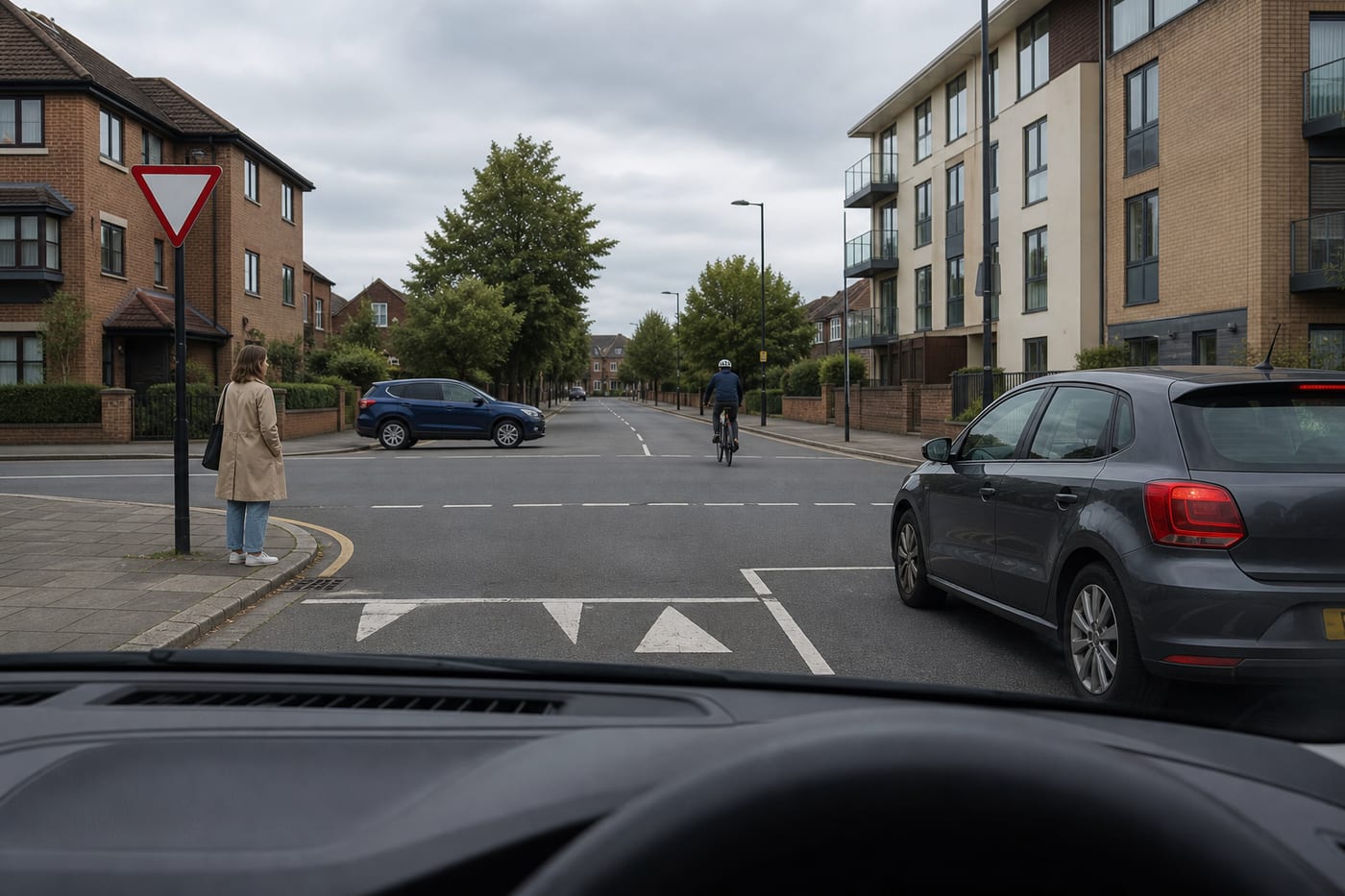
For example, a driver facing a Give Way line must give way to traffic on the major road. A driver turning across the path of approaching traffic must wait for a safe gap. Drivers turning into or out of a road should also give way to pedestrians who are crossing or waiting to cross.
Priority never removes your responsibility to avoid a collision. If another driver pulls out when they should have waited, slowing down is safer than trying to enforce your priority.
The main junction priority rules
Although every junction is different, several basic rules apply repeatedly.
Obey traffic lights, signs and road markings
Traffic controls take precedence over the usual assumptions about who should go first.
At a junction:
- A red traffic light means you must stop behind the stop line.
- A Stop sign requires you to stop at the solid white line and wait for a safe opportunity to proceed.
- A Give Way sign and broken white line require you to give way to traffic on the major road.
- Directions given by a police officer or authorised traffic officer must be followed.
Do not rely on the shape of the road alone. Check for signs and markings as you approach. Our guide to UK road markings and what they mean can help you recognise the lines used at junctions.
Give way when emerging onto a main road
When leaving a side road, you will usually encounter Give Way markings or a Stop line. Traffic already travelling along the main road has priority, so you must assess vehicles approaching from both directions.
Use an appropriate observation routine, looking right, left and right again while continuing to monitor the whole junction. On roads with restricted visibility, edge forward slowly only after you have completed your initial observations. This is sometimes described as “peep and creep”.
Do not allow the driver behind to pressure you into moving. Wait until the gap is large enough for you to join the road without making another road user brake, swerve or significantly change speed.
Give way when turning right across approaching traffic
When turning right from a main road, you normally have to cross the path of oncoming vehicles. Those vehicles have priority, so wait until there is a safe gap.
Take particular care if an approaching vehicle is signalling left. A signal may have been left on accidentally, and the driver may not turn. Look for supporting clues such as reduced speed and road position, but do not proceed until you are confident it is safe.
If another vehicle is also waiting to turn right, you may pass right side to right side or left side to left side, depending on the road layout and markings. Avoid cutting the corner, and make sure the chosen route does not create a conflict. For a fuller driving routine, see how to turn right safely off a main road.
Pedestrian priority at junctions
Drivers, motorcyclists, horse riders and cyclists should give way to pedestrians who are crossing or waiting to cross a road into which or from which they are turning.
Imagine that you are turning left into a side road. If a pedestrian is waiting to cross that side road, you should slow down and allow them to cross. The same principle applies when turning out of the side road.
If a pedestrian has already started crossing, they have priority and you must allow them to finish safely. Never drive closely behind or in front of them to save a few seconds.
When giving way, check your mirrors early and slow progressively. Avoid waving someone across because there may be another danger you have not seen, such as a cyclist filtering past or a vehicle approaching from another direction. Instead, stop safely and let the pedestrian make their own decision.
Pedestrians may be especially difficult to see near parked vehicles, at night or in poor weather. Children, older people and disabled pedestrians may also need more time. Keep the junction clear and remain patient.
Crossings have additional rules, so it is worth studying the differences in our guide to UK pedestrian crossings.
Cyclists, horse riders and horse-drawn vehicles
When turning into or out of a junction, drivers should not cut across cyclists, horse riders or horse-drawn vehicles who are continuing straight ahead. This applies whether they are using the road or an appropriate cycle facility alongside it.
Before turning, use your mirrors and check the relevant blind spot. A cyclist may be travelling on your left when you intend to turn left, or passing slow traffic on either side. If cutting across their path would cause them to stop or change direction, wait and let them continue.
This is particularly important when a cycle lane crosses the mouth of a side road. Do not assume that your indicator gives you priority. A signal communicates your intention; it does not require other road users to get out of your way.
Give horse riders plenty of time and space. Avoid revving the engine or accelerating sharply, as sudden noise can startle a horse.
What happens at an unmarked junction?
At an unmarked junction or crossroads, no driver automatically has priority. Do not assume that the wider or straighter road is the main road, and do not expect traffic from one particular direction to give way.
Approach slowly enough to assess the situation. Look in every relevant direction and be prepared to stop. Try to make eye contact with other drivers where possible, but never treat eye contact as a guarantee that they will wait.
If two vehicles arrive together, one driver may clearly allow the other to proceed. Even then, complete your own checks before moving. There could be a pedestrian, motorcycle or cyclist hidden from view.
Unmarked junctions are a good example of why defensive driving matters more than trying to claim priority.
T-junctions and crossroads
At a marked T-junction, traffic emerging from the road that ends must give way to traffic on the continuing road. The Give Way or Stop markings usually make this clear.
At a crossroads, follow the lights, signs and markings. If you are travelling on the priority road, continue only after checking that drivers on the side roads are slowing or stopping. Vehicles can emerge unexpectedly, particularly where visibility is restricted.
When traffic lights are not working, treat the junction with extreme caution. Do not assume that your road has priority simply because its signal would normally show green at a particular stage.
Roundabout priority
At most roundabouts, you should give priority to traffic approaching from your right unless signs, road markings or traffic lights direct otherwise. Reduce your speed early, choose the correct lane and look for a safe opportunity to enter.
Do not enter merely because the vehicle to your right is signalling to leave. Check its speed and position, and consider whether another vehicle may be hidden behind it.
Mini-roundabouts follow the same basic priority principle. You must pass around the central marking rather than driving over it, except that large vehicles may be physically incapable of doing so. Where several vehicles reach a mini-roundabout together, avoid rushing or assuming another driver will wait. Our complete UK roundabout guide for learners explains lane choice, signals and exits in more detail.
Filter arrows and yellow box junctions
A green filter arrow allows traffic to move in the direction shown, but you must still watch for anyone remaining in the junction. In particular, be alert for pedestrians finishing a crossing and emergency vehicles approaching.
At a yellow box junction, you must not enter unless your exit is clear. The main exception is when turning right and being prevented from doing so only by oncoming traffic or other vehicles waiting to turn right.
Having priority over side-road traffic does not permit you to block a junction. Look beyond the vehicle ahead and make sure there is enough room for your whole vehicle on the other side.
Common learner mistakes at junctions
Frequent errors include:
- Looking only for cars and missing pedestrians or cyclists.
- Treating another driver’s signal as proof that they will turn.
- Entering a junction because the vehicle behind is waiting impatiently.
- Approaching too quickly to make effective observations.
- Assuming that a green light guarantees a clear path.
- Cutting across a cyclist while turning left.
- Stopping unnecessarily when it is clearly safe to proceed.
- Trying to enforce priority when another road user makes a mistake.
A useful routine is to identify the junction early, check your mirrors, reduce speed, select a suitable gear and make repeated observations. Keep looking as you move because the situation can change quickly.
How junction priority appears in the theory test
Theory test questions may use a diagram or short scenario and ask which road user should move first. Before choosing an answer, identify:
- Traffic lights, signs and road markings.
- Which vehicles are turning or crossing another path.
- Pedestrians waiting or already crossing.
- Cyclists, horse riders or motorcyclists continuing straight ahead.
- Anything that could make proceeding unsafe despite apparent priority.
Avoid answering from personal experience alone. Base your choice on the Highway Code and select the safest lawful response.
Frequently asked questions
Does the vehicle on the main road always have priority?
Traffic on the main road normally has priority over vehicles facing Give Way or Stop markings. However, its drivers must still respond to traffic lights, pedestrians, cyclists and developing hazards. Priority is never permission to cause a collision.
Who has priority when a car turns into a side road?
A driver turning into a side road should give way to pedestrians crossing or waiting to cross that road. The driver should also avoid cutting across cyclists, horse riders or horse-drawn vehicles continuing straight ahead.
Who goes first at an unmarked crossroads?
No one has automatic priority at an unmarked crossroads. Every driver should approach cautiously, observe in all directions and be prepared to stop. Proceed only when you are satisfied that other road users are waiting and it is safe.
Does indicating give a driver priority?
No. An indicator only shows an intention to change direction or position. You must still give way where required and ensure that the manoeuvre will not endanger pedestrians, cyclists or other traffic.
Conclusion
UK right of way rules are best understood as rules of priority combined with a continuing duty to drive safely. Follow signs, lights and road markings, give proper consideration to vulnerable road users and never assume that another person will behave correctly.
At every junction, slow down, observe carefully and be ready to wait. A few extra seconds spent checking are always better than proceeding simply because you believe it is your turn.