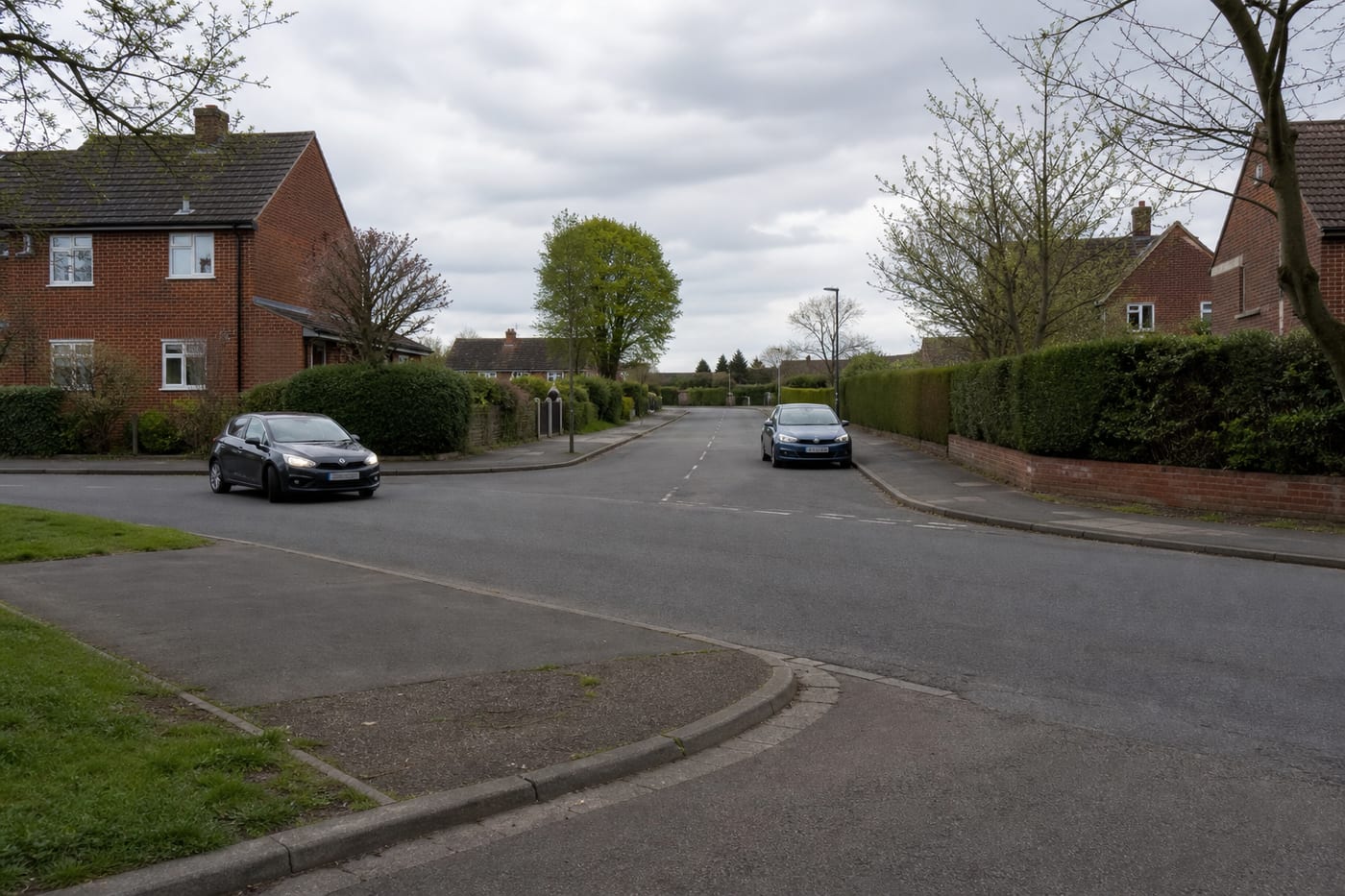
Unmarked crossroads can be confusing because there are no signs or road markings telling drivers which route has priority. Unlike a typical main-road junction, you cannot rely on a GIVE WAY sign, a STOP sign or broken white lines to decide who should proceed first.
The essential rule is simple: at an unmarked crossroads, no driver automatically has priority. You must approach carefully, look in every direction and be prepared to give way. Never assume that travelling straight ahead, arriving first or approaching from a particular side gives you an automatic right to continue.
For learner drivers, the safest strategy is to reduce speed early, observe continuously and communicate through careful positioning and vehicle movement. This guide explains how to do that in theory test questions and during everyday driving.
What is an unmarked crossroads?
A crossroads is a junction where two roads cross. At a conventional crossroads, signs, traffic lights or road markings normally control the movement of traffic. These may identify a major road and tell traffic on the minor road to stop or give way.
An unmarked crossroads has no clear signs or markings establishing priority. You are more likely to encounter one on quiet residential roads, narrow rural lanes or older local streets.
Do not confuse an unmarked crossroads with a junction where markings are merely difficult to see. Lines may be obscured by standing water, mud, leaves, snow or poor maintenance. If you cannot determine how a junction is controlled, reduce your speed and treat the situation with particular caution rather than making an assumption.
Who has priority at an unmarked crossroads?
No one has automatic priority at an unmarked crossroads. Every driver should approach cautiously and be ready to stop.
This means you should not assume priority because:
- you are travelling straight ahead
- your road looks wider or busier
- you reached the crossroads first
- you are approaching from the right or left
- another vehicle is turning
- you are driving uphill
- your route appears to be the natural continuation of the road
Some drivers may expect informal conventions to settle the situation, but these are not a substitute for proper observation and co-operation. The broader principles are covered in our guide to UK right-of-way rules at junctions.
In practical terms, your aim is not to prove that you should go first. It is to avoid conflict by identifying what every road user is doing and proceeding only when it is safe.
How to approach an unmarked crossroads safely
An unmarked crossroads calls for a slow, planned approach. You should gather information early rather than reaching the centre of the junction before deciding what to do.
Check your mirrors
Use your mirrors in good time so that you know what is happening behind you. This is especially important before slowing down, because a following driver may not have noticed the junction.
If you intend to turn, check the appropriate mirrors before signalling. Remain aware of cyclists and motorcyclists who may be passing alongside you.
Reduce your speed early
Ease off the accelerator and approach at a speed that allows you to stop within the distance you can see to be clear. The correct speed depends on visibility, traffic, road width, weather and the presence of vulnerable road users.
At a restricted or “closed” crossroads, buildings, walls, parked cars or hedges may block your view. You may need to move very slowly and use careful observations before entering.
Look in every direction
Check ahead, left and right repeatedly. A single glance is not enough because another vehicle, cyclist or pedestrian may appear while you are moving.
Remember to look beyond cars. Motorcycles and bicycles are narrower and can be concealed by street furniture, parked vehicles or windscreen pillars. Listening may also help, but an absence of engine noise never proves that the road is clear.
Signal when it will help others
If you are turning, signal in good time when the signal will benefit another road user. Avoid signalling so early that somebody could mistake your intended turning.
A signal shows what you intend to do; it does not give you priority. Continue checking that other road users have understood your actions.
Proceed only when it is safe
If another vehicle is close enough to create uncertainty, slow down or stop and allow the situation to develop. Move off only when you are satisfied that the route is clear and that another driver is not about to enter at the same time.
Accelerate gently through the crossroads and keep looking for changing hazards. Avoid hesitating in the middle unless stopping is necessary for safety.
Common unmarked crossroads situations
The same basic rule applies in every case, but your observations and positioning will depend on where you intend to go.
Travelling straight ahead
Going straight on does not give you priority. Check for traffic approaching from both sides and be prepared for an oncoming vehicle to turn across your path.
Do not simply follow a vehicle ahead through the crossroads. It may block your view, and traffic conditions can change before you reach the junction.
Turning left
Check your mirrors, signal if it will help and reduce speed before the junction. Look for pedestrians crossing or waiting to cross the road into which you are turning, and give way to them in accordance with the Highway Code.
Also check for cyclists who may be travelling alongside you. Do not turn across their path. Complete the turn at a controlled speed and avoid swinging wide into the other side of the road.
Turning right
A right turn involves crossing the path of oncoming traffic, so it usually creates more potential conflict. Position appropriately without cutting the corner, observe all approaches and wait for a safe opportunity.
An oncoming driver may be travelling straight ahead or turning. Do not rely on their road position alone; look for a signal, changes in speed and the direction of the front wheels while remaining prepared for them to act unexpectedly.
For more detailed turning advice, see how to turn right safely off a main road.
Meeting another vehicle at the same time
If two vehicles reach an unmarked crossroads together, neither gains automatic priority. Slow down and assess the other driver’s intentions.
One driver may clearly stop and allow the other to proceed. If another driver gives way, make sure all other approaches are clear before moving. Their decision cannot guarantee that a cyclist, pedestrian or third vehicle will also wait.
If intentions remain uncertain, it is safer to wait than to force your way through. Avoid aggressive acceleration or moving forward merely to claim space.
Pedestrians, cyclists and motorcyclists
Priority at a crossroads is not only about deciding which car moves first. You must account for people who may be less visible or more vulnerable.
When turning at a junction, you should give way to pedestrians crossing or waiting to cross the road you are turning into or from. If pedestrians have already started crossing, allow them plenty of time and space. Never pressure them by edging forward.
Before turning, check for cyclists travelling straight ahead, including those approaching from behind. A cyclist may be hidden in a blind spot or beside a line of parked vehicles. Do not turn across them.
Motorcycles can approach more quickly than they first appear, and their narrow profile makes speed and distance harder to judge. Take another look before entering the crossroads. Learning to identify these risks early is also useful preparation for the hazard perception test.
Should you wave another driver through?
A friendly gesture may seem helpful, but it can create misunderstanding. Another road user might interpret the gesture as confirmation that every direction is clear, even though you cannot see all possible hazards.
It is usually better to communicate by stopping in a clear, controlled position and allowing the other road user to make their own observations. If somebody gestures for you to proceed, do not move solely because of the signal. Check the entire junction yourself first.
The same applies to flashing headlights. Under the Highway Code, flashing headlights should be used only to let others know that you are there. Never treat a flash as a definite instruction or invitation to go.
Mistakes learners commonly make
Assuming the wider road has priority
A road may look more important because it is wider, straighter or carries more traffic. Without signs or markings establishing priority, its appearance is not enough.
Approaching too quickly
Excess speed leaves less time to observe and can make other drivers think you intend to continue. Even if you stop at the last moment, your approach may alarm or confuse them.
Looking only left and right
You must also check ahead, behind and around the corners. Oncoming traffic may turn across you, while pedestrians or cyclists may enter the road you plan to use.
Treating eye contact as a guarantee
You may believe another driver has seen you, but reflections, tinted glass and poor light can make eye contact difficult to confirm. Judge the vehicle’s actual movement and remain prepared to stop.
Following another vehicle without checking
The driver ahead may have a clear view when they enter, but you may not. Make your own decision every time.
Being over-cautious without observation
Caution is essential, but simply stopping and waiting indefinitely is not a complete solution. Observe actively, identify a safe opportunity and proceed positively when you are confident it is clear.
Unmarked crossroads in the practical driving test
During the practical test, the examiner will expect you to recognise the junction, adjust your speed and make effective observations. They are not looking for unnecessary speed or a race to claim priority.
A sound routine includes:
- Checking your mirrors early.
- Identifying signs, markings and possible hazards.
- Signalling correctly if you are turning.
- Reducing speed enough to stop safely.
- Looking in all directions more than once.
- Giving way when there is doubt or a potential conflict.
- Moving through under control when it is safe.
Potential faults include approaching too fast, failing to notice crossing traffic, causing another road user to brake or change direction, and waiting when there is a clear and safe opportunity to proceed.
The appropriate response depends on the circumstances. A clear crossroads on a quiet road may require only a significant reduction in speed and thorough observations. A junction with obstructed views may require you to stop and edge forward carefully.
Theory test tips for priority questions
Theory test questions often describe several road users approaching an unmarked junction and ask who should proceed. Read the wording carefully and examine every sign, line, signal and road user shown in the image.
Remember these principles:
- no one automatically has priority at an unmarked crossroads
- do not rely on road width or direction of travel
- choose the cautious, co-operative response
- signals do not create priority
- consider pedestrians, cyclists and motorcyclists
- be prepared to stop when intentions are unclear
Avoid importing rules from another country, such as assuming that traffic from one particular side always has priority. Apply UK Highway Code guidance to the situation presented.
Conclusion
At an unmarked crossroads, no driver has automatic priority. Approach slowly, observe every direction and be prepared to give way rather than relying on assumptions about road size, arrival order or direction of travel.
Good judgement comes from creating enough time to assess the situation. If there is uncertainty, wait. When the junction is clearly safe, proceed smoothly and continue watching for vulnerable road users.
Frequently asked questions
Does traffic from the right have priority at an unmarked crossroads?
No. At an unmarked crossroads in the UK, traffic approaching from the right does not automatically have priority. Check every direction and proceed only when it is safe.
Does the first vehicle to arrive go first?
Not automatically. Arrival order may help drivers co-operate, but it does not create a guaranteed right to proceed. Make sure the other driver is clearly giving way and check all approaches yourself.
Must I always stop at an unmarked crossroads?
Not necessarily. You should approach at a speed that allows you to stop safely and must stop if visibility, traffic or uncertainty makes it necessary. If the junction is clearly visible and free from conflict, you may be able to continue slowly after effective observations.
Who has priority when I am turning right?
Being at an unmarked crossroads means you cannot assume priority. A right turn also crosses potential paths of oncoming and side-road traffic, so observe carefully and give way whenever moving would create a conflict.