Seeing blue flashing lights in your mirrors can feel stressful, particularly when you are learning to drive. You know the emergency vehicle needs to make progress, but you must not put anyone else in danger or break the law to let it pass.
The key is to remain calm, observe where the vehicle is coming from and make space only when it is safe and legal. An ambulance, police car or fire engine will not expect you to drive through a red light, mount the pavement or make a sudden manoeuvre.
This guide explains the Highway Code rules for dealing with emergency vehicles and how to apply them at traffic lights, junctions, roundabouts and on faster roads.
What does the Highway Code say about emergency vehicles?
Rule 219 of the Highway Code tells drivers to look and listen for emergency vehicles. These may use flashing blue, red or green lights, sirens or flashing headlights.
Vehicles you may encounter include:
- Police vehicles
- Ambulances
- Fire engines
- Coastguard vehicles
- Bomb disposal vehicles
- Mountain rescue vehicles
- Vehicles used by doctors responding to emergencies
- Other emergency or incident-support vehicles
When one approaches, consider its route and take appropriate action to let it pass while complying with traffic signs. The Highway Code specifically warns drivers not to panic, brake harshly or endanger other road users.
If necessary, pull to the side of the road and stop. However, avoid stopping before the brow of a hill, on a bend or in a narrow section of road where your position could obstruct the emergency vehicle.
The correct routine when you see blue lights
There is no single manoeuvre that works in every situation. Use this simple process instead.
1. Stay calm and identify the vehicle
Do not react to the sound of a siren by immediately steering or braking. Check your mirrors and look around to establish:
- Where the emergency vehicle is
- Which direction it is travelling
- Whether more than one vehicle is approaching
- The route it is likely to take
- What nearby drivers, cyclists and pedestrians are doing
Sound can reflect from buildings, so a siren may initially appear to come from the wrong direction. Keep observing until you understand the situation.
2. Reduce speed progressively if needed
Ease off the accelerator and slow smoothly. Avoid harsh braking, as the driver behind may not yet have noticed the emergency vehicle.
Check your mirrors before changing speed or direction. Signal if it would help others understand what you intend to do, but remember that a signal does not give you priority.
3. Find a safe, legal place to make room
You may be able to pull towards the left and stop, but only do so where there is enough space for the vehicle to pass. Keep clear of pedestrian refuges, traffic islands and other obstructions that could create a bottleneck.
Do not mount the kerb. This could endanger pedestrians, damage your vehicle and leave you trapped in an unsafe position.
4. Check before moving off again
After the emergency vehicle passes, look and listen for further vehicles. Police, fire and ambulance vehicles sometimes travel together.
Make full mirror and blind-spot checks before rejoining the flow of traffic. Do not automatically follow the emergency vehicle through the gap it has created.
What should you do at a red traffic light?
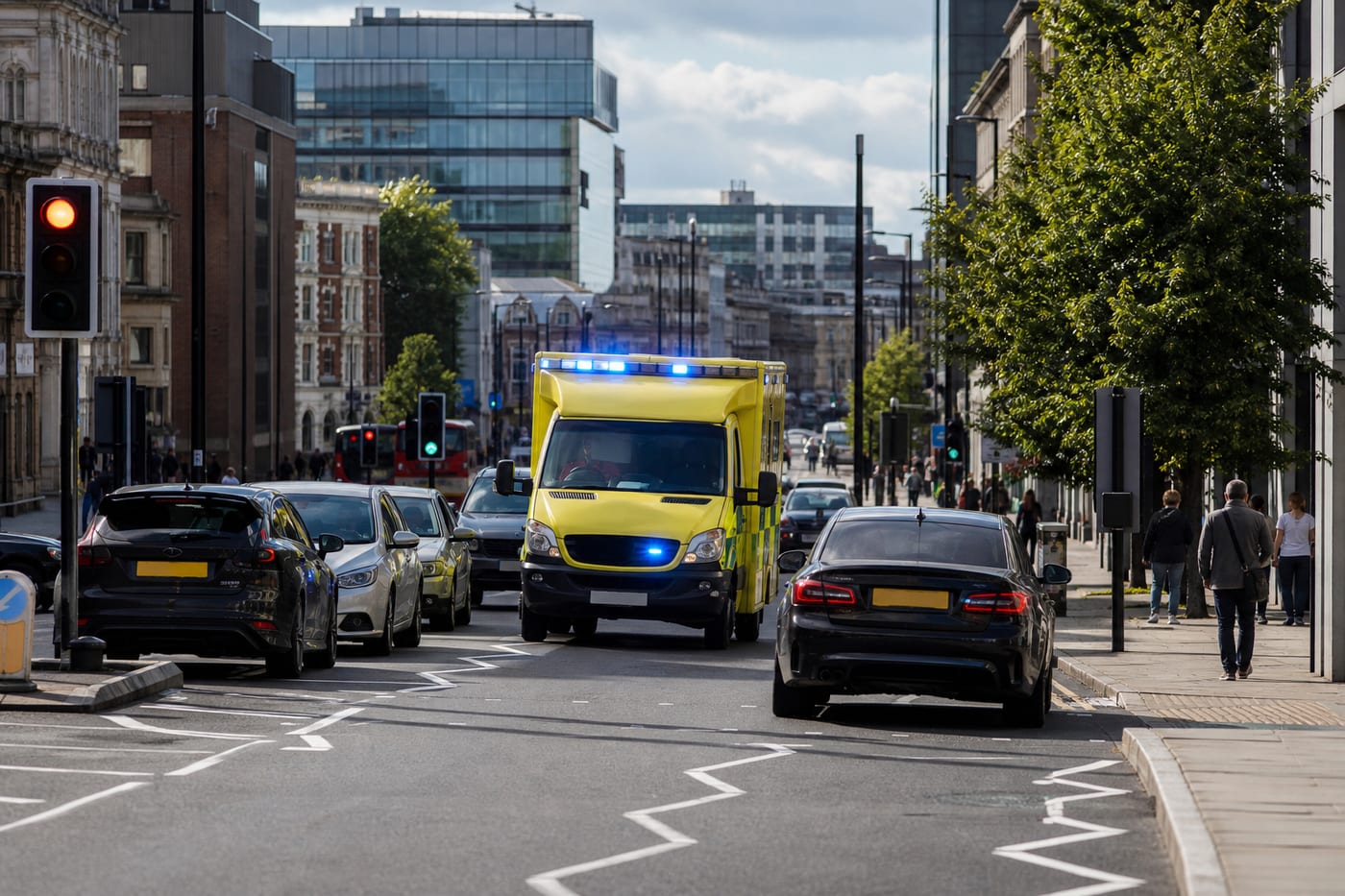
A common theory test scenario involves an emergency vehicle approaching from behind while you are waiting at a red light.
You must not pass the stop line while the signal is red. The presence of a blue-light vehicle does not authorise you to drive through the light. Moving beyond the line could expose pedestrians or crossing traffic to danger, and it may result in enforcement action.
Stay behind the stop line unless a uniformed police officer directs you otherwise. If you can create room without crossing the line or entering a prohibited area, do so carefully. Otherwise, remain where you are and let the emergency driver decide how to proceed.
Emergency drivers are trained to assess the situation. They may switch off the siren temporarily to avoid pressuring drivers into an illegal move.
Learners should also understand the normal UK traffic light sequence and its requirements. Blue lights do not change the meaning of a red signal.
Where should you avoid stopping?
Stopping in the wrong place can delay an emergency vehicle rather than help it. Avoid stopping:
- On or immediately before a bend
- Near the brow of a hill
- In a narrow part of the road
- On a pedestrian crossing or its zigzag markings
- In a junction or where you would block an entrance
- Beside a traffic island if this leaves no passing space
- Opposite parked vehicles where the remaining gap is too narrow
- Anywhere that puts pedestrians, cyclists or motorcyclists at risk
Think ahead. It may be safer to continue briefly at a controlled speed and stop after a bend or beyond a narrow section.
Emergency vehicles at junctions and roundabouts
If you are approaching a junction, avoid entering it and then stopping in the emergency vehicle’s path. Slow down, observe carefully and leave space where possible.
Do not enter a junction against a red signal. At a give-way line, do not pull into traffic merely because an emergency vehicle is behind you. You still need a safe gap.
At a roundabout, establish which direction the emergency vehicle is coming from. If you have not entered, it may be safest to wait and let it pass. If you are already on the roundabout, continue safely to an exit rather than stopping suddenly on the circulatory carriageway.
Do not assume other drivers have heard the siren. A driver entering from another road may not yet be aware of the emergency vehicle.
Bus lanes, solid white lines and other restrictions
You should not break traffic rules to make way. Do not enter a bus lane during its operating hours, cross a solid white line where prohibited or drive into a restricted area simply because a blue-light vehicle is behind you.
Equally, do not enter a yellow box junction unless your exit is clear, subject to the usual exception when turning right and waiting for oncoming traffic or other right-turning vehicles. Becoming stranded in the box could block the emergency vehicle’s route.
Always follow the directions of a police officer or authorised traffic officer where applicable. Their directions take priority over normal signs and signals in the circumstances covered by the Highway Code.
What to do on motorways and dual carriageways
At higher speeds, sudden reactions are especially dangerous. Check all mirrors, assess the emergency vehicle’s position and avoid abrupt lane changes.
If an emergency vehicle approaches from behind:
- Maintain predictable control of your vehicle
- Do not exceed the speed limit to get away from it
- Move lanes only when it is safe and legal
- Do not stop in a live traffic lane
- Do not use the hard shoulder unless there is an emergency or you are directed to do so
- Obey lane-control signals, including red X signs
In congestion, leave sensible space ahead rather than driving extremely close to the vehicle in front. This gives you room to adjust your position if emergency access is needed. Do not copy manoeuvres made by other drivers without checking that they are safe and legal.
For a wider explanation of lane discipline, breakdown procedures and smart motorway signals, see this complete guide to safe motorway driving.
Understanding different warning lights
Not every flashing light has the same meaning.
Blue lights
Blue flashing lights are used by emergency and certain authorised vehicles. They may be accompanied by sirens or flashing headlights. Look for the vehicle, anticipate its route and make space safely.
Green lights
A green flashing beacon may be used by a doctor responding to an emergency. Treat the situation seriously and allow the vehicle to pass when safe, but do not break traffic laws.
Amber lights
Amber flashing lights usually warn of a hazard, obstruction or slow-moving vehicle. They can be seen on recovery vehicles, road maintenance vehicles, abnormal loads and other authorised vehicles.
An amber beacon does not normally mean that the vehicle is asking for priority in the same way as an emergency vehicle displaying blue lights. Slow down and assess the hazard.
Common mistakes learner drivers should avoid
Panicking and stopping immediately
An instant stop may block the road or cause a collision. Observe first, then respond smoothly.
Driving through a red light
Do not cross the stop line to make room unless directed by a uniformed police officer. Wait for the signal to permit you to proceed.
Mounting the pavement
The pavement may contain pedestrians who cannot see or hear your vehicle approaching. Stay on the carriageway and find another safe solution.
Accelerating above the speed limit
You must not speed to stay ahead of an emergency vehicle. Let it pass as soon as a suitable opportunity arises.
Following closely behind
Never use the emergency vehicle to make faster progress. Other road users may move back into position or fail to notice you following it.
Focusing only on the blue lights
Keep scanning for pedestrians, cyclists, traffic signals and vehicles arriving from side roads. Emergency vehicles are an important developing hazard, but they are not the only hazard present. Practising how to identify road hazards early can help you respond without losing awareness of your surroundings.
Practical advice for lessons and the driving test
Ask your instructor to discuss suitable stopping places while driving through different environments. Consider what you would do on a narrow residential road, at a busy signal-controlled junction or in slow motorway traffic.
If an emergency vehicle appears during your practical test, the examiner will expect a safe, legal and proportionate response. Keep checking your mirrors, avoid rushed decisions and explain the situation only if the examiner asks or if brief clarification is genuinely necessary.
Your priority is not to perform a dramatic manoeuvre. It is to remain in control, comply with signs and signals, and avoid creating another emergency.
Conclusion
When an emergency vehicle approaches, stay calm, locate it and consider its likely route. Make space when it is safe and legal, but never drive through a red light, mount the kerb or make a dangerous sudden move.
Good observation and predictable driving help emergency crews more than panic does. If there is no safe way to move, remain controlled and allow the emergency driver to assess the best route.
Frequently asked questions
Can I go through a red light to let an ambulance pass?
No. You must not pass the stop line while the light is red unless a uniformed police officer directs you to do so. Stay where you are if you cannot make room legally.
Should I always pull over to the left for a police car or ambulance?
Not automatically. Pulling left is often appropriate, but only if it creates useful space and is safe. On a bend, near a junction or beside a traffic island, continuing briefly to a safer position may be better.
Can I use a bus lane to make way for an emergency vehicle?
Do not enter an operating bus lane if you are not permitted to use it. Emergency vehicles do not expect you to contravene traffic signs or restrictions. Move only where it is legal and safe.
What if there are several emergency vehicles?
After the first vehicle passes, remain alert and check your mirrors before moving off. Listen and look for additional vehicles, as emergency services may travel in a group. Rejoin traffic only when the route is clear and it is safe to do so.