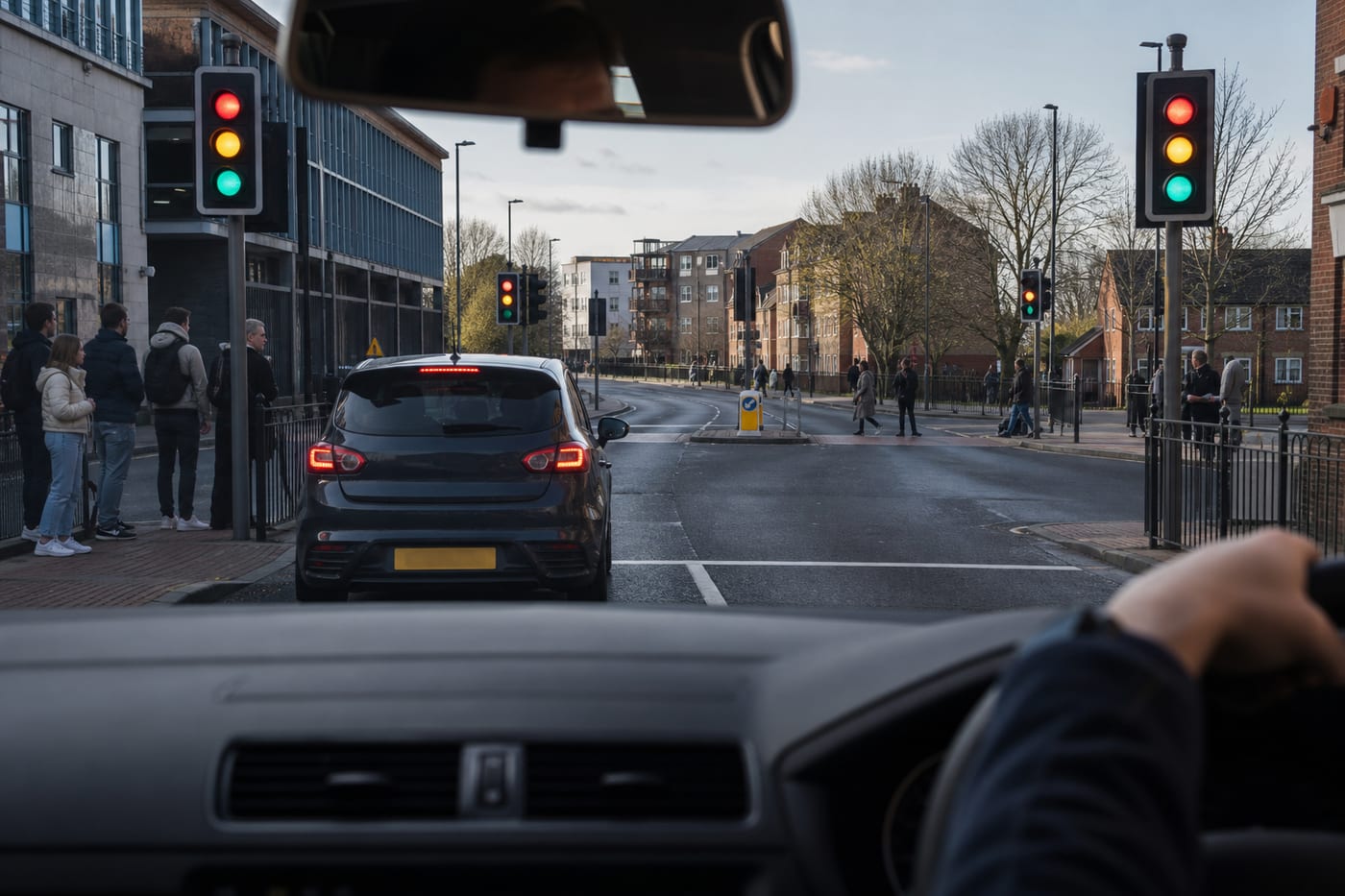
Traffic lights control the movement of vehicles, cyclists and pedestrians at busy junctions, crossings and roadworks. For learner drivers, knowing the UK traffic light sequence is essential—but recognising the colours is only the beginning. You must also know where to stop, when you may proceed and how to react when the junction ahead is blocked.
The standard UK sequence is red, red and amber together, green, amber, then red again. Each stage gives a specific instruction. Misunderstanding red and amber together, rushing through amber or moving automatically when green appears can create danger and lead to faults during a practical driving test.
This guide explains the complete sequence, filter arrows, stop lines, pedestrian crossings and the safest routine to use when approaching traffic signals.
What is the UK traffic light sequence?
At a standard signal-controlled junction, the lights normally follow this order:
- Red
- Red and amber together
- Green
- Amber
- Red
A useful way to remember it is that red and amber come before green, while amber alone comes before red.
That distinction matters. Red and amber together prepare you to move, but they do not give you permission to go. Amber on its own warns that the signals are about to turn red and generally requires you to stop.
What does each traffic light mean?
Red means stop
A red light means you must stop. Stop behind the white stop line across your side of the road. If there is no stop line, stop before the traffic signal itself.
Do not allow the front of your vehicle to cross the line while the red signal is showing. Leave enough space from the vehicle ahead to see its rear tyres meeting the road, where possible, and avoid stopping over pedestrian crossing areas or cycle spaces.
A red light remains an instruction to stop even if:
- The junction looks empty
- Other drivers move early
- You are turning left
- No pedestrians appear to be crossing
- An emergency vehicle is behind you
Unlike in some countries, there is no general rule allowing drivers to turn left through a red light in the UK. You may proceed only if a separate green filter arrow authorises your direction and it is safe to do so.
If an emergency vehicle approaches with blue lights or a siren, remain calm and look for a safe, legal way to create space. You should not cross the stop line against a red signal merely to let it pass.
Red and amber mean prepare—but wait
Red and amber illuminated together mean that the lights are about to change to green. You may prepare to move, but you must not cross the stop line yet.
In a manual car, this may be the time to select first gear if you have not already done so and prepare the clutch. In an automatic, keep the brake applied until the green signal appears and it is safe to move.
Avoid creeping over the line or moving because the vehicle beside you has started. Watch your own signal, as neighbouring lanes or separate filter lanes may receive different instructions.
Green means proceed if the way is clear
A green light allows you to proceed, but it does not mean you must move regardless of conditions. Before setting off, check that the junction and your intended exit are clear.
You may need to wait at green if:
- Traffic is blocking the junction
- A pedestrian is still crossing
- An oncoming vehicle has priority while you turn right
- A cyclist is travelling alongside you as you turn
- Another road user has entered the junction late
- Moving would cause you to stop in a yellow box unlawfully
At a green light, use effective observations before moving. Check ahead and around the junction rather than focusing entirely on the signal. If you are turning, check mirrors and blind spots as appropriate and look for pedestrians crossing the road you are entering.
The rules at signals also interact with road markings. Our guide to UK road markings explains stop lines, lane arrows, yellow boxes and other markings you may find around junctions.
Amber usually means stop
An amber light means stop at the stop line. The exception is when you have already crossed the line, or you are so close that stopping could cause a collision.
This exception is not an invitation to accelerate. If you have enough time and distance to stop safely, you should stop. Check your mirrors as you approach and reduce speed early so that you are not forced into a harsh last-second decision.
If the light changes after you have crossed the stop line, continue through the junction carefully. Do not reverse back towards the line or stop suddenly in a position that obstructs crossing traffic.
A safe routine for approaching traffic lights
Good signal driving begins before the lights change. Use the following routine whenever you approach a signal-controlled junction.
1. Check your mirrors
Look in your mirrors early to understand what is behind you. This is particularly important if the lights have been green for some time and may change before you arrive.
A close-following vehicle does not remove your duty to stop, but knowing it is there allows you to brake smoothly and give the driver more warning.
2. Ease off and assess the junction
Look beyond the signal. Identify your lane, road markings, pedestrians, cyclists, turning traffic and the space available on the other side.
A green signal that has been showing for a while is sometimes described by instructors as a “stale green”. This is not a separate legal signal; it is simply a reminder that the light may change soon. Stay prepared rather than accelerating to beat it.
3. Make a controlled decision at amber
If amber appears, ask whether you can stop smoothly behind the line. If you can, stop. If you have already crossed the line or braking sharply could cause a collision, continue with care.
Early observation makes this decision easier. Following too closely, approaching too quickly or checking the lights too late reduces your options.
4. Keep the junction clear
Do not enter merely because the light is green. Make sure there is room for your whole vehicle beyond the junction.
This is especially important at yellow box junctions. Generally, you must not enter a box unless your exit is clear, although there is a specific exception when turning right and being prevented from doing so by oncoming traffic or other vehicles waiting to turn right. See our learner’s guide to yellow box junctions for a fuller explanation.
5. Move only after checking it is safe
When green appears, check that traffic has stopped and no one is still crossing your path. Move away positively but without rushing.
Hesitating unnecessarily can disrupt traffic, but safety takes priority. A brief check is particularly valuable where your view is restricted or where another road user may have passed their signal late.
How green filter arrows work
A green filter arrow permits movement in the direction shown, provided the route is clear. It may appear before or after the main green light, depending on the junction design.
For example, a left-pointing green arrow may allow left-turning traffic to proceed while other movements remain stopped. Use the lane indicated by road markings and watch for pedestrians or cyclists whose route may cross yours.
A right-turn filter arrow can provide a protected phase for turning traffic. Do not assume it will appear at every junction. If the main signal shows green without a right-turn arrow, you may sometimes move into the junction and wait to turn, but you must give way to oncoming traffic and turn only when it is safe and permitted by the junction layout.
Always follow the signal applying to your lane. Directional signals, lane markings and separate signal heads can create different instructions for adjacent traffic.
Traffic lights and pedestrian crossings
Signal-controlled pedestrian crossings may use different phases from ordinary junction signals. The driver's red and green lights still have their usual meanings, but the sequence after green can vary by crossing type.
At a traditional pelican crossing, drivers may see a flashing amber phase after red. Flashing amber means you must give way to pedestrians who are still on the crossing. If nobody is crossing, you may proceed carefully.
Puffin, toucan and many other signal-controlled crossings do not use the same flashing amber arrangement. Drivers should respond to the signals displayed rather than guessing the crossing type. Our guide to UK pedestrian crossings covers how the main crossing designs differ.
Never move simply because the pedestrian signal appears to have changed. Your view of it may be poor, and your instruction comes from the vehicle signal. Even when your light turns green, allow anyone already crossing to reach safety.
Advanced stop lines for cyclists
Some junctions have two stop lines with a cycle reservoir between them. When the lights are red, drivers of motor vehicles must stop at the first line they reach and must not enter the marked cycle area.
If the signal changes to red after you have crossed the first line, stop at the second line. Do not reverse into traffic behind you.
Before moving at green, check for cyclists in front of and beside your vehicle. Give them time and space to set off, and avoid turning across their path.
What if the traffic lights are not working?
If signals are unlit or appear faulty, approach with great care. Do not assume you have priority. Treat the situation as an uncontrolled junction, reduce your speed and be prepared to give way or stop.
Look for police officers, traffic officers where applicable, temporary signs or other authorised traffic control. A police officer directing traffic takes precedence over traffic signals.
At temporary roadworks signals, stop at the temporary stop line or sign when red shows. Leave space for approaching traffic to clear the controlled section before you move on green. If a temporary signal seems stuck, do not simply drive through it without properly assessing the situation; remain cautious and follow any instructions from road workers or authorised personnel.
Common learner mistakes at traffic lights
Frequent errors include:
- Moving on red and amber instead of waiting for green
- Accelerating when a green light changes to amber
- Crossing the stop line while waiting at red
- Watching another lane's signal by mistake
- Entering a blocked junction at green
- Failing to give way when turning right across oncoming traffic
- Forgetting pedestrians and cyclists when turning
- Stopping inside a cycle reservoir
- Setting off without checking that the junction is clear
You can avoid many of these mistakes by approaching at a controlled speed and looking well ahead. The safest drivers plan for a possible change instead of reacting at the final moment.
Conclusion
The standard UK traffic light sequence is red, red and amber, green, amber, then red. Red and amber means prepare but remain stopped; green means proceed only when safe; and amber means stop unless you have crossed the line or cannot stop safely without risking a collision.
For both the theory and practical driving tests, remember that a green light never removes your responsibility to observe, give way where necessary and keep the junction clear.
Frequently asked questions
Can you drive through an amber traffic light?
You should stop at amber unless you have already crossed the stop line or are so close that stopping could cause a collision. You should never accelerate simply to beat the red light.
Can you move when red and amber show together?
No. Red and amber mean prepare to move, but you must remain behind the stop line until green appears. You must also check that the way is clear before setting off.
Does a green light always give you priority?
No. Green permits you to proceed if it is safe. You may still need to give way to pedestrians, cyclists or oncoming traffic when turning, and you must not enter a blocked junction.
What should you do if traffic lights are not working?
Slow down, approach cautiously and do not assume priority. Observe all directions, be prepared to stop and follow instructions from police officers or other authorised personnel controlling traffic.