The Highway Code is regularly reviewed to reflect changes in road use, technology and safety guidance. For learner drivers, the most important recent adjustments concern how drivers interact with pedestrians, cyclists, horse riders and other vulnerable road users.
The major revisions introduced on 29 January 2022 remain particularly important. They added a hierarchy of road users, clarified priority at junctions and strengthened guidance on overtaking vulnerable people. Other updates have addressed mobile phone use, electric vehicle charging and automated driving technology.
These are not simply facts to memorise for the theory test. They affect the decisions you should make during lessons, on your practical test and throughout your driving life.
First, understand the language of the Highway Code
Before studying individual changes, it is essential to recognise the difference between legal requirements and advisory guidance.
Rules containing MUST or MUST NOT normally reflect a legal requirement. Breaking one of these rules means you may be committing an offence. The rule usually includes a reference to the relevant legislation.
Wording such as should, should not, do or do not is generally advisory. Ignoring this guidance is not automatically a separate offence, but the Highway Code can still be used as evidence in court when establishing liability or whether someone was driving carelessly or dangerously.
Learners should therefore avoid treating advisory rules as optional safety tips. They describe the standard of responsible road use expected in Great Britain.
The Highway Code covered here applies to England, Scotland and Wales. Northern Ireland has its own version, so learners there should use the official Northern Ireland guidance.
The hierarchy of road users
One of the most significant additions was the introduction of three new introductory rules: H1, H2 and H3. Together, they establish a hierarchy based on the amount of harm different road users can cause in a collision.
The road users most at risk are placed towards the top of the hierarchy:
- Pedestrians, particularly children, older adults and disabled people
- Cyclists
- Horse riders
- Motorcyclists
- Cars and taxis
- Vans and minibuses
- Large passenger vehicles and heavy goods vehicles
The principle is straightforward: those in charge of vehicles capable of causing the greatest harm carry the greatest responsibility to reduce danger.
What the hierarchy does not mean
The hierarchy does not remove anyone’s responsibility for their own safety. Pedestrians and cyclists must still follow the rules that apply to them, while nobody receives an unlimited right to proceed regardless of the circumstances.
It also does not mean that drivers should stop suddenly or make an unsafe manoeuvre simply to offer priority. You must check mirrors, assess traffic behind and act predictably.
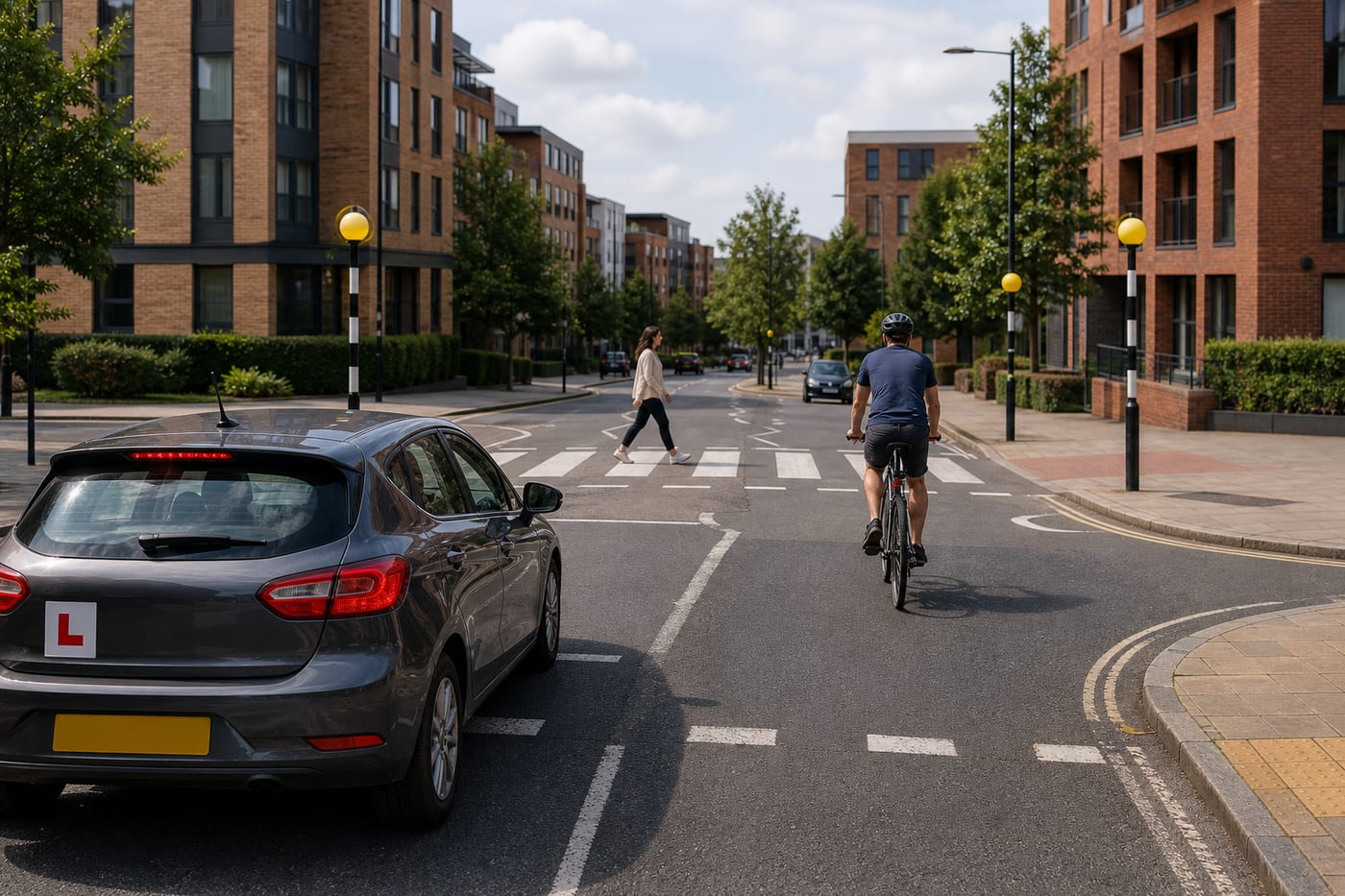
For a learner, the practical lesson is to look actively for people who may be less visible, less protected or less able to move out of danger. This includes checking carefully for cyclists before turning and anticipating that a pedestrian may cross at a junction.
Pedestrian priority at junctions
Rule H2 clarified what should happen when pedestrians cross at junctions.
When people are crossing, or waiting to cross, a road into which or from which you are turning, you should give way. If a pedestrian has already started crossing the road, they have priority and you should allow them to finish safely.
Imagine that you are turning left from a main road into a side road. A pedestrian is standing at the mouth of the side road and clearly intends to cross. Under the updated guidance, you should give way rather than turning across their intended path.
This applies when turning both into and out of a junction. It requires observations beyond simply checking for motor vehicles.
A safe junction routine
As you approach a turn:
- Check your mirrors early.
- Signal in good time where necessary.
- Reduce speed so you can stop smoothly.
- Look into the road for pedestrians as well as vehicles.
- Check the pavement edges and areas obscured by parked cars.
- Give people enough time and space to cross.
- Check again before completing the turn.
Do not wave someone across. Another road user may not have seen them, and your gesture could be misunderstood. Instead, stop safely and let the pedestrian decide when it is safe to move.
For more detail about how these principles apply to different layouts, see our guide to UK right of way rules at junctions.
Priority at zebra and parallel crossings
The revised wording also emphasises that drivers and riders should give way to pedestrians waiting to cross at a zebra crossing. You must give way once a pedestrian has moved onto the crossing.
At a parallel crossing, drivers should give way to pedestrians and cyclists waiting to cross and must give way once they are on the crossing.
Approach these crossings at a speed that allows you to stop safely. Scan both pavements and never assume someone waiting nearby has seen you. Be particularly cautious when another vehicle has stopped, as it may be hiding a person already crossing.
You must not overtake the vehicle nearest a pedestrian crossing or park on the zigzag markings. Our complete guide to zebra crossing rules explains the signals, markings and common learner mistakes in more detail.
Giving priority to cyclists going straight ahead
Rule H3 states that drivers should not cut across cyclists, horse riders or horse-drawn vehicles going straight ahead when turning into or out of a junction or changing direction or lane.
This applies whether the cyclist is using the road, a cycle lane or a cycle track. You should stop and wait for a safe gap rather than trying to turn ahead of them.
A common risk occurs when a driver intends to turn left while a cyclist is travelling straight ahead on the driver’s left. The driver may move across the cyclist’s path without checking properly. To prevent this:
- Use your mirrors well before the turn.
- Check the appropriate blind spot.
- Signal early enough to communicate your intentions.
- Never rely on the cyclist slowing down.
- Wait behind if turning would cause them to change speed or direction.
Cyclists may also pass slower or stationary traffic on either side. In queues, check carefully before moving, turning or opening a door.
Updated guidance on cyclist road position
The Code gives cyclists clearer guidance about where to ride. On quiet roads, in slower-moving traffic and when approaching junctions or road narrowings, cyclists may ride in the centre of their lane. This makes them more visible and can discourage unsafe overtaking.
On faster or busier roads, cyclists may ride at least half a metre from the kerb, and further out where it is safer. Drivers should not assume that riding away from the kerb is inconsiderate or incorrect.
Cyclists can also ride two abreast. This may be safer in larger groups or on narrow lanes because it makes the group more visible and can shorten the distance needed to overtake. Cyclists are advised to be considerate of traffic behind and, when it is safe, allow drivers to pass.
As a learner, remain patient. Do not sound your horn aggressively, follow too closely or attempt to squeeze past where there is insufficient room.
Safe overtaking distances and speeds
The Highway Code now provides clearer examples of the space drivers should allow when passing vulnerable road users.
You should:
- Leave at least 1.5 metres when overtaking cyclists at speeds of up to 30 mph, giving more room at higher speeds.
- Pass horse riders and horse-drawn vehicles at under 10 mph, allowing at least 2 metres of space.
- Allow at least 2 metres when passing pedestrians walking in the road, where there is no pavement, and keep your speed low.
These are minimum examples, not targets to meet regardless of conditions. A cyclist may need to avoid a drain cover or pothole, while a horse may react unpredictably to noise. Wind can also affect cyclists, particularly when they pass gaps in hedges or large vehicles.
Wait until you have enough space to move out properly. If oncoming traffic prevents a safe overtake, stay back and be patient. Only return to your lane when you are well clear.
Roundabouts and cyclists, horse riders and motorcyclists
Drivers should give priority to cyclists on a roundabout and should not attempt to overtake them within their lane. Cyclists, horse riders and motorcyclists may remain in the left-hand lane while continuing around the roundabout, so give them room and expect their road position to differ from that of a car.
When leaving a roundabout, check your mirrors and blind spot for a cyclist continuing around the outside. Do not cut across their path to reach your exit.
The same principle applies throughout the updated Code: a signal shows what you intend to do, but it does not create priority or make a manoeuvre safe.
Opening a vehicle door with the opposite hand
The Highway Code recommends a technique often called the Dutch Reach. When opening a vehicle door, use the hand on the opposite side to the door—for example, use your left hand to open the driver’s door.
This movement encourages you to turn your head and look over your shoulder. It makes it easier to see cyclists, motorcyclists and pedestrians approaching from behind.
You must ensure that opening a door does not injure or endanger anyone. Before getting out, check your mirrors, look over your shoulder and open the door gradually. Passengers should do the same.
Hand-held mobile phone rules
The law on using a hand-held mobile phone while driving was strengthened in 2022. You must not use a hand-held phone or similar device for any purpose while driving or supervising a learner. This includes activities such as taking photographs, selecting music, scrolling through content or playing a game.
The prohibition still applies when you are stationary in traffic or waiting at traffic lights. Limited legal exceptions include making a contactless payment while stationary for goods or services received at the same time, calling 999 or 112 in a genuine emergency when it is unsafe or impractical to stop, and using a device to park remotely.
Hands-free equipment is not automatically safe. If any device distracts you or prevents proper control, you may still commit an offence. Set your route and music before moving off, secure the phone in a suitable cradle if needed for navigation, and stop somewhere safe before making adjustments.
Electric vehicle charging guidance
The Code also includes guidance for using electric vehicle charging points. Drivers should park close to the charger, avoid creating a trip hazard with cables and return charging equipment neatly after use.
Where possible, charging cables should be positioned so they do not obstruct pavements or create danger for pedestrians, including wheelchair users and people with visual impairments. The wider lesson is that parking and charging must not make public spaces less accessible.
How to revise these changes for the theory test
Do not learn the updates as an isolated list. Connect each rule to a realistic driving situation.
For example, picture yourself:
- Turning into a side road where someone is waiting to cross.
- Following a cyclist on a narrow country lane.
- Leaving a roundabout beside a cycle lane.
- Passing a horse rider on a bendy rural road.
- Opening your door after parking on a busy street.
When answering theory questions, identify the safest lawful option. Be wary of answers that suggest rushing, forcing another road user to stop or assuming that a signal gives you priority.
It also helps to review hazards in context. Our guide to identifying road hazards as a driver explains how to recognise situations that may develop into a risk.
Use the latest official online Highway Code alongside reliable theory test practice. Avoid relying entirely on an old printed copy, as individual rules can be amended after publication.
Conclusion
The most important recent Highway Code adjustments place greater emphasis on protecting vulnerable road users. Remember the hierarchy, give pedestrians appropriate priority at junctions, avoid cutting across cyclists and allow generous space when overtaking.
Safe driving is not about claiming priority. It is about observation, patience and making choices that reduce danger for everyone.
Frequently asked questions
Do pedestrians always have priority over cars?
No. The hierarchy does not give pedestrians an unrestricted right to enter the road anywhere. However, drivers should give way to pedestrians crossing or waiting to cross a road into which or from which they are turning. Drivers must also give way to pedestrians already on a zebra crossing.
Is the hierarchy of road users a new law?
The hierarchy is set out in the Highway Code and establishes responsibility according to the potential to cause harm. Not every part is a separate legal requirement, but underlying traffic laws still apply and the Code may be used as evidence in legal proceedings.
Must I leave exactly 1.5 metres when passing a cyclist?
The Code advises leaving at least 1.5 metres at speeds of up to 30 mph and more space at higher speeds. You may need to leave considerably more room because of wind, poor surfaces, the cyclist’s age or experience, or other hazards.
Are older Highway Code books still suitable for revision?
An older book may contain useful information, but it might not include current rules or wording. Check its publication date and compare it with the latest official online Highway Code. Use up-to-date theory test materials rather than relying solely on an old edition.