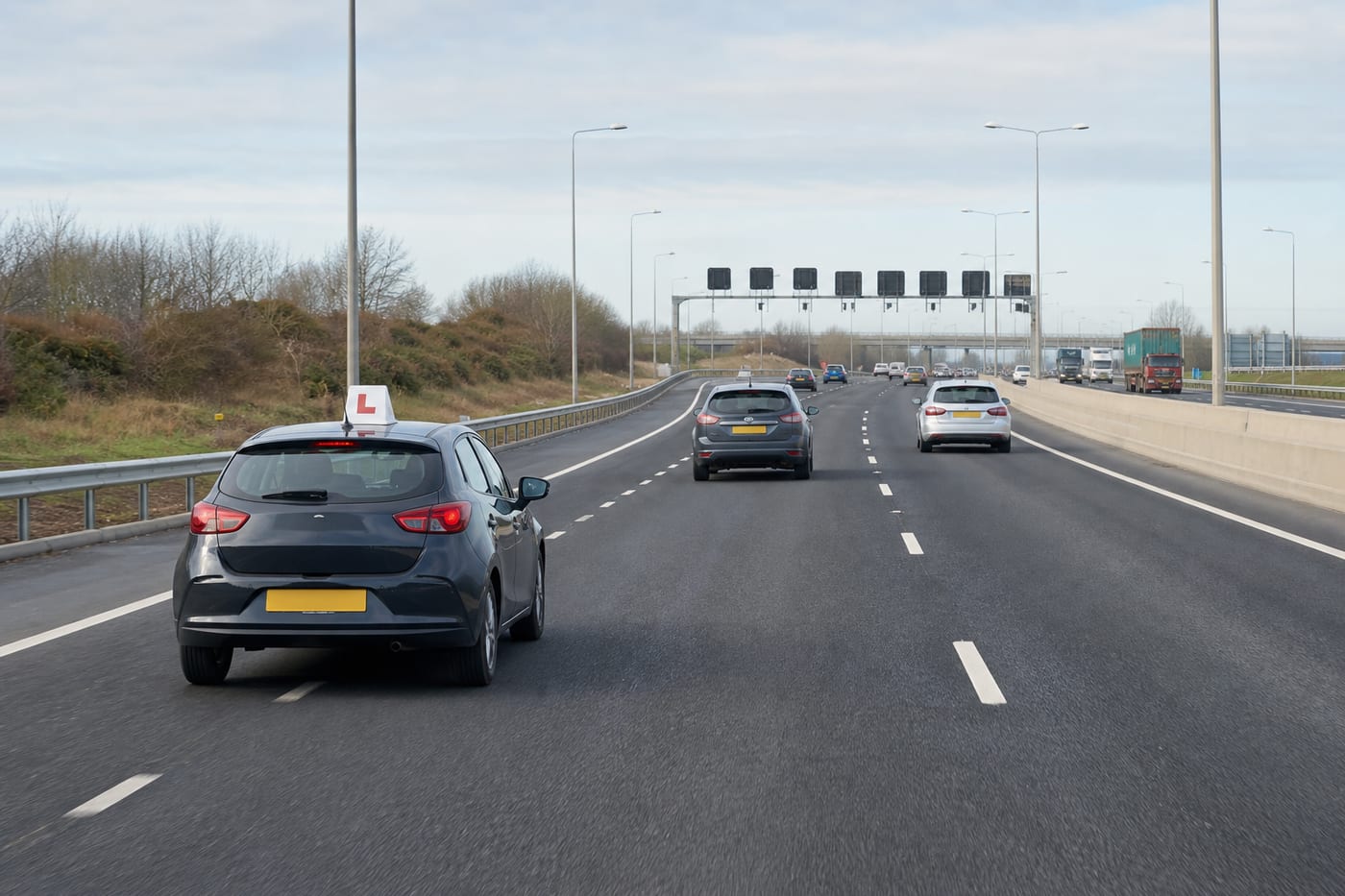
Learner drivers are allowed on motorways in Great Britain, but only under specific conditions. You cannot simply practise with a parent, friend or other supervising driver, even if they meet the usual rules for accompanying a learner.
Motorway lessons can give you valuable experience of joining fast-moving traffic, choosing lanes, overtaking and responding to motorway signals. However, they are voluntary and should only take place when your driving instructor believes you are ready.
This guide explains who can take a learner onto a motorway, the rules you must follow and the motorway topics most likely to matter in your theory test and future driving.
Can learner drivers drive on motorways?
In England, Scotland and Wales, a learner car driver may drive on a motorway only when:
- They are accompanied by an approved driving instructor, known as an ADI.
- The vehicle is fitted with dual controls.
- The instructor considers the learner ready for motorway driving.
- The vehicle is properly insured and displays L plates, or D plates where applicable in Wales.
An ordinary supervising driver cannot accompany a learner on a motorway. This remains the case even if the supervisor is over 21, has held a full licence for at least three years and is legally allowed to supervise the learner on other roads.
Learner motorcyclists are not allowed on motorways. The rules are also different in Northern Ireland, where learner drivers must not use motorways. Learners should therefore check the rules that apply where they are driving.
Are motorway lessons compulsory?
Motorway lessons are not compulsory, and motorway driving is not included in the standard car practical driving test. Test routes may use high-speed dual carriageways, but these are not the same as motorways.
You can pass your practical test without having driven on a motorway. Nevertheless, professional instruction before you begin driving independently can make your first solo motorway journey less intimidating.
Your instructor may initially teach the relevant skills on dual carriageways. You should be comfortable with mirrors, blind-spot checks, acceleration, lane changes and judging the speed of other vehicles before entering motorway traffic.
How to join a motorway safely
Motorways are normally joined using a slip road and acceleration lane. The purpose of the acceleration lane is to help you build an appropriate speed and find a safe gap in the traffic.
As you join:
- Observe the traffic on the motorway as early as possible.
- Use your mirrors and signal right in good time.
- Adjust your speed to fit safely into an available gap.
- Check around the vehicle, including the relevant blind spot.
- Merge smoothly without crossing solid white lines or forcing another road user to brake.
- Cancel your signal once established in the lane.
Traffic already on the motorway has priority. Other drivers may move over to help you join, but you must never assume they will. If necessary, adjust your speed to merge behind a vehicle rather than competing for the same gap.
Avoid stopping at the end of the slip road unless congestion or another genuine obstruction makes it unavoidable. Stopping removes your opportunity to match the speed of motorway traffic and can make joining more difficult.
Motorway speed limits for learner drivers
There is no separate lower motorway speed limit for learner car drivers in Great Britain. For a car, the national speed limit on a motorway is generally 70 mph unless signs show a lower limit.
However, 70 mph is a maximum rather than a target. Your speed must remain safe for the traffic, weather, visibility and road conditions. You may need to travel more slowly in heavy rain, strong winds, fog or congestion.
Temporary and variable speed limits displayed inside a red circle are mandatory. They apply even if the motorway appears clear. You should also reduce your speed when warning signals indicate congestion, an incident or another hazard ahead.
Driving unnecessarily slowly can create risk as well. Your instructor will help you make safe progress without exceeding the limit or holding up traffic without good reason.
Keep left unless you are overtaking
On a normal motorway, you should use the left-hand lane unless you are overtaking or signs and markings direct you elsewhere. After overtaking, return to the left when it is safe.
Remaining in the middle or right-hand lane when the left lane is clear is poor lane discipline. It reduces the motorway’s capacity and can cause frustration and unsafe overtaking by other drivers.
Before changing lanes, use a careful routine:
- Check your interior and relevant door mirror.
- Assess the speed and position of vehicles around you.
- Signal if it will benefit other road users.
- Check the blind spot where necessary.
- Move gradually into the lane when there is a safe gap.
Do not weave between lanes to gain a small advantage. You should not normally overtake on the left. In congestion, however, traffic in one lane may move faster than traffic to its right. If this happens, remain in your lane and avoid changing lanes simply to pass other vehicles.
Leave a safe following distance
Motorway speeds make following distance especially important. In dry conditions, allow at least a two-second gap from the vehicle ahead. At least double that gap in wet weather, and increase it substantially in snow or ice.
Large vehicles may block your view of hazards and signs. If you are too close to a lorry, its driver may also be unable to see you in their mirrors. Drop back until you can see clearly and be seen.
Our guide to maintaining proper stopping distances explains how speed, weather and road conditions affect the space required to stop.
Understand motorway signs and road studs
Motorway signs usually have a blue background. Direction signs show destinations, junction numbers and route information, while overhead gantries may display speed limits, lane closures and hazard warnings.
Reflective road studs can also help you understand the road layout:
- White studs separate lanes.
- Red studs mark the left edge of the carriageway.
- Amber studs mark the central reservation side.
- Green studs mark slip roads and lay-bys.
- Green-and-yellow fluorescent studs may indicate temporary changes, such as roadworks.
Never enter a lane displaying a red X. The lane is closed, and continuing in it is both dangerous and unlawful. Move into an open lane safely as soon as you see the closure signal rather than waiting until the last possible moment.
For more help recognising lane lines and temporary layouts, see our complete guide to UK road markings.
Rules for smart motorways and hard shoulders
Some motorway sections use technology such as overhead signals, variable speed limits and emergency areas to manage traffic.
On an all-lane-running section, there is no continuous hard shoulder. Emergency areas are positioned at intervals for vehicles that cannot continue. On some sections with dynamic hard-shoulder running, the hard shoulder may be opened as a traffic lane at busy times. Only use it as a running lane when signs clearly show that it is open.
A solid white line separates a hard shoulder from the main carriageway. You must not use the hard shoulder for normal driving unless signs direct you to do so. It must not be used to avoid congestion or reach an exit more quickly.
Always pay attention to overhead signals. Conditions ahead may be very different from those immediately around you.
What to do if you break down
If your vehicle develops a problem, try to leave the motorway at the next exit or service area. If that is not possible, move left into an emergency area or onto the hard shoulder where one is available. Stop as far left as possible, switch on your hazard warning lights and turn the front wheels towards the verge.
If you have stopped in a safe place on the left and can leave the vehicle safely, exit through the left-hand doors. Wait behind a safety barrier and stay well away from moving traffic. Do not place a warning triangle on a motorway.
Use an emergency telephone if one is available, as it provides the operator with your location. Otherwise, use a mobile phone to request assistance.
If your vehicle stops in a live traffic lane and you cannot reach a safer location, switch on your hazard lights and call 999 immediately. If it is not safe to leave, remain in the vehicle with your seat belt fastened and follow the emergency operator’s instructions.
Actions that are prohibited on a motorway
Learners should remember that motorway restrictions apply to all drivers. You must not:
- Stop on the carriageway except in an emergency, when instructed or because traffic forces you to stop.
- Reverse or make a U-turn.
- Drive on the hard shoulder unless it is an emergency or signs show that it is open for traffic.
- Cross the central reservation.
- Ignore a red X or mandatory speed limit.
- Pick up or set down passengers on the motorway.
If you miss your exit, continue to the next junction. Never stop, reverse or cross hatched areas in an attempt to recover the route.
How to leave a motorway
Look for advance signs showing your junction and move into the left-hand lane in good time. Signal left before entering the exit slip road, but avoid signalling so early that drivers think you intend to enter an earlier exit or stopping place.
Keep a suitable speed until you enter the slip road, then slow progressively. After travelling at motorway speed, a lower speed can feel slower than it really is, so check your speedometer rather than relying only on sensation.
At the end of the slip road, be prepared for bends, roundabouts, traffic lights or queues. The normal rules of observation, lane choice and signalling still apply. For broader advice covering longer journeys, changing conditions and motorway planning, consult our guide to safe motorway driving in the UK.
Practical tips for your first motorway lesson
Plan the lesson for a time when traffic and weather are manageable. Wear suitable footwear, adjust your seat and mirrors properly, and make sure you understand the route before setting off.
Listen to your instructor’s directions, but continue making your own observations. Avoid staring at the vehicle ahead. Look well into the distance, scan mirrors regularly and watch for brake lights, joining traffic and changing overhead signals.
Stay calm if another driver behaves impatiently. Do not exceed the speed limit or make a rushed lane change to satisfy someone behind you. Maintain a safe, predictable course and let your instructor help manage the situation.
Frequently asked questions
Can I drive on a motorway with a parent while learning?
No. In Great Britain, a learner car driver may only use a motorway when accompanied by an approved driving instructor in a dual-controlled car. The usual rules allowing a qualified family member or friend to supervise do not apply on motorways.
Will I have to drive on a motorway during my practical test?
No. Motorways are not used for the standard car practical driving test, although the route may include fast dual carriageways. Motorway lessons are optional.
Is a dual carriageway the same as a motorway?
No. A dual carriageway is a road where opposing traffic is separated by a central reservation. Its signs, restrictions and speed limit may differ from those on a motorway. Learners can drive on dual carriageways with a legally eligible supervisor; an ADI and dual controls are not specifically required as they are for motorway lessons.
Do learner drivers have to stay below 70 mph on a motorway?
All drivers must stay within the displayed limit, and 70 mph is generally the maximum for cars when the national speed limit applies. Learners do not have a separate lower motorway limit in Great Britain, but they must drive at a safe speed for the conditions.
Conclusion
Motorway lessons are not compulsory, but they can prepare you for safer independent driving. The key rules are to learn only with an approved instructor in a dual-controlled car, join without forcing other traffic to react, keep left unless overtaking, obey every signal and leave a generous following distance. With professional instruction and calm observation, motorway driving becomes far more manageable.