Passing your practical test gives you the freedom to use motorways without supervision, but your first motorway journey can still feel daunting. Traffic travels quickly, junctions can be busy and decisions often need to be made earlier than they would on an ordinary urban road.
The reassuring part is that motorways are designed to keep traffic moving in the same direction. There are no roundabouts, pedestrian crossings or vehicles emerging directly from side roads. Once you understand joining, lane discipline, safe following distances and motorway signals, the experience should become much more manageable.
These essential motorway tips will help you plan your first journeys and deal safely with the situations you are most likely to encounter.
Prepare before your first motorway journey
Good preparation reduces the number of decisions you need to make while travelling at motorway speeds. Before leaving, check your route, junction numbers and intended exit. A sat-nav can help, but you should not depend on it completely. Motorway signs and road markings remain your primary guide.
For an early motorway drive, try to choose:
- A familiar or relatively simple route
- Good weather and daylight
- A time when heavy traffic is less likely
- A journey with several service areas or alternative stopping points
Consider taking an experienced and calm driver with you. You can also arrange a post-test lesson focused on motorways if you want professional guidance. Our broader guidelines for newly licensed drivers cover other important steps after passing, including insurance and building experience gradually.
Check that your vehicle is ready for the journey. Make sure you have enough fuel or battery charge, your tyres are correctly inflated and your windows, mirrors and lights are clean. Oil, coolant and screen wash are especially important before a longer trip; use our beginner’s guide to checking vital engine fluids if you are unsure how to inspect them safely.
Joining the motorway safely
The slip road gives you space to build up an appropriate speed and find a suitable gap. Traffic already on the motorway has priority, so it is your responsibility to merge safely.
As you travel along the slip road:
- Look ahead to assess its length and the flow of traffic.
- Check your mirrors early and regularly.
- Adjust your speed to fit into a safe gap.
- Signal right when it will help other road users understand your intention.
- Check the lane beside you, including the blind-spot area.
- Merge smoothly without forcing another driver to brake or change direction.
Avoid joining much more slowly than the traffic unless congestion or conditions require it. A large speed difference makes merging harder for everyone. Equally, do not accelerate towards a gap that is clearly disappearing.
Use the available length of the slip road rather than attempting to enter immediately. Do not cross a solid white line separating the slip road from the motorway. If the slip road continues as its own lane, remain in it until you can change lanes safely.
Most importantly, never assume that another driver will move over to let you join. They might do so when it is safe, but you must be prepared to adjust your speed and merge behind them.
Keep left unless you are overtaking
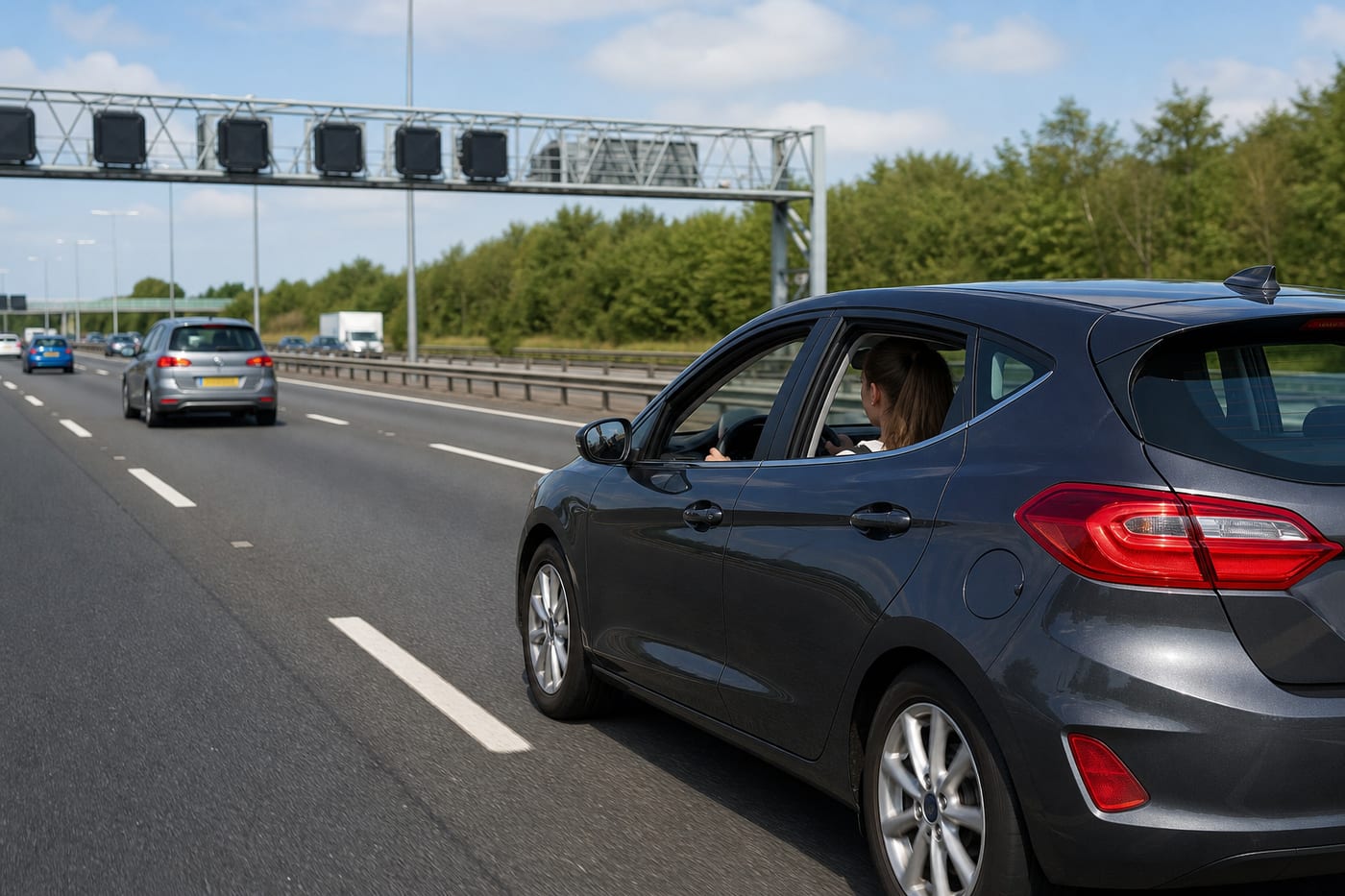
On a standard three-lane motorway, the left-hand lane is lane one, the middle lane is lane two and the right-hand lane is lane three. You should normally drive in the left-hand lane when the road ahead is clear.
Use the lanes to the right for overtaking. Once you have passed the slower vehicle and have left a safe gap, return to the left when it is safe. Remaining in the middle or right-hand lane unnecessarily can obstruct traffic and encourage other drivers to make unsafe manoeuvres.
Before changing lanes, use a simple routine:
- Check the road well ahead
- Check your interior and relevant door mirror
- Signal if it will benefit other road users
- Make a brief blind-spot check where necessary
- Move smoothly into the lane
- Cancel the signal after completing the manoeuvre
Do not weave between lanes to gain a small advantage. Frequent lane changes create additional risk and rarely save meaningful time.
You should normally overtake on the right. In congested conditions, traffic in one lane may move faster than traffic in another. You may keep up with the traffic in your lane, but should not deliberately weave left and right to pass vehicles.
Maintain a safe following distance
Motorway traffic can slow suddenly because of congestion, incidents or queues around junctions. Leaving enough space gives you time to recognise the problem and brake progressively.
In dry conditions, allow at least a two-second gap behind the vehicle ahead. Choose a fixed object, such as a bridge or marker post. When the vehicle in front passes it, say: “Only a fool breaks the two-second rule.” If you reach the object before finishing the phrase, drop back.
At least double the gap on wet roads. Ice, snow, fog, darkness and poor visibility may require a much greater distance and a lower speed. Our guide to maintaining proper stopping distances explains how road and weather conditions affect the space needed to stop.
Do not follow a large vehicle closely. It can block your view of signs, queues and changing traffic conditions. Leaving more space improves your visibility and helps the driver see you in their mirrors.
If somebody follows you too closely, do not brake sharply or try to teach them a lesson. Increase the space in front of your own vehicle so you can brake more gently, then move left when it is safe and allow the other driver to pass.
Treat the speed limit as a maximum
The national speed limit for a car on a motorway is 70 mph unless signs show a lower limit. This is a maximum, not a target. You must travel more slowly when required by traffic, weather, visibility or road conditions.
Some motorway sections use variable speed limits. A speed displayed inside a red circle is mandatory and must not be exceeded. The limit may be reduced because of congestion, roadworks, an incident or a hazard that you cannot yet see.
Avoid focusing only on the speedometer. Scan far ahead, check your mirrors frequently and look for changing signals. At motorway speeds, early observation is much safer than reacting at the last moment.
Understand red X signals
A red X above a lane means that the lane is closed. You must not drive in it. Move into an open lane as soon as you can do so safely, without cutting across other traffic.
The lane might be closed because of a collision, a breakdown, road workers or an obstruction. The danger may be beyond your current view, so never ignore the signal simply because the lane appears clear.
Arrows shown before a red X usually direct drivers away from the lane that is about to close. Respond early rather than waiting until you reach the closure.
A hard shoulder is also not an ordinary driving lane. Only use it in an emergency unless signs clearly indicate that it is open to normal traffic.
Plan overtaking rather than rushing it
Before overtaking, ask whether the manoeuvre is necessary and whether you can complete it without exceeding the speed limit. Check that the lane to your right is clear far enough behind and ahead.
Move out smoothly, pass without lingering beside the other vehicle and wait until you can see it clearly in your interior mirror before returning to the left. This helps you avoid cutting in too closely.
Take particular care near lorries. They have larger blind spots, need more room and may be affected by side winds. Do not remain alongside one unnecessarily. If a lorry is overtaking you, maintain a steady speed rather than accelerating and extending the manoeuvre.
Prepare for your exit early
Motorway exits are announced in advance through signs and countdown markers. The three countdown signs represent 300, 200 and 100 yards from the exit.
As your junction approaches:
- Check your mirrors and identify the correct lane early
- Move left in good time without making abrupt changes
- Signal left before entering the exit slip road
- Maintain a safe speed until you are on the slip road
- Reduce speed progressively for the road or junction ahead
After travelling at motorway speed, a lower speed can feel slower than it really is. Check your speedometer as you approach bends, traffic lights or a roundabout at the end of the slip road.
If you miss your exit, continue to the next junction and find a safe alternative route. Never stop, reverse or cross the hatched area separating the carriageway from the exit.
Stay alert on longer journeys
Motorway driving can become monotonous. If you feel tired, leave at the next safe opportunity and take a proper break. The Highway Code advises taking a break of at least 15 minutes after every two hours of driving. If necessary, stop sooner.
Do not rely on opening a window, turning up the radio or consuming caffeine as a substitute for rest. Never stop on the hard shoulder for a nap or routine break; use a service area or another suitable place away from the motorway.
Keep scanning the road rather than staring at the vehicle immediately ahead. Regularly check:
- Traffic several vehicles in front
- Your mirrors and surrounding lanes
- Gantry signals and speed limits
- Vehicles joining from slip roads
- Brake lights and developing queues
- Weather and road-surface changes
This active observation helps you detect hazards before they become urgent.
Know what to do if you break down
If your vehicle develops a problem, try to reach a place of relative safety, such as a service area, an emergency area or the hard shoulder where one is available. Move as far left as possible, switch on your hazard warning lights and stop.
If you are safely off the running lanes and can leave the vehicle, exit through the left-hand doors where possible. Move behind a safety barrier and stand well away from traffic. Do not attempt repairs beside the motorway and never place a warning triangle on the motorway.
Use an emergency telephone where available, or contact your breakdown provider. An emergency-area telephone can provide the operator with your location.
If you stop in a live traffic lane and cannot reach a safer place, switch on your hazard warning lights and call 999 immediately. If you cannot leave the vehicle safely, keep your seat belt fastened and remain inside while waiting for instructions. Do not step into moving traffic.
Build confidence gradually
Your first motorway drive does not need to be a long cross-country journey. Start with one or two junctions on a familiar route, then increase the distance as your confidence develops.
Concentrate on being predictable rather than trying to match impatient drivers. Keep a safe gap, obey signs, plan lane changes and allow extra time. Calm decisions are more valuable than fast ones.
For a more detailed explanation of motorway signs, smart motorway rules and emergency procedures, see our complete guide to safe motorway driving in the UK.
Frequently asked questions
Can I drive on a motorway immediately after passing my test?
Yes. Once you hold a full licence and are correctly insured for the vehicle, you can drive on a motorway without supervision. There is no requirement to complete an additional course, although a post-test motorway lesson can be useful if you lack confidence.
Which motorway lane should a new driver use?
You should normally use the left-hand lane when you are not overtaking. The middle and right-hand lanes are not “fast lanes”; they are primarily used for overtaking slower traffic before returning safely to the left.
What should I do if I miss my motorway exit?
Continue to the next junction and allow your sat-nav or route plan to find a safe alternative. Never reverse, stop on the carriageway or drive across the hatched area to recover a missed exit.
What does a red X above a motorway lane mean?
A red X means the lane is closed and you must not drive in it. Move into an open lane safely and as early as possible. The closure may protect people or vehicles from a danger that is not yet visible to you.
Conclusion
Motorway confidence comes from preparation, observation and predictable driving. Plan your route, join at an appropriate speed, keep left unless overtaking and leave plenty of space. By obeying signals and knowing what to do in an emergency, you can make your first motorway journeys calmer and safer.