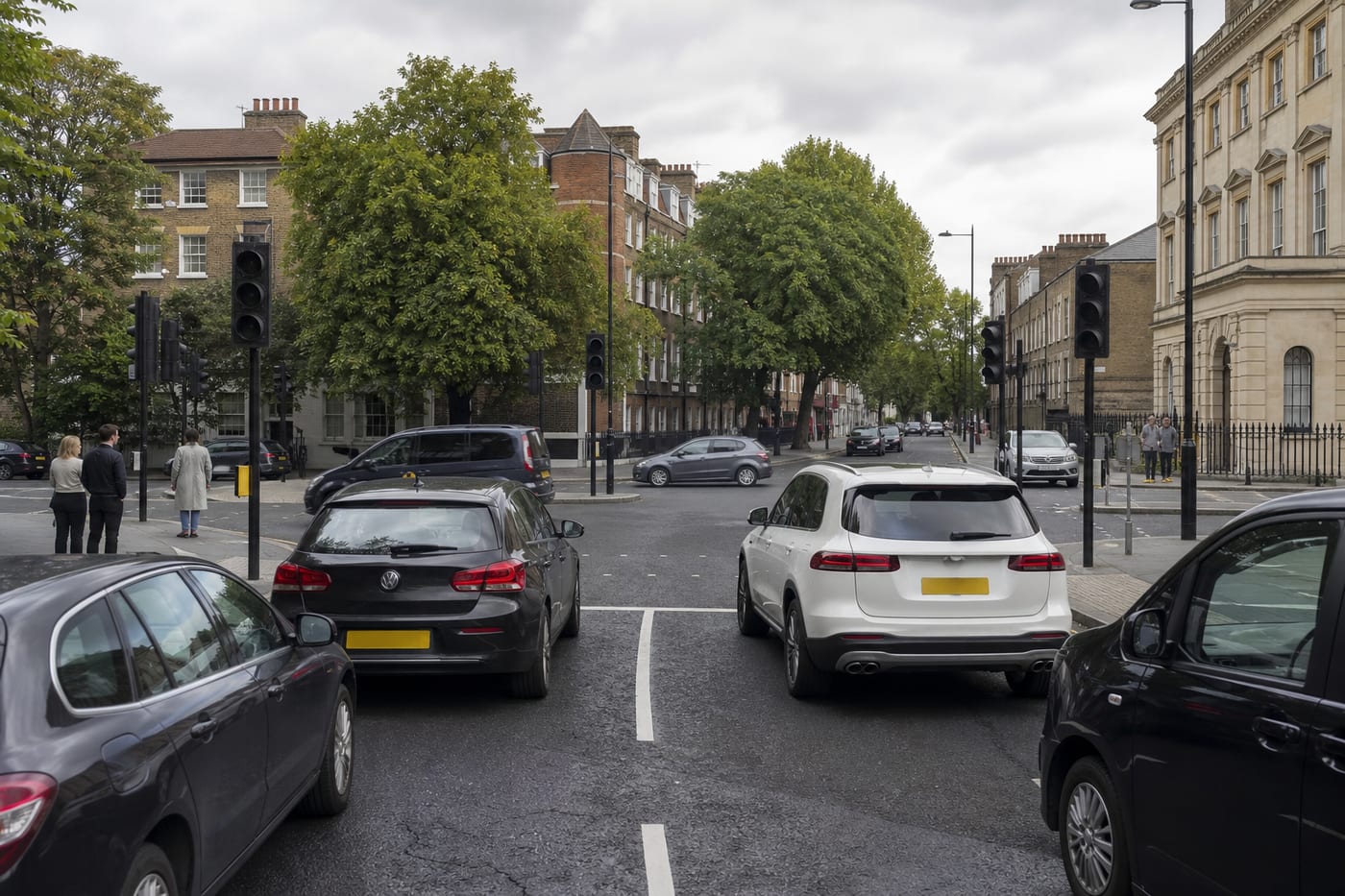
Broken traffic lights can turn a familiar junction into a confusing and potentially dangerous situation. Without the usual red, amber and green signals, drivers may be uncertain about who should move first.
The most important rule is simple: if traffic lights are not working, treat the situation with great care and proceed cautiously. A failed signal does not give anyone automatic priority, nor does it turn the junction into a first-come, first-served system.
As a learner driver, you need to reduce your speed, observe every approach and be prepared to stop. You should only enter when you are satisfied that other road users have seen you and it is safe to complete your movement.
What does the Highway Code say about broken traffic lights?
The Highway Code says that when traffic lights are not working, drivers should treat the situation with great care and proceed cautiously. This is deliberately broad because signal-controlled junctions vary considerably.
Some junctions have clear road markings or signs that continue to indicate priority. Others depend almost entirely on their signals. A large crossroads with several lanes, filter arrows and pedestrian crossings will require more caution than a small junction with good visibility.
There is no general UK rule saying that traffic from one particular direction automatically has priority when signals fail. Do not assume that:
- traffic on the wider or busier road goes first
- vehicles travelling straight ahead have priority
- the first vehicle to arrive must move first
- traffic approaching from the right automatically has priority
- an extinguished signal is permission to continue without stopping
Your task is to assess the actual junction, signs, markings, traffic and visibility.
For a reminder of how working signals operate, including red and amber lights and filter arrows, see our guide to the UK traffic light sequence.
Who has priority when traffic lights are out?
At many failed traffic-light junctions, the safest answer is that no driver should assume priority. Each road user must proceed carefully and co-operate with others.
Follow anyone authorised to control traffic
A police officer or another authorised person may take control of a junction when the signals have failed. Their directions must be obeyed, even when those directions differ from the traffic lights.
Slow down early and make sure you understand the signal being given. Do not copy the vehicle ahead without checking that the instruction also applies to you.
Continue to obey signs and road markings
Traffic lights may be broken while the junction’s signs and markings remain fully valid. Look for stop lines, give-way markings, lane arrows, prohibited-turn signs, one-way restrictions and yellow box markings.
A signal failure does not cancel these controls. For example, you must not enter a yellow box unless your exit is clear, subject to the normal exception for a right turn where applicable.
Be careful not to interpret the white traffic-light stop line as evidence that another road has priority. Its usual purpose is to show where vehicles must stop for a red signal. At some crossroads, there may be no separate markings that establish priority once the lights are out.
Traffic already in the junction needs space to leave
Do not enter merely because another vehicle has slowed down. First check whether vehicles already within the junction are clearing it, particularly those completing right turns.
Allow them to leave before you move. Blocking the centre creates further conflict and may trap pedestrians or cyclists between streams of traffic.
Roundabout rules may still apply
If signals fail at a signal-controlled roundabout, look carefully for roundabout signs and give-way markings. Where the layout and controls establish a normal roundabout, you should usually give priority to traffic approaching from your right, unless signs, markings or an authorised person direct otherwise.
Do not assume that every signal-controlled circular junction will be straightforward. Large spiral roundabouts may have several signal stages and lane divisions. If the route is unclear or traffic is not co-operating, wait rather than forcing your way into a gap. Our guide to UK roundabout types explains how signal-controlled and spiral layouts differ.
How to approach a junction with failed signals
A safe approach begins well before the stop line. The following routine gives you time to understand what is happening.
1. Check your mirrors and slow down
Check your interior and relevant door mirror before reducing speed. Drivers behind may not have noticed that the signals are out, so brake progressively where possible rather than stopping sharply.
Approach at a speed that allows you to stop within the distance you can see to be clear. Never maintain your normal junction speed simply because the road ahead appears open.
2. Look for evidence of a fault
A completely dark signal head is an obvious warning, but other faults may be less clear. Signals may be stuck on one colour, facing the wrong direction or showing apparently conflicting instructions.
Do not try to guess which traffic stream was intended to receive green. Treat unclear or contradictory signals as a serious hazard.
3. Observe every direction
Check right, left and ahead, including roads partly hidden by buildings, parked vehicles or queuing traffic. Look specifically for:
- motorcycles and bicycles filtering through queues
- pedestrians crossing between stationary vehicles
- buses or large vehicles hiding smaller road users
- drivers turning across your path
- emergency vehicles approaching from another direction
- vehicles moving unexpectedly because their driver assumes priority
A driver making eye contact or slowing down can be useful information, but it is not a guarantee. Avoid relying on gestures alone, as another road user may interpret them differently.
4. Stop if necessary
At a busy crossroads with failed signals, stopping may be essential even if there is no working red light. From a stationary position, reassess the whole junction rather than focusing only on the nearest vehicle.
Do not allow a driver behind to pressure you into moving. Sounding a horn does not change the priority or make an unsafe gap acceptable.
5. Move only when you can clear the junction
Before entering, confirm that your route and exit are clear. Proceed at low speed so that you retain time to respond, but avoid stopping unnecessarily in the path of cross traffic once committed.
Continue checking as you cross. A vehicle that was stationary may begin moving because its driver has reached a different conclusion about who should go first.
The same cautious judgement is needed at other junctions where priority is unclear. Our guide to priority at unmarked crossroads covers observation and co-operation in more detail.
What if the traffic light is stuck on red?
A signal that remains illuminated red is different from a set of lights that is completely unlit. A red light means you must stop behind the stop line.
Do not drive through merely because you have waited for a long time or believe the signal is faulty. Waiting does not turn red into permission to proceed. If possible, choose another route or wait for an authorised person to manage the junction.
Report the fault when you can do so safely. Never use a handheld phone while driving, and do not stop somewhere dangerous to make a report.
The same principle applies to temporary traffic lights at roadworks. If red is showing, stop at the indicated position. If temporary signals are completely out, do not enter a narrow controlled section unless you can establish that it is clear and safe. Oncoming traffic, road workers or construction vehicles may be hidden beyond the works.
Pedestrians and cyclists at failed signals
Pedestrian signals may fail at the same time as the main traffic lights. Expect pedestrians to be uncertain, and remember that some people may not realise there is a fault.
When turning at a junction, you should give way to pedestrians crossing or waiting to cross the road into which or from which you are turning. You must also allow anyone who has already started crossing to reach safety.
Cyclists can be harder to detect among stopped traffic, especially if they are travelling through a cycle lane or filtering beside a queue. Check mirrors and blind spots before turning, and do not cut across their path.
A nearby zebra crossing remains a zebra crossing even if unrelated junction signals have failed. Its normal priority rules and zigzag restrictions continue to apply.
Common mistakes learner drivers should avoid
Broken signals test judgement rather than confidence alone. Common errors include:
- following the vehicle ahead without making an independent observation
- assuming the main road has priority when no sign or marking confirms it
- entering because another driver flashes their headlights
- looking only right and left while forgetting oncoming turning traffic
- stopping in the centre because the exit was blocked
- moving through an illuminated red signal because it appears stuck
- accelerating aggressively to claim a gap
- concentrating on vehicles while overlooking pedestrians and cyclists
During a practical test, the examiner will not expect you to take an unnecessary risk. Show that you have identified the fault by slowing down, making effective observations and responding calmly. You must not break the law simply to avoid holding up traffic.
Reporting broken traffic lights safely
Faulty permanent traffic lights can usually be reported to the relevant highway authority. Depending on the road, this may be a local council, Transport for London, National Highways or another responsible authority.
Record the location and nature of the fault only if it is safe to do so. A road name, nearby junction and description such as “all signals unlit” will be more useful than a vague report.
Make the report after parking safely, or ask a passenger to do it. If the failure is creating an immediate and serious danger, contact the emergency services. Do not stand in the carriageway or attempt to direct traffic yourself.
Conclusion
When traffic lights fail, nobody gains an automatic right to go first. Slow down, check for valid signs and markings, observe every approach and only move when you can clear the junction safely.
If a red light is still illuminated, remain behind the stop line. Above all, avoid assumptions: patience and careful co-operation are safer than trying to claim priority.
Frequently asked questions
Do traffic lights become a four-way stop when they break in the UK?
No. The UK does not have a general rule turning every failed signal-controlled junction into a four-way stop. Drivers should treat the junction with great care, follow any signs or markings and proceed only when safe.
Can I drive through a traffic light that is stuck on red?
You must not cross the stop line while a red signal is illuminated. Do not decide for yourself that waiting has made it safe or legal to continue. Use another route, wait for the fault to be managed or follow directions from an authorised person.
Does traffic on the main road have priority when the lights are out?
Not automatically. Signs and road markings may establish priority, but the size or appearance of a road does not do so by itself. If priority is unclear, slow down, be prepared to stop and co-operate with other road users.
What should I do if the lights fail during my driving test?
Reduce speed, check your mirrors, observe the entire junction and proceed only when it is safe and legal. Do not follow another vehicle blindly or cross an illuminated red signal. The examiner will assess whether your observations and decisions are safe.