Contraflow systems can feel intimidating when you first encounter one. Traffic may be diverted onto an unfamiliar part of the road, lanes are often narrower than usual, and vehicles travelling in opposite directions can appear much closer than expected.
The key is to recognise the system early, reduce your speed smoothly and follow the temporary signs and markings. You should also leave a safe gap and avoid making unnecessary lane changes.
Contraflows are particularly common around major roadworks, including on motorways and dual carriageways. However, the term can also describe permanent arrangements that allow buses or cyclists to travel against the usual direction of traffic on an urban street.
Understanding both types will help you answer theory test questions and deal with them confidently during lessons and after passing your test.
What is a contraflow system?
A contraflow system temporarily or permanently changes the normal direction in which traffic uses part of a road.
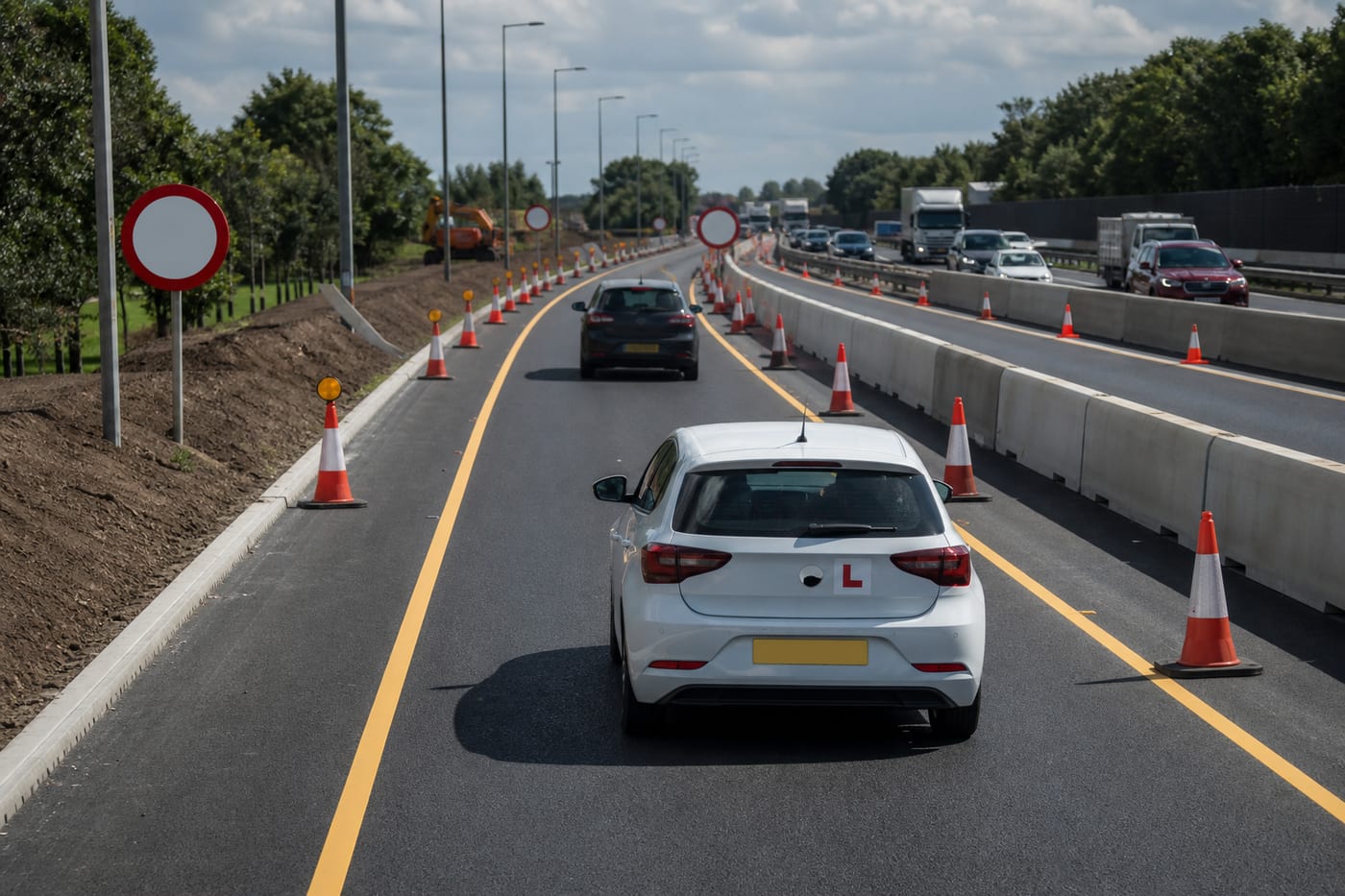
At major roadworks, one side of a dual carriageway or motorway may be closed. Traffic that would normally use the closed carriageway is guided through a crossover and onto the opposite carriageway. That carriageway is divided so that traffic can travel in both directions while remaining separated by cones or a temporary barrier.
As a result, you might find yourself driving on the opposite side of the central reservation from normal. Although this can initially seem strange, the temporary signs, cones and lane markings are designed to guide you through the altered layout.
Urban contraflow lanes work differently. For example, a one-way street may contain a lane that allows buses or cyclists to travel in the opposite direction. Signs at the entrance identify which vehicles may use the lane.
How to recognise a contraflow at roadworks
Advance signs normally warn you that roadworks and a changed road layout are ahead. A contraflow sign uses arrows to show traffic travelling in opposing directions within the temporary arrangement.
You may also see:
- Temporary speed limits
- Signs showing lane closures or changes
- Yellow temporary road markings or studs
- Traffic cones and barriers
- Narrow-lane warnings
- Instructions to move into a particular lane
- Restrictions affecting wide or heavy vehicles
Look well ahead rather than waiting until you reach the cones. Early observation gives you time to understand the layout, check your mirrors and move into the correct lane without rushing.
Signs at roadworks are instructions, not suggestions. Follow the displayed speed limit and any lane restrictions, even if the road appears quiet or workers are not visible. If you need to strengthen your knowledge, revise the hardest UK road sign questions alongside your contraflow practice.
How to approach a contraflow safely
Check your mirrors early
As soon as you see roadworks or a contraflow warning, check your interior and door mirrors. This tells you how close following traffic is and whether another vehicle is alongside you.
If your lane is closing, plan your move in good time. Signal where necessary and change lanes only when there is a safe gap. Do not force another driver to brake sharply or swerve.
Reduce speed progressively
Ease off the accelerator and slow down smoothly for the temporary speed limit. Harsh braking can surprise following drivers, particularly in dense motorway traffic.
Your speed should also reflect the conditions. A posted limit is the maximum permitted speed, not a target. Narrow lanes, rain, poor visibility or heavy traffic may require you to drive more slowly.
Choose the correct lane
Use the information on the approach signs to select an appropriate lane. Some contraflow lanes may have width restrictions, so larger vehicles could be directed elsewhere.
Once you have entered the system, stay in your lane unless signs direct you to move or a lane change is genuinely necessary and permitted. Unnecessary weaving increases risk where space is limited.
Follow temporary markings
Roadworks can include temporary markings that alter the normal lane layout. Follow the markings, studs, cones and signs that apply to the temporary arrangement rather than relying on your memory of the road.
Avoid drifting towards old or covered markings. Keep your eyes directed towards the safe path ahead, using the temporary lane boundaries as your guide. Our complete guide to UK road markings can help you revise how permanent and temporary markings communicate road layouts.
Driving through narrow contraflow lanes
Lane discipline is especially important because contraflow lanes are often narrower than standard motorway lanes.
Look well ahead and make small, smooth steering adjustments. If you stare at the barrier or at a large vehicle beside you, you may unintentionally steer towards it. Focus primarily on the centre of the space available in your lane while continuing to scan for hazards.
Hold the steering wheel securely and maintain a steady course. Avoid sudden braking, acceleration or steering. Smooth control makes your actions easier for other drivers to predict.
Be particularly careful around lorries, buses and vehicles towing trailers. They need more room and may appear very close in a narrow layout. Do not remain beside a large vehicle unnecessarily, but never accelerate beyond the speed limit to pass it.
Strong crosswinds can also affect vehicles as they pass gaps in barriers or emerge from alongside large vehicles. Be prepared to make a gentle correction without overreacting.
Keep a safe following distance
A generous gap gives you more time to react if traffic ahead slows or stops. In dry conditions, use at least the two-second rule. Allow at least double that gap on wet roads and a much larger gap in icy conditions.
Do not reduce the gap simply because traffic behind is close. Tailgating leaves you with little time to respond and restricts your view of signs, lane markings and brake lights ahead.
Try to look beyond the vehicle immediately in front. This can help you notice a queue developing before its driver brakes. For a fuller explanation, review how to maintain proper stopping distances.
Common hazards in a contraflow system
Roadworks create a changing environment, so scan continuously for potential problems. Typical hazards include:
- Queues forming beyond a bend or crest
- Sudden braking as lanes narrow
- Drivers changing lanes late
- Large vehicles occupying much of a narrow lane
- Broken-down vehicles with limited space around them
- Workers or roadworks vehicles near live traffic
- Temporary surfaces, ramps or uneven joins
- Cones moved out of position
- Glare, spray or poor visibility
- Drivers distracted by the roadworks
Opposing traffic can also be closer than usual. Do not cross a line of cones or a temporary barrier, and never attempt a U-turn or use a works access point.
What if you break down in a contraflow?
A breakdown in roadworks can be especially dangerous because there may be no hard shoulder or safe refuge immediately available.
If your vehicle develops a problem, try to reach a place of relative safety only if you can do so without putting anyone at greater risk. Switch on your hazard warning lights and follow any emergency signs or instructions provided at the location.
If you stop in a live traffic lane and cannot leave the vehicle safely, keep your seat belt fastened, switch on the hazard lights and call 999. Make the operator aware that you are in a live lane. Do not attempt a repair where moving traffic puts you at risk.
Before a longer motorway journey, basic checks of tyres, fuel or charge, lights and fluid levels can reduce the chance of an avoidable breakdown.
Urban bus and cycle contraflows
Not every contraflow involves motorway roadworks. In towns and cities, a one-way street may include a lane for buses or cyclists travelling in the opposite direction.
A bus contraflow lane is usually identified by signs and road markings. Unless signs allow your vehicle to use it, keep out. Never assume that all traffic will approach from the direction expected on an ordinary one-way street.
Contraflow cycle lanes may be marked or separated from other traffic. When emerging from a junction, crossing the lane or opening a car door, check carefully for cyclists approaching from either direction.
These arrangements make observation particularly important. Look for signs at the entrance to the street and check both ways before moving across another road user’s path.
Mistakes learner drivers should avoid
Entering too fast
Excess speed gives you less time to interpret the altered layout and makes it harder to stay accurately within a narrow lane. Slow down before entering rather than braking sharply inside the system.
Following the vehicle ahead blindly
The driver in front may choose the wrong lane or react too late. Read signs and markings for yourself instead of treating another vehicle as your guide.
Fixating on barriers or opposing traffic
Looking continuously at the barrier can cause your steering to drift. Keep your vision directed towards where you want the car to go while maintaining general awareness of surrounding traffic.
Changing lanes at the last moment
Late changes create conflict and may place you in another vehicle’s blind spot. Plan ahead, check mirrors and move only when safe.
Driving too close
A short following distance reduces your view and leaves little braking space. Keep a proper gap even if another driver moves into it; simply restore the distance smoothly.
Contraflow questions in the theory test
Theory test questions may ask you to recognise a contraflow sign, identify an appropriate speed or choose the safest action in narrow lanes.
Remember these core principles:
- Observe warning signs early
- Obey temporary speed limits and lane restrictions
- Keep a safe distance from the vehicle ahead
- Stay within the temporary lane markings
- Avoid unnecessary lane changes and overtaking
- Expect queues and sudden changes in traffic speed
- Watch for road workers and works vehicles
Do not memorise only the appearance of one sign. Understand what the altered traffic flow means and how it affects your positioning, speed and observations.
Practical lesson tips for building confidence
Ask your driving instructor to explain roadworks signs before you encounter a major contraflow. You can also practise narrow-lane positioning on a suitable road without needing to enter motorway roadworks immediately.
If your lessons include motorway or dual-carriageway driving, talk through the advance signs aloud when it is safe to do so. Identify the speed limit, lane closures and intended route before reaching the changed layout.
When driving independently, avoid rushing because another motorist appears impatient. Your priorities are to obey the signs, maintain control and leave enough space to react.
Conclusion
Contraflow systems are easier to manage when you prepare early. Read the advance signs, reduce speed smoothly, choose the correct lane and follow temporary markings carefully. Once inside, maintain a safe following distance, use steady steering and avoid unnecessary manoeuvres.
Treat every contraflow as a changing road environment. Good observation and calm decisions will help you navigate it safely in lessons, during your theory preparation and after you pass.
Frequently asked questions
What does a contraflow system mean?
It means that traffic is directed against its normal flow on part of a road. At major roadworks, traffic from one carriageway may be diverted onto the other. In urban areas, a contraflow lane may allow buses or cyclists to travel against the usual one-way direction.
Can you overtake in a contraflow system?
Follow the signs, markings and restrictions displayed at the roadworks. Even where changing lanes is possible, avoid unnecessary overtaking because lanes may be narrow and traffic conditions can change quickly. Never cross cones, barriers or prohibited markings.
Why are lower speed limits used in contraflows?
Contraflows may have narrow lanes, altered road surfaces, limited recovery space, road workers nearby and opposing traffic closer than normal. A lower limit helps drivers negotiate these conditions with more time and control.
What should I do if I choose the wrong lane?
Remain calm and follow the lane safely. Do not make a sudden or prohibited move through cones or barriers. Continue until signs provide a safe and legal opportunity to correct your route, even if that means taking a longer journey.