Puffin, toucan and pelican crossings all use traffic lights to help people cross the road, but they do not operate in exactly the same way. For learner drivers, recognising the differences is important both for the theory test and for safe everyday driving.
The most obvious distinctions involve who can use the crossing, where pedestrian signals are positioned and whether the traffic lights include a flashing amber phase. However, your basic responsibility remains consistent: approach at a safe speed, watch for people near the crossing and obey the signals.
This guide explains how each crossing works, what drivers should do and which common mistakes to avoid.
Why crossing types matter to learner drivers
Questions about pedestrian crossings can test more than your ability to recognise street furniture. You may need to understand the light sequence, decide when you may proceed or identify a developing hazard.
Crossings also demand careful judgement during driving lessons and the practical test. A person approaching the kerb may press the button, step towards the carriageway or cross before you expect them to. Cyclists at toucan crossings can arrive more quickly than pedestrians, making early observation particularly important.
For an overview that also covers zebra and equestrian crossings, see our guide to UK pedestrian crossings.
What is a pelican crossing?
A pelican crossing is a signal-controlled pedestrian crossing operated using a push button. Its name comes from “pedestrian light-controlled crossing”.
Traditional pelican crossings usually have the red and green pedestrian figures on the opposite side of the road. People waiting to cross look across the carriageway to see their signal.
The feature learners most need to remember is the flashing amber traffic light. Pelican crossings are the type associated with this special phase.
The pelican crossing light sequence
When the crossing has been activated, drivers will normally see:
- A green light, meaning traffic may proceed if the road is clear.
- A steady amber light, meaning stop unless you have already crossed the stop line or stopping could cause an accident.
- A red light, requiring traffic to stop.
- A flashing amber light after the red phase.
- A green light when the crossing sequence has finished.
At flashing amber, you must give way to anyone still on the crossing. If the crossing is completely clear, you may proceed with care. You do not have to wait for green when nobody remains on the crossing.
This is a frequent source of theory test mistakes. Flashing amber does not mean that you may drive around pedestrians or pressure them to hurry. It gives pedestrians already crossing priority.
What pedestrians see
Pedestrians receive a green figure when they may begin crossing. A flashing green figure warns them not to start crossing, although anyone already on the crossing should have time to finish.
As a driver, concentrate on whether the crossing is occupied rather than assuming everybody will respond perfectly to their signal. Children, older people and disabled pedestrians may require additional time.
What is a puffin crossing?
“Puffin” comes from “pedestrian user-friendly intelligent crossing”. Like a pelican crossing, it is intended for pedestrians and is controlled by traffic lights.
A puffin crossing normally places the red and green pedestrian figures on the near side, usually above or beside the push-button unit. This allows pedestrians to view their signal while also facing approaching traffic.
Puffin crossings use detectors to help manage the crossing phase. A detector can recognise whether someone is still crossing, while another may detect whether a person who pressed the button has walked away before the signals change.
How puffin crossings differ from pelican crossings
The key theory test differences are:
- Puffin pedestrian signals are normally on the near side.
- Puffin crossings use detectors to monitor pedestrians.
- They do not use the pelican crossing’s flashing amber traffic-light phase.
- Drivers follow the normal red, red-and-amber and green sequence before moving again.
The detectors can help provide pedestrians with sufficient time, but drivers should never rely entirely on the technology. Before moving on green, check that nobody remains in front of you.
Why near-side signals help
A pedestrian waiting at a puffin crossing can look at the signal and approaching vehicles in roughly the same direction. This can reduce the temptation to stare across the road while traffic is still moving.
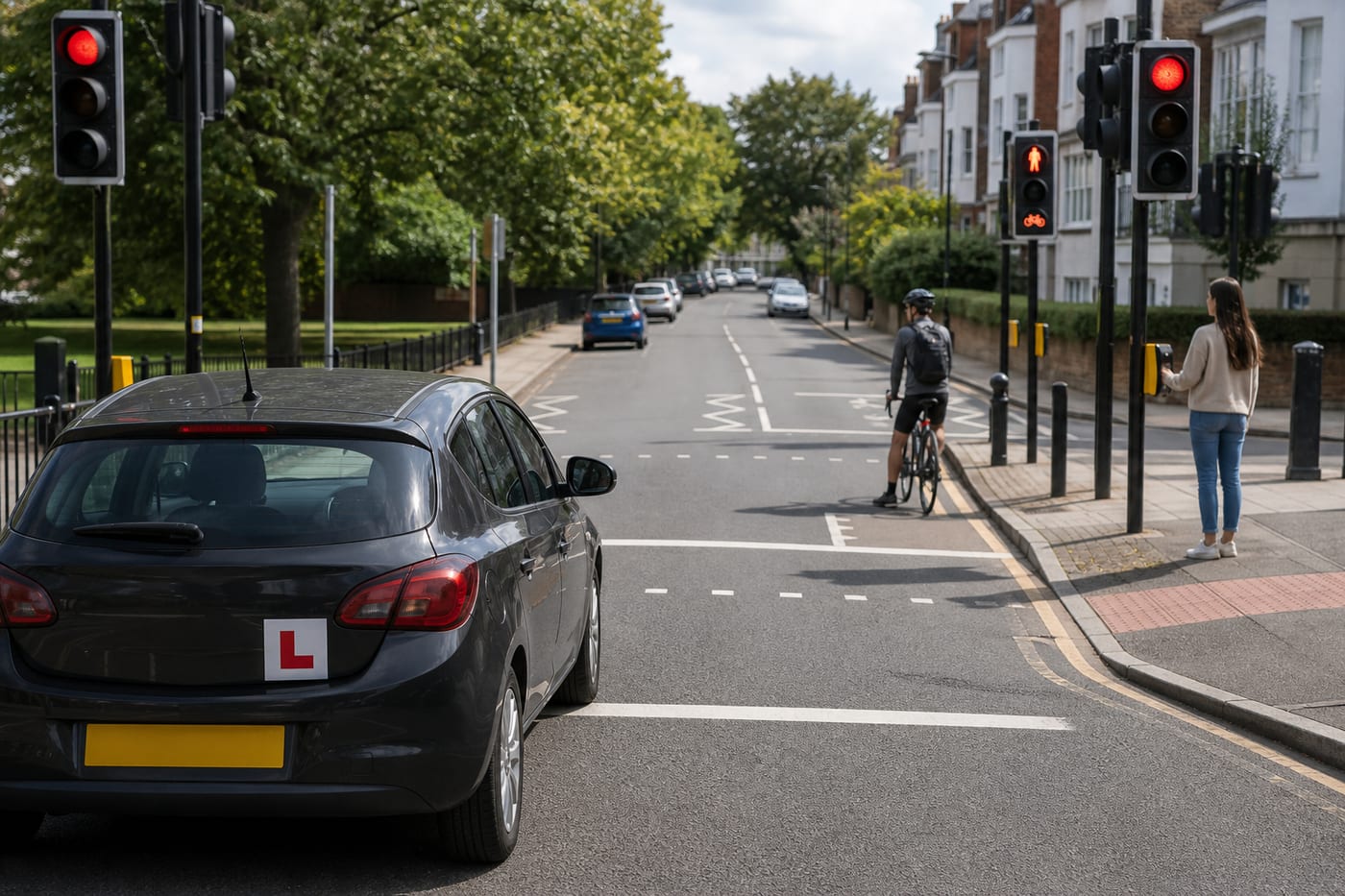
From the driver’s perspective, the near-side pedestrian signal may be less obvious. Look for the traffic lights, stop line, zigzag markings and push-button unit rather than relying only on seeing a red or green pedestrian figure across the road.
What is a toucan crossing?
A toucan crossing is designed for both pedestrians and cyclists. The name is a useful memory aid: “two can” cross together.
Unlike at ordinary pedestrian-only crossings, cyclists may ride across a toucan crossing. The crossing is generally wider to provide enough room for both types of user, and its signals display pedestrian and cycle symbols.
Toucan crossings are frequently found where cycle routes meet or cross busy roads. Signal layouts can vary, so identify them by the pedestrian and cycle symbols rather than assuming every installation will look identical.
The main risk at a toucan crossing
Cyclists can approach considerably faster than people on foot. A cyclist who appears some distance from the crossing can reach it quickly, particularly on a downhill route.
When approaching, check pavements and cycle tracks on both sides. Reduce speed early if your view is limited by parked vehicles, signs, foliage or street furniture. Be prepared for the signals to change if someone is close to the controls.
Drivers should obey the traffic lights and remain behind the stop line while the red signal is showing. When the lights permit you to move, check that pedestrians and cyclists have cleared your path first.
Pelican vs puffin vs toucan: the essential differences
The following memory points can help with revision:
| Crossing | Main users | Pedestrian signals | Distinctive feature | |---|---|---|---| | Pelican | Pedestrians | Usually on the far side | Flashing amber phase for drivers | | Puffin | Pedestrians | Normally on the near side | Uses detectors; no flashing amber | | Toucan | Pedestrians and cyclists | Pedestrian and cycle symbols | Cyclists may ride across |
Do not base a real-world decision solely on the crossing’s name. Road layouts and signal installations can change over time. Your immediate priorities are the traffic signal, the stop line and the people using or approaching the crossing.
How to approach a signal-controlled crossing safely
A reliable routine will help you deal with all three crossing types.
1. Look well ahead
Scan for traffic lights, zigzag markings, central islands, push-button units and people near the kerb. Spotting the crossing early gives you time to adjust smoothly.
A crossing is also a useful clue in hazard perception clips. Someone turning towards the button or a cyclist approaching a toucan crossing may develop into a situation requiring you to slow or stop. Our guide to identifying road hazards as a driver explains how to recognise these changes early.
2. Check your mirrors
Before reducing speed, check the appropriate mirrors so you know what is behind you. Brake progressively where possible, but do not continue through a red light simply because another driver is following too closely.
3. Control your speed
Approach at a speed that allows you to respond if the lights change. Never accelerate merely to beat an amber signal.
A steady amber light means stop at the stop line unless you have already crossed it or are so close that stopping could cause an accident. It is not an invitation to speed up.
4. Stop in the correct place
Stop before the white stop line. Do not allow the front of the vehicle to project over it or into the crossing.
If traffic is queuing beyond the crossing, wait before entering until there is enough room for your whole vehicle on the other side. You should not block the crossing while stationary, even if the light is green when you approach.
5. Check before moving away
A green light permits you to proceed, but only when it is safe. Look for pedestrians who are still crossing, cyclists arriving from the side and vehicles that may be obstructing your view.
Move away smoothly without revving the engine or using the horn to hurry anyone.
Zigzag markings and overtaking rules
Signal-controlled crossings are often surrounded by white zigzag markings. These markings help preserve visibility and protect crossing users.
You must not park on the crossing or in the area covered by its zigzag markings. You must also not overtake the moving vehicle nearest the crossing or a vehicle that has stopped nearest the crossing to give way to pedestrians.
These restrictions matter because an overtaking driver may be unable to see someone crossing in front of the stopped vehicle. You can revise this topic in more depth with our complete guide to UK road markings.
Common mistakes to avoid
Confusing steady and flashing amber
Steady amber tells you to stop unless it would be unsafe to do so. Flashing amber is specific to pelican crossings and allows you to proceed only when the crossing is clear.
Moving as soon as the light turns green
Check the crossing before moving. A slow pedestrian, wheelchair user or cyclist may still be in your path.
Watching only the lights
Signals are essential, but observation must include the pavements, cycle paths and crossing itself. People do not always behave predictably.
Blocking the crossing in congestion
A green light does not guarantee space beyond the crossing. Wait if your vehicle would become stranded across it.
Waving someone across
Avoid beckoning pedestrians into the road. Another road user may not have seen them, and you cannot guarantee that every direction is safe. Stay stopped where required and allow the pedestrian to make their own decision.
Assuming cyclists must dismount at a toucan crossing
Toucan crossings are specifically designed to be shared by pedestrians and cyclists. Be ready for cyclists to ride across when their signal allows.
A simple revision method
Use three short associations:
- Pelican = flashing amber.
- Puffin = near-side signals and detectors.
- Toucan = pedestrians and cyclists.
Then practise applying the rules to scenarios rather than memorising names alone. Ask yourself who may cross, what the light means and whether the crossing is clear. This makes your knowledge more useful in both multiple-choice questions and hazard perception clips.
Frequently asked questions
Can I drive through a pelican crossing on flashing amber?
Yes, but only if there is nobody on the crossing. You must give way to any pedestrian who is still crossing and wait until they are safely clear of your path.
Do puffin crossings have a flashing amber phase?
No. Puffin crossings use the normal traffic-light sequence rather than the flashing amber phase associated with pelican crossings. Always obey the signal facing you.
Can cyclists ride over a toucan crossing?
Yes. Toucan crossings are designed for pedestrians and cyclists to share, so cyclists do not have to dismount to use the crossing.
Should I stop when someone is only waiting beside a puffin or pelican crossing?
Follow the traffic signals and approach cautiously. A person waiting may activate the crossing, so be prepared for the lights to change. If the signal turns red, stop behind the stop line.
Conclusion
Pelican, puffin and toucan crossings become easier to navigate once you remember their defining features. Pelicans use flashing amber, puffins use near-side signals and detectors, and toucans allow pedestrians and cyclists to cross together.
Whatever the crossing type, look ahead, control your speed, obey the lights and check that the crossing is clear before proceeding. Safe drivers treat the signals as one part of a wider observation routine rather than relying on them alone.