

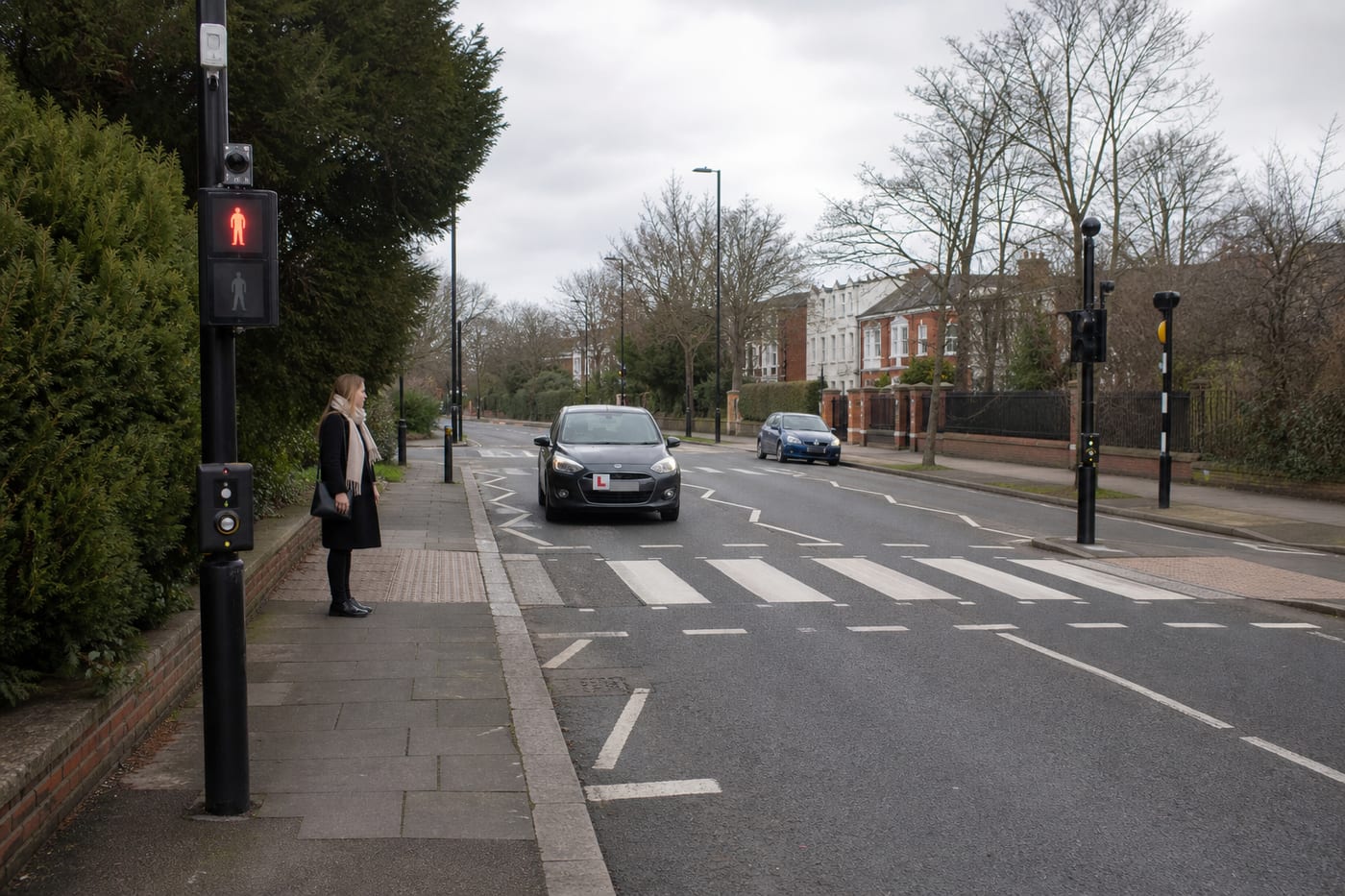
Puffin crossings are signal-controlled pedestrian crossings designed to make crossing the road safer and more convenient. As a learner driver, you need to recognise them early, understand their light sequence and know how their sensors affect the crossing phase.
A puffin crossing may initially look similar to a pelican crossing, but there are important differences. The pedestrian signals are normally beside the person waiting rather than on the opposite side of the road, and the crossing uses sensors to monitor pedestrians. For drivers, one of the most important facts is that puffin crossings do not have a flashing amber phase.
Understanding these details will help you answer theory test questions and respond correctly during driving lessons and your practical test.
What is a puffin crossing?
The name “puffin” comes from Pedestrian User-Friendly Intelligent crossing. It is a type of traffic-light-controlled crossing intended primarily for pedestrians.
A pedestrian normally activates the crossing by pressing a button. Instead of relying only on a fixed amount of crossing time, sensors monitor the waiting area and the crossing itself. This allows the system to respond more intelligently to what pedestrians are doing.
For example, a kerbside sensor may detect whether someone is still waiting. If the person presses the button but then walks away or crosses elsewhere before the lights change, the request may be cancelled where the system determines that nobody remains at the crossing.
Other sensors can detect pedestrians who are still on the carriageway. The traffic signal phase can then allow them enough time to finish crossing before vehicles receive a green light. Drivers must still remain patient and obey the signals rather than assuming that the lights are taking too long.
How to identify a puffin crossing
Several features can help you distinguish a puffin crossing from other UK pedestrian crossings.
Nearside pedestrian signals
At a puffin crossing, the red and green pedestrian symbols are normally displayed on the same side of the road as the waiting pedestrian. They are usually incorporated into or positioned just above the push-button unit.
This arrangement encourages pedestrians to look towards approaching traffic while checking the signal. It also makes the signal easier to see at close range.
At older pelican crossings, the pedestrian signals are typically positioned on the opposite side of the road. However, learners should consider the complete layout rather than relying on just one feature.
Pedestrian sensors
Puffin crossings have sensors directed towards the waiting area and crossing. These may be visible as small detector units mounted on or near the signal poles.
You do not need to identify the exact type of sensor for your theory test. The important point is that the system can detect whether pedestrians are waiting and whether they are still crossing.
No flashing amber phase
Unlike a pelican crossing, a puffin crossing does not give drivers a flashing amber signal. Its vehicle lights use the normal traffic-light sequence.
This distinction is particularly important in theory test questions. At a pelican crossing, flashing amber allows a driver to proceed only when the crossing is clear, while giving way to pedestrians who are still crossing. At a puffin crossing, drivers wait for the normal red and red-and-amber phases to finish and do not move until green appears and it is safe to proceed.
For a broader comparison, see our guide to UK pedestrian crossings.
How the puffin crossing sequence works
Although the exact waiting time can vary according to the location and traffic conditions, the basic process is straightforward.
- A pedestrian presses the button and waits.
- The system confirms the request, usually with an illuminated indicator on the push-button unit.
- Traffic continues while the signals complete the necessary sequence.
- Drivers receive an amber light followed by red and must stop.
- The pedestrian signal changes to green when it is time to cross.
- Sensors monitor pedestrians using the crossing.
- Once the pedestrian phase is complete and the crossing is clear, drivers receive red and amber, followed by green.
Pressing the button does not necessarily make the traffic lights change immediately. The crossing may need to coordinate with nearby junctions, other signals or the safe flow of traffic.
Pedestrians should therefore wait for the green figure rather than assuming vehicles will stop as soon as the button is pressed.
What each traffic-light signal means for drivers
Puffin crossings use familiar traffic-light signals, but you must respond correctly to each one.
Green
Green means you may proceed if the crossing and the road ahead are clear. It does not give you permission to drive at a pedestrian who is still crossing or to enter an area that you cannot clear.
Check both sides of the crossing before moving. A pedestrian may be walking slowly, a child may be partially hidden, or someone may have entered late.
Amber
A steady amber light means stop at the stop line. The exception is when you have already crossed the line or are so close that stopping could cause a collision.
Do not accelerate to “beat” the red light. On approach, ease off the accelerator and be prepared to stop, particularly if pedestrians are waiting near the push-button unit.
Red
Red means stop behind the stop line. Do not allow the front of your vehicle to project into the crossing.
Remain stopped even if you cannot see anyone crossing. The signal may be serving a pedestrian who is outside your immediate view, and moving through a red light is both dangerous and unlawful.
Red and amber
Red and amber together mean stop, but prepare to move. Do not cross the stop line until green appears.
Before moving, check that pedestrians have cleared the carriageway and that there is enough space beyond the crossing for your vehicle.
How learner drivers should approach a puffin crossing
A safe approach begins well before the stop line. Look ahead for traffic lights, zigzag markings, people near the kerb and vehicles slowing in front.
Use your mirrors before changing speed. Ease off the accelerator early and cover the brake if the signals may change or pedestrians appear likely to use the crossing.
Maintain enough distance from the vehicle in front. This gives you a clearer view and reduces the risk of stopping abruptly. Our guide to maintaining proper stopping distances explains how speed, weather and road conditions affect the space you need.
You should also:
- watch for pedestrians approaching from either side;
- be especially cautious around children, older people and anyone whose movement may be difficult to predict;
- avoid overtaking near the crossing;
- never park on the crossing or its zigzag markings;
- keep the crossing clear in queuing traffic;
- avoid waving pedestrians across, as another road user may not stop;
- check that the full width of the crossing is clear before moving away.
If traffic is stationary beyond the crossing, wait before the stop line until there is enough room for your entire vehicle on the other side. A green light does not justify blocking the crossing.
Puffin crossings and hazard perception
A pedestrian waiting at a puffin crossing may initially be a potential hazard. The situation becomes a developing hazard when it requires you to change speed or direction—for example, when the lights change, the vehicle ahead brakes or a pedestrian moves towards the carriageway.
Look for clues such as:
- a person reaching towards the push button;
- several pedestrians gathering near the kerb;
- a child moving ahead of an adult;
- brake lights appearing on vehicles in front;
- traffic signals that have been green for some time;
- a pedestrian who appears not to have noticed approaching traffic.
Spotting these clues early helps you brake smoothly instead of reacting at the last moment. This is equally useful on real roads and when learning how to identify developing road hazards.
Puffin, pelican and toucan crossings compared
These signal-controlled crossings serve different users and operate in slightly different ways.
Puffin crossing
A puffin crossing is intended for pedestrians. It normally has nearside pedestrian signals, uses sensors and has no flashing amber signal for drivers.
Pelican crossing
A pelican crossing is also for pedestrians, but it traditionally uses pedestrian signals on the opposite side of the road and has a flashing amber phase for drivers. During flashing amber, drivers may proceed only if the crossing is clear and must give way to pedestrians still crossing.
Toucan crossing
A toucan crossing allows both pedestrians and cyclists to cross—“two can” cross together. Its pedestrian display normally includes cycle and pedestrian symbols.
Do not assume that cyclists may ride across every puffin crossing. Unless the crossing forms part of an authorised shared-use facility, cyclists should dismount and cross as pedestrians.
Common mistakes to avoid
One common mistake is searching for a pedestrian signal on the opposite side of the road. At a puffin crossing, the pedestrian display is normally beside the person waiting.
Drivers also sometimes confuse puffin and pelican signal sequences. Remember that there is no flashing amber stage at a puffin crossing.
Other errors include:
- accelerating when the light has been green for some time;
- stopping over the white line;
- moving on red and amber rather than waiting for green;
- proceeding on green without checking for pedestrians;
- blocking the crossing in slow traffic;
- approaching too quickly because no pedestrians are immediately visible;
- assuming that a slow pedestrian must hurry because the lights are changing.
The safest routine is to identify the crossing early, control your speed, obey the lights and confirm that the road is clear before proceeding.
Conclusion
Puffin crossings use nearside pedestrian signals and sensors to respond to people waiting and crossing. For drivers, the crucial difference from a pelican crossing is the absence of a flashing amber phase.
Approach at a controlled speed, stop behind the line when required and do not move until the light is green and the crossing is clear. These habits will help you answer theory questions correctly and deal safely with puffin crossings on the road.
Frequently asked questions
What does puffin crossing mean?
“Puffin” stands for Pedestrian User-Friendly Intelligent crossing. The crossing uses sensors to monitor pedestrians waiting at the kerb and moving across the road.
Do puffin crossings have a flashing amber light?
No. Puffin crossings use the normal traffic-light sequence for drivers. Flashing amber is associated with pelican crossings, not puffin crossings.
Where is the green pedestrian figure on a puffin crossing?
It is normally on the pedestrian’s side of the road, positioned on or just above the push-button unit. This is known as a nearside signal.
Can cyclists ride across a puffin crossing?
A standard puffin crossing is intended for pedestrians. Cyclists should normally dismount unless signs and markings show that the crossing is part of a facility that permits cycling, such as a toucan or other authorised shared-use crossing.