Zebra crossings are among the most recognisable pedestrian crossings on UK roads, but the rules surrounding them can still catch learner drivers out. You need to know when to slow down, when to give way, where you may stop and how to respond if someone is waiting near the crossing.
The most important distinction is between a pedestrian who is waiting to cross and one who has already stepped onto the crossing. The Highway Code says drivers should give way to pedestrians waiting to cross and must give way once a pedestrian has moved onto the crossing.
Understanding that difference will help you answer theory test questions and, more importantly, protect vulnerable road users during everyday driving.
What is a zebra crossing?
A zebra crossing is an uncontrolled pedestrian crossing. Unlike pelican, puffin and toucan crossings, it does not use traffic lights to tell drivers when to stop.
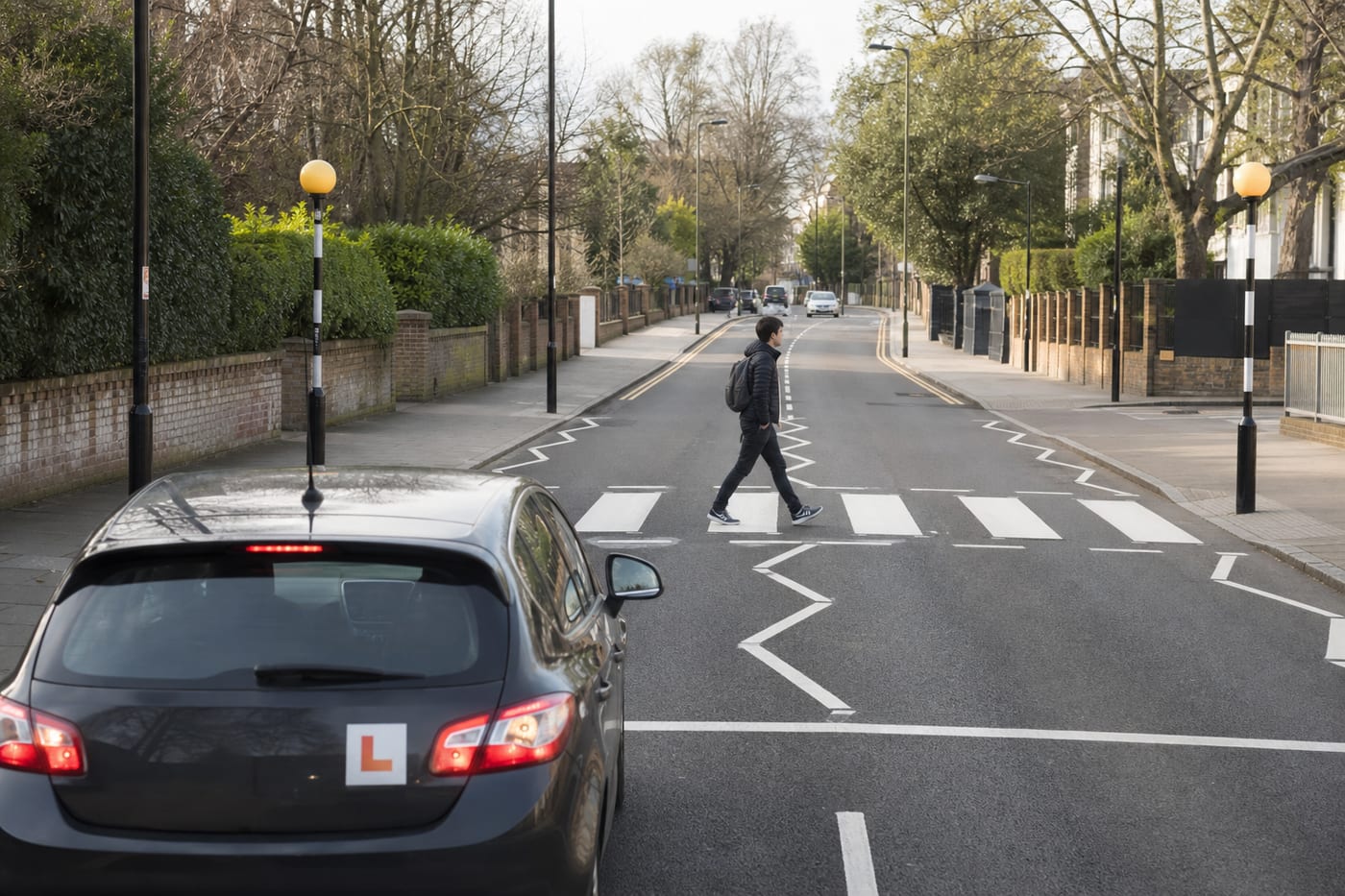
You can normally identify one by:
- Black-and-white stripes across the road
- Flashing amber Belisha beacons on black-and-white poles
- Zigzag road markings on each approach
- A central refuge island in some locations
Because there are no red and green traffic signals, drivers must assess what pedestrians are doing and respond appropriately. This makes good observation and speed control especially important.
If you want to compare zebra crossings with other designs, see our guide to UK pedestrian crossings.
Who has priority at a zebra crossing?
Drivers and motorcyclists should give way to pedestrians waiting to cross and must give way to pedestrians who have moved onto the crossing.
In practice, you should approach at a speed that allows you to stop smoothly if somebody is waiting, approaching the crossing or beginning to cross. Do not rely on a pedestrian remaining on the pavement simply because they have not yet stepped onto the stripes.
Pedestrians waiting at the crossing
The Highway Code uses should when describing a driver giving way to a pedestrian waiting at a zebra crossing. Although this is different from a rule using must, you should not treat it as optional driving advice that can simply be ignored.
The safe response is to reduce your speed, check your mirrors and be prepared to stop. If it is clear that the pedestrian intends to cross, stop before the crossing and allow them to do so.
Be particularly cautious with:
- Children who may step out suddenly
- Older or disabled pedestrians who may need more time
- People with visual or hearing impairments
- Pedestrians distracted by phones or headphones
- People partly hidden by parked vehicles, street furniture or crowds
Someone standing near a crossing may not intend to use it, so look for clues such as their position, direction of travel and whether they are checking the traffic. If you are unsure, slow down and prepare to stop rather than making an optimistic assumption.
Pedestrians already on the crossing
Once a pedestrian has moved onto a zebra crossing, drivers and riders must give way. Stop before the crossing and wait until the person has safely passed your path.
Never drive closely behind or in front of a pedestrian to save a few seconds. Give them space and remember that they may stop, turn back or drop something unexpectedly.
You must also avoid pressuring pedestrians by revving the engine, sounding the horn or creeping forward. They should be able to finish crossing without feeling hurried.
A safe zebra crossing approach routine
A reliable routine will help you respond consistently during lessons, the practical test and independent driving.
1. Identify the crossing early
Look for the Belisha beacons, striped road surface and zigzag markings. Your view may be restricted by bends, parked vehicles, buses or poor weather, so do not wait until you reach the stripes before assessing the situation.
Zigzag markings provide an early warning that you are approaching a pedestrian crossing. Our complete guide to UK road markings explains these and other markings learners need to recognise.
2. Check your mirrors
Check the interior mirror as you approach. If you may need to change position, also check the relevant door mirror.
Knowing what is behind you helps you brake in a controlled way. However, a vehicle following too closely is not a reason to continue through when a pedestrian is crossing. Slow progressively where possible and stop safely.
3. Reduce your speed
Adjust your speed according to visibility, traffic and pedestrian activity. A crossing beside a school, shopping area or bus stop may require a much earlier reduction in speed than an empty crossing on a clear road.
Do not accelerate towards the crossing in the hope of passing before a pedestrian arrives. That can intimidate the pedestrian and leave you unable to respond if they step out.
4. Scan both pavements
Check both ends of the crossing, not only the side nearest to you. A person may be approaching quickly from the opposite pavement or may be hidden behind another pedestrian.
Look beneath and around parked vehicles for early clues, such as feet or a pushchair appearing near the kerb. This type of active scanning is also valuable when learning how to identify developing road hazards.
5. Stop before the crossing
If you need to give way, stop before entering the striped area. Keep the crossing clear and leave pedestrians enough space.
Avoid harsh braking unless it is necessary in an emergency. Early observation should normally allow you to slow and stop smoothly.
6. Move off only when it is safe
Before moving, check that the pedestrian has cleared your path and that nobody else is about to cross. Recheck both sides, because another person may have followed behind the first.
Move away smoothly without rushing or passing unnecessarily close to anyone still on the crossing.
Rules for zigzag markings
The zigzag lines around zebra crossings are safety markings, not convenient waiting or parking areas. They improve visibility between drivers and pedestrians.
You must not park on a crossing or in the area covered by its zigzag markings. Stopping there can block sight lines and make it difficult for approaching traffic to see pedestrians.
You must not overtake:
- The moving vehicle nearest the crossing
- The vehicle nearest the crossing if it has stopped to give way to pedestrians
These restrictions prevent a pedestrian from being hidden by one vehicle and then struck by another passing alongside it.
Do not assume a stopped vehicle is parked or hesitating. It may be shielding a pedestrian who is already crossing. If a vehicle ahead stops near a zebra crossing, slow down and establish why.
Zebra crossings with a central island
Where a zebra crossing is divided by a central island, each half is treated as a separate crossing.
A pedestrian may therefore cross one half, wait safely on the island and then assess traffic on the other half. Even so, drivers should remain cautious. A pedestrian may continue without pausing, particularly if they believe traffic has seen them.
Do not use the separate-crossing rule as an excuse to pass at speed. Approach carefully, watch the pedestrian’s movement and be ready to stop.
What if traffic is queuing over the crossing?
You should not enter a zebra crossing unless there is enough room beyond it for your vehicle to clear the crossing completely.
In slow traffic, wait before the stripes until your exit is available. Blocking the crossing forces pedestrians to walk around vehicles, where they may be exposed to traffic travelling in another lane or direction.
The same principle applies even if there is no pedestrian nearby when you enter. Traffic conditions can change while you are stationary.
Can cyclists ride across zebra crossings?
Cyclists should not ride across a zebra crossing. They should dismount and wheel their cycle across, at which point they are using the crossing as a pedestrian.
Do not assume every cyclist will dismount, however. If somebody rides towards or onto the crossing, avoid responding aggressively. Slow down, be prepared to stop and prioritise preventing a collision.
Toucan crossings are specifically designed to be shared by pedestrians and cyclists. Their signals and rules differ from those at zebra crossings.
Common learner driver mistakes
Approaching too quickly
A high approach speed gives you less time to identify a pedestrian’s intentions. Even if the crossing is clear, failing to adjust for restricted visibility or nearby pedestrians may demonstrate poor planning.
Looking at only one side
Learners sometimes concentrate on the nearest pavement and miss somebody approaching from the far side. Develop the habit of scanning from side to side as you approach.
Stopping on the stripes
Poor anticipation in queuing traffic can leave your vehicle blocking the crossing. Hold back until there is room for your whole vehicle on the other side.
Moving off too soon
Do not focus only on the pedestrian who caused you to stop. Check for anyone following them before proceeding.
Waving pedestrians across
Avoid using hand gestures to tell pedestrians it is safe to cross. You cannot control traffic coming from the opposite direction, and your gesture could be misunderstood. Stop clearly, remain patient and let the pedestrian make their own decision.
Overtaking near the crossing
Passing a vehicle near a zebra crossing is particularly dangerous because that vehicle may hide a pedestrian. Remember the overtaking restrictions within the zigzag area.
Advice for pedestrians using zebra crossings
Pedestrians should give traffic enough time to see them and stop before beginning to cross. They should keep looking and listening while crossing rather than assuming every driver has noticed them.
Pedestrians should not loiter on the crossing or cross diagonally. Where there is a central island, they should assess each half of the road carefully.
Drivers must still remain responsible for their own actions. A pedestrian making a mistake does not justify continuing when stopping could prevent harm.
Zebra crossings in the theory and practical tests
Theory test questions may examine:
- Who should be given priority
- The meaning of the zigzag markings
- When overtaking is prohibited
- How central islands affect the crossing
- What to do when traffic is queuing
- Whether cyclists should ride across
In the practical test, the examiner will look for effective observations, suitable speed and a safe response to pedestrians. You may make a serious or dangerous fault if your actions put a pedestrian at risk, while poor planning or an unnecessarily abrupt response may also be marked depending on the circumstances.
The aim is not to memorise a rigid stopping point for every situation. It is to identify the crossing early, assess the people nearby and respond calmly.
Frequently asked questions
Must I stop if someone is waiting at a zebra crossing?
The Highway Code says drivers and riders should give way to pedestrians waiting to cross. Once a pedestrian has moved onto the crossing, you must give way. The safe approach is to slow down early and stop when somebody is clearly waiting to use the crossing.
Can I park on zebra crossing zigzag lines?
No. You must not park on the crossing or in the area covered by the zigzag markings. Doing so obstructs visibility and places pedestrians at risk.
Can I drive on once a pedestrian has passed my car?
Only proceed after confirming that the pedestrian has cleared your path and nobody else is entering the crossing. Check both sides again before moving away smoothly.
Is a zebra crossing with an island one crossing or two?
If a central island divides the zebra crossing, each half is treated as a separate crossing. You should still approach cautiously and be prepared for pedestrians to continue across.
Conclusion
Safe use of zebra crossings depends on early observation, appropriate speed and patience. Give way to people waiting to cross, remember that you must give way once they are on the crossing, and never park, queue or overtake unlawfully within the controlled area.
Treat every zebra crossing as a potential developing hazard. By checking both pavements, stopping smoothly and moving off only after a final scan, you will be better prepared for the theory test, practical test and real-world driving.