Crossroads can feel demanding because traffic may approach from four directions while drivers, cyclists and pedestrians make different movements. As a learner, you need to identify the junction early, establish who should give way and choose a safe speed and position.
There is no single priority rule that applies to every crossroad. Some are controlled by traffic lights, signs or road markings, while others are unmarked. Understanding those differences will help you answer theory test questions and deal with crossroads confidently during lessons and your practical test.
What is a crossroad junction?
A crossroad is a junction where two roads cross. It usually has four arms, although the layout may be staggered or irregular rather than forming a perfect cross.
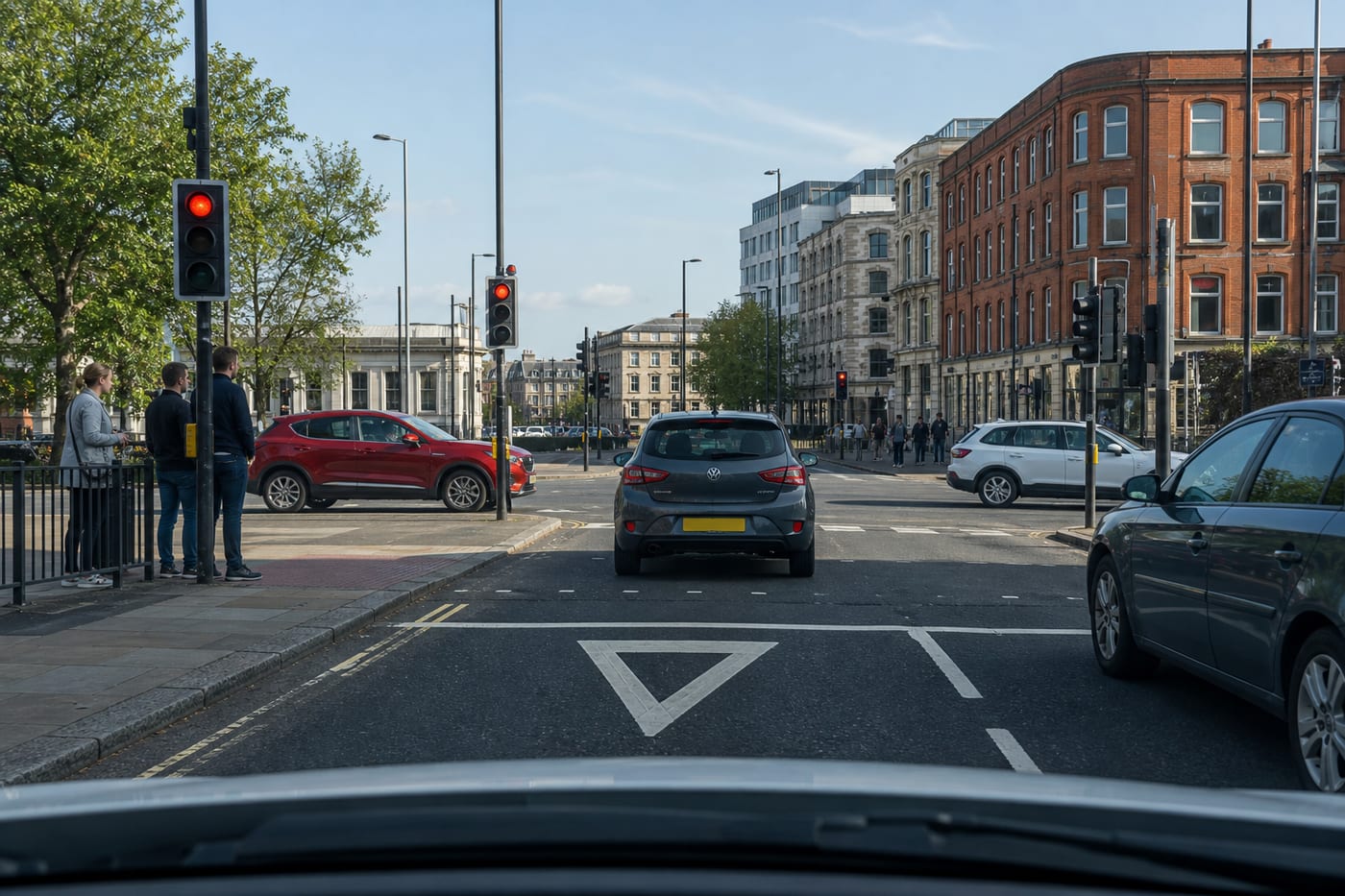
At a typical marked crossroad, one road may continue as the main road while traffic on the joining road faces give-way or stop controls. At a signal-controlled crossroad, traffic lights determine when each stream of traffic can move.
Crossroads may also include:
- Pedestrian or cycle crossings
- Filter arrows for turning traffic
- Yellow box markings
- Dedicated turning lanes
- Advanced stop lines for cyclists
- Central refuges or traffic islands
- Restricted turns shown by signs or markings
Do not assume that every junction will follow the same pattern. Look at the complete layout before deciding what to do.
How to recognise who has priority
Priority is normally indicated by traffic lights, signs and road markings. Start looking for these features well before reaching the junction.
Give-way markings
A broken white line across your side of the road means you must give way to traffic on the road you are joining or crossing. Reduce your speed so that you can assess the traffic and stop if necessary.
You do not always have to come to a complete stop at a give-way line. However, you must not continue unless it is safe.
Stop signs and solid lines
A red octagonal stop sign accompanied by a solid white line means you must stop. Bring the vehicle to a complete stop at the line, even if the road appears empty, and then make effective observations before moving.
Traffic lights
At traffic-light-controlled crossroads, obey the signals applying to your lane. A green light means you may proceed only if the junction is clear and it is safe to do so. It does not give you permission to force your way through pedestrians, blocked traffic or vehicles already completing a manoeuvre.
A green filter arrow permits movement in the direction shown, provided the route is clear. Check that the arrow applies to your lane and intended direction.
Unmarked crossroads
At an unmarked crossroad, no driver has automatic priority merely because they are travelling straight ahead, using a wider road or approaching from a particular direction. Approach slowly and be prepared to give way.
Try to make eye contact with other drivers where possible, but never rely on eye contact, flashing headlights or a hand gesture as proof that it is safe. For a closer look at these situations, see our guide to priority rules for unmarked crossroads.
A safe routine for approaching crossroads
A structured routine helps you gather information without rushing. Your instructor may teach this through the mirror–signal–manoeuvre routine, followed by position, speed and look.
1. Check your mirrors
Check the appropriate mirrors early. You need to know whether another vehicle is following closely, overtaking or moving alongside you before you change speed or direction.
For a left turn, check the interior and left door mirrors, paying particular attention to cyclists. For a right turn, check the interior and right door mirrors.
2. Signal when necessary
Signal clearly and in good time if you intend to turn. Avoid signalling so early that other road users might think you are turning into an earlier entrance.
You will not usually need to signal when continuing straight ahead, but your road position and speed should still make your intentions predictable.
3. Choose the correct position
For a left turn, keep to the left without moving so close to the kerb that you endanger cyclists or make the turn unnecessarily tight.
For a right turn, position towards the centre of your side of the road or in a designated right-turn lane. Do not cross the centre line while waiting, and avoid steering right before you begin the turn. Keeping the wheels straight reduces the risk of being pushed into oncoming traffic if another vehicle hits you from behind.
When going ahead, use the lane indicated by signs and arrows. Where there are no lane markings, keep a normal position on the left and avoid drifting across the junction.
4. Adjust your speed
Approach at a speed that allows you to stop safely and make proper observations. The appropriate speed depends on visibility, traffic, weather and the junction layout—not simply the posted speed limit.
If buildings, parked vehicles or vegetation block your view, reduce your speed further. At a closed junction, you may need to edge forward carefully after stopping or giving way until you can see clearly.
5. Look in every relevant direction
Before emerging, check right, left and right again, while also looking ahead for pedestrians, cyclists and vehicles turning across your path. Continue scanning as you move because the situation can change quickly.
Effective observation means acting on what you see. A quick glance is not enough if you fail to notice an approaching motorcycle or pedestrian.
Turning right at a crossroad
Right turns are often the most complicated crossroad manoeuvre because you may need to cross the path of oncoming traffic.
Wait in a suitable position until there is a safe gap. Judge the speed and distance of approaching vehicles carefully, and remember that motorcycles and bicycles can be harder to spot. Do not let a waiting driver behind pressure you into accepting a doubtful gap.
At traffic lights, you may move forward on green if appropriate, but you must give way to oncoming traffic unless a protected signal phase or green filter arrow permits your turn. Make sure the road you are entering is clear.
If another vehicle opposite is also turning right, the layout may allow you to pass either nearside to nearside or offside to offside. Road markings sometimes indicate the intended route. Offside-to-offside turning can offer a better view of approaching traffic, but it may not suit every junction. Follow markings and take particular care if the other driver obscures your view.
For more detail on preparation and gap selection, review how to turn right safely off a main road.
Pedestrians and cyclists at crossroads
When turning into or out of a road, give way to pedestrians who are crossing or waiting to cross the road into which or from which you are turning. Be particularly careful around children, older people and anyone who may need more time.
Before turning left, check for cyclists travelling on your left, including those using a cycle lane or track. Do not cut across them. When turning right, look for cyclists and motorcyclists approaching from both directions.
If the crossroad includes a pedestrian crossing, obey its signals and stop line. Never wave someone across unless you are certain it is safe; traffic approaching from another direction may not stop. Our guide to UK pedestrian crossings explains the main crossing types and driver responsibilities.
Yellow box junctions at crossroads
Some busy crossroads have a yellow criss-cross box painted on the road. You must not enter the box unless your exit road or lane is clear.
The main exception is when you are turning right. You may enter and wait in the box if your exit is clear but you are prevented from completing the turn by oncoming traffic or by other vehicles waiting to turn right.
Before entering, look beyond the car immediately ahead. If traffic is stationary and there is not enough room for your whole vehicle on the far side, wait before the box. A green light does not cancel the box-junction rule.
Staggered crossroads
At a staggered crossroad, the two joining roads do not meet directly opposite each other. To continue on your intended route, you may have to turn briefly onto the main road and then turn again.
Treat each part as a separate manoeuvre. Use the correct mirrors and signals for each turn, establish the priority at both junctions and avoid cutting diagonally across the main road.
A right-left stagger may leave you waiting near the centre of the road before the second turn. A left-right stagger may require you to join the main road, build an appropriate speed and then prepare to turn right. Plan early and watch for vehicles emerging from the other arm.
Common crossroad mistakes
Learners often make faults because they concentrate on only one part of the junction. Common errors include:
- Approaching too quickly to observe properly
- Assuming a green light guarantees a clear route
- Following another vehicle into a blocked junction
- Failing to check for cyclists before turning left
- Looking once and then moving after the gap has changed
- Positioning too far right or cutting the corner
- Waiting unnecessarily when a safe opportunity is available
- Relying on another driver’s signal without checking their movement
- Forgetting pedestrians when turning into a side road
- Entering a yellow box without a clear exit
During practice, ask your instructor to include marked, unmarked, staggered and signal-controlled crossroads. Experience across several layouts will help you apply principles rather than memorise one junction.
Crossroads in the theory and hazard perception tests
A multiple-choice question may test the meaning of signs, lines, traffic lights or box markings. Read every part of the scenario and identify which control applies before choosing an answer.
In hazard perception clips, a crossroad may contain several potential hazards. A vehicle waiting at a side road is a potential hazard; it becomes a developing hazard when it starts moving into your path or shows clear signs that you may need to alter speed or direction.
Watch the wheels of waiting vehicles, gaps between parked cars, pedestrians near the kerb and cyclists approaching from behind. Keep scanning beyond the nearest vehicle so that you notice problems early.
Practical tips for building confidence
Begin with quieter crossroads where you have time to practise the observation routine. As your confidence improves, move to busier and more complex layouts with your instructor.
Say the controls and hazards quietly to yourself: “give-way line, pedestrian on the left, car approaching from the right”. This can stop you from fixating on one vehicle.
If you cannot see, do not guess. Slow down, stop if required and edge forward carefully while maintaining all-round observations. Safe hesitation is preferable to entering the path of another road user, although you should proceed when you have a genuinely safe opportunity.
Conclusion
Crossroads become manageable when you identify the controls early, approach at a safe speed and keep observing throughout the manoeuvre. Never assume priority, even when you have a green light or appear to be on the main road. Check that your route is clear, account for vulnerable road users and be prepared for other people to make mistakes.
Frequently asked questions
Who has priority at an unmarked crossroad?
No one has automatic priority at an unmarked crossroad. Approach slowly, observe carefully and be ready to give way. Do not assume traffic from the right or traffic travelling straight ahead must go first.
Can I enter a crossroad when the traffic light is green?
Only if the junction and your exit are clear and it is safe to proceed. A green light allows you to move, but you must still avoid blocking the junction and give way where required, including to pedestrians and oncoming traffic when turning right.
Should I stop at every crossroad?
No. You must stop at a stop sign and solid white stop line, at a red light, or whenever traffic and safety require it. At a give-way line, you may continue without stopping if you have observed properly and the route is clearly safe.
Where should I look when emerging at a crossroad?
Check right, left and right again, but do not rely on a rigid sequence alone. Look in every direction from which danger could develop, including ahead and alongside for pedestrians, cyclists and turning vehicles. Continue observing while crossing the junction.