Junctions are places where roads meet, separate or cross. They range from simple side-road entrances to busy, signal-controlled intersections with several lanes. Being able to identify the type of junction ahead helps you anticipate traffic movements, choose the correct position and decide who may need to give way.
For the theory test, you need to understand the signs, signals and road markings associated with junctions. During driving lessons and the practical test, you must turn that knowledge into a safe routine involving observation, speed control, positioning and good judgement.
How to recognise a junction ahead
A junction is not always immediately obvious. Parked vehicles, bends, trees and buildings can hide entrances or approaching traffic, so look for several clues rather than relying on one sign.
Common clues include:
- Give Way or Stop signs
- Direction signs pointing towards another road
- Broken give-way lines or solid stop lines
- Traffic lights or filter arrows
- Vehicles emerging, slowing or signalling
- Gaps between buildings, walls or hedges
- Changes in kerb lines and road width
- Pedestrians waiting near corners
- Cyclists crossing or joining your path
- Street lighting extending into a side road
Road markings often tell you where to stop, which lane to use and whether traffic movements are restricted. Our complete guide to UK road markings explains these features in more detail.
When approaching any junction, check your mirrors early, reduce speed if necessary and scan the entire area. Do not focus only on the direction you intend to travel. A pedestrian, cyclist or vehicle may approach from somewhere less obvious.
T-junctions
A T-junction is formed when one road ends where it meets another. Viewed from above, the roads resemble the letter T.
If you are approaching along the road that ends, you will normally need to give way to traffic on the continuing road. Look for a Give Way sign, broken give-way markings, a Stop sign or a solid stop line. At some quiet T-junctions there may be few or no markings, but you must still assess the layout carefully.
The end of the road may not meet the main road at a perfect right angle. Buildings, vegetation and parked cars can also restrict your view. Approach slowly enough to stop and use effective observations in both directions before emerging.
A Stop sign requires you to stop at the stop line, even when the road appears clear. A Give Way sign does not always require a complete stop, but you must slow down sufficiently and give way when necessary.
For a more detailed routine, see our guide to approaching T-junctions safely and correctly.
Y-junctions and forked junctions
At a Y-junction, one road divides into two, or two roads meet at an angle that resembles the letter Y. These junctions can be deceptive because one route may appear to continue straight ahead even though it is legally a turn.
Look for direction signs, lane arrows, road markings and the path of the kerbs. These clues help you determine whether you are following the main route or leaving it.
Do not assume that the wider or straighter-looking branch has priority. Signs and markings are more reliable than the visual shape of the road. If you need to turn or change position, check your mirrors and signal in good time where a signal would benefit other road users.
Crossroads
Crossroads are formed where two roads cross. Traffic may potentially approach from the front, left and right, making observation particularly important.
Priority at a crossroads may be controlled by:
- Give Way or Stop signs
- Give-way or stop lines
- Traffic lights
- A roundabout or mini-roundabout
- Priority signs or other road signs
If your road has priority, do not assume that another driver will stop. They may not have seen the sign, or their view may be restricted. Look for vehicles approaching too quickly and be ready to respond.
When turning right, you may have to cross the path of oncoming traffic. Wait for a safe gap and watch for motorcycles or bicycles that may be harder to see. Also check the road you are entering for pedestrians who are crossing or waiting to cross.
Unmarked crossroads
At an unmarked crossroads, there may be no signs, traffic lights or priority markings. No road user has automatic priority simply because they are travelling straight ahead or using the wider road.
Approach slowly, make careful observations and be prepared to give way. Try to establish the intentions of other drivers without relying on eye contact alone. A flashing headlamp only lets another road user know that someone is there; it does not transfer priority or guarantee that it is safe to proceed.
Our guide to priority rules at unmarked crossroads covers this situation in greater depth.
Staggered crossroads
A staggered crossroads consists of two side roads joining a main road a short distance apart. The side roads may be offset to the left or right rather than directly opposite one another.
To travel from one side road to the other, you may have to join the main road briefly and then turn again. This can involve two separate decisions and, depending on the layout, more than one signal or change of position.
Treat each part carefully. Do not rush across simply because you can see your destination. Check for traffic on the main road, enter only when safe and then prepare properly for the second turn.
Roundabouts and mini-roundabouts
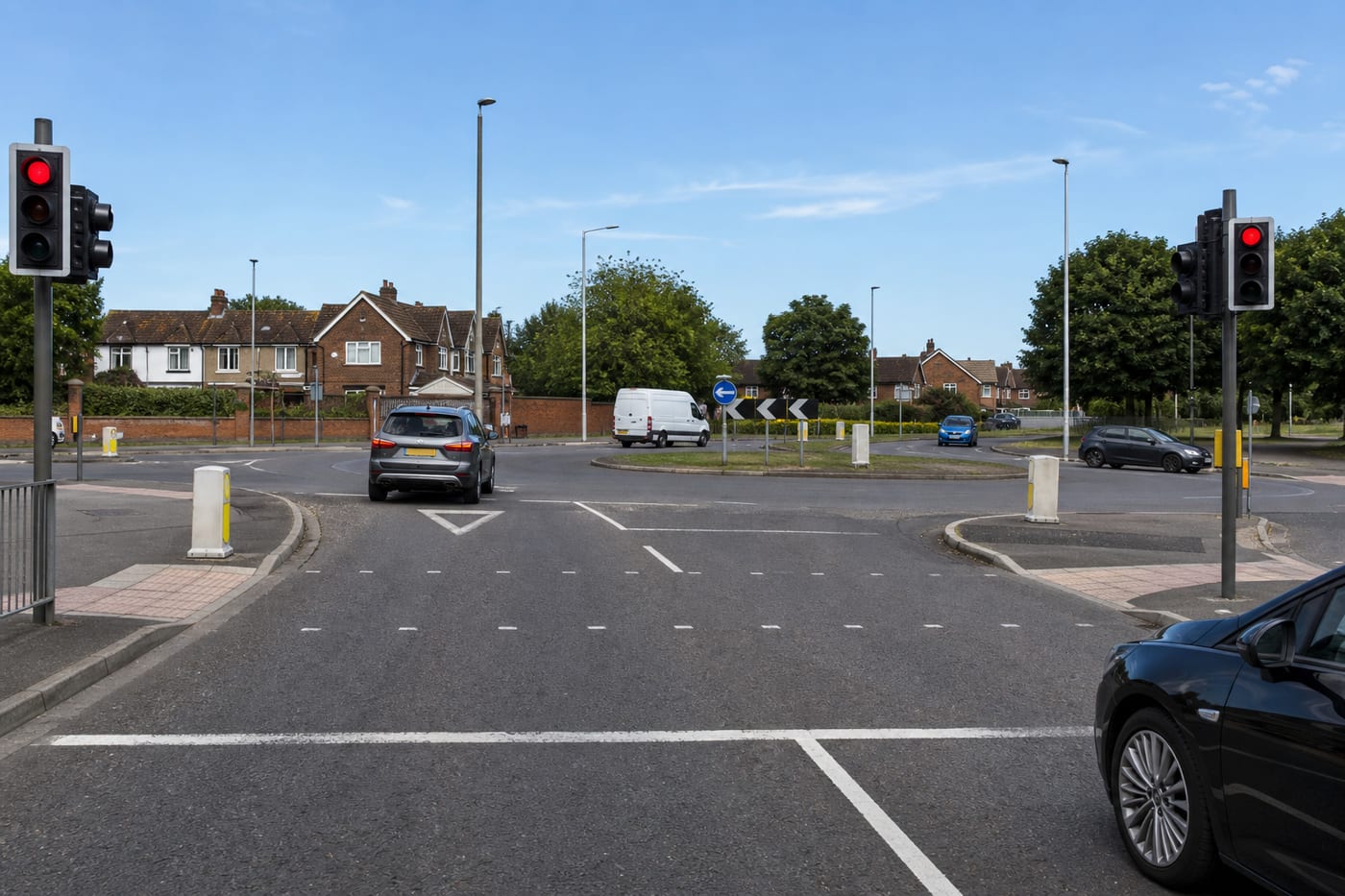
A roundabout is a junction where traffic travels around a central island. In most cases, drivers approaching a roundabout give way to traffic coming from the right, unless signs, road markings or traffic lights indicate otherwise.
Roundabouts vary considerably. You may encounter:
- Standard single-lane roundabouts
- Multi-lane roundabouts
- Mini-roundabouts
- Double roundabouts
- Signal-controlled roundabouts
- Spiral or lane-guided roundabouts
A mini-roundabout has a circular road marking instead of a large central island. You should treat it as a roundabout and pass around the central marking, unless the size or construction of your vehicle makes that impractical. Avoid driving straight over it merely to shorten your route.
Identify your exit early and use signs and lane markings to choose an appropriate position. Continue observing because vehicles may change lanes or fail to signal correctly.
Traffic-light-controlled junctions
Traffic lights are used where traffic movements need to be controlled in phases. A signal-controlled junction may be a crossroads, T-junction, roundabout or complex multi-lane intersection.
A red light means stop behind the stop line. Red and amber also mean stop and prepare to move, while green allows you to proceed only if your route is clear and it is safe to do so.
Some junctions use green filter arrows. A lit arrow permits movement in the direction shown, provided it is safe, but you must still watch for road users who may be crossing or clearing the junction.
Never follow another vehicle through a light without checking the signal yourself. Also avoid entering a junction if congestion will leave you blocking crossing traffic.
Box junctions
A box junction is identified by yellow criss-cross lines painted on the road. It is designed to keep an important area clear, often at a busy crossroads or T-junction.
You must not enter the box unless your exit road or lane is clear. The main exception is when you want to turn right and are prevented from doing so only by oncoming traffic or by other vehicles waiting to turn right.
Before entering, look beyond the vehicle immediately ahead. Make sure there is enough room for your whole vehicle on the far side. A green traffic light does not cancel the box-junction rule.
Side roads and concealed junctions
A side road is a smaller road joining another road. Warning signs may show whether it joins from the left, right or both sides. Where visibility is poor, a junction may be concealed until you are close to it.
Watch for gaps in hedges, vehicles appearing between parked cars and road users slowing ahead. If a warning sign indicates a concealed junction, reduce speed early and prepare for someone to emerge.
Country-road junctions require particular care. High hedges, sharp bends and narrow entrances can make it difficult for drivers to see one another. Mud or loose material near an entrance may also suggest slow agricultural vehicles could join the road.
Slip roads and merging junctions
Slip roads allow traffic to join or leave major roads, including dual carriageways and motorways. Entry slip roads usually provide space to build up speed before merging with traffic on the main carriageway.
When joining, use the slip road to adjust your speed, check your mirrors and blind spot, and identify a suitable gap. Traffic already on the main carriageway has priority. Do not force another driver to change speed or direction.
When leaving, move into the appropriate lane in good time and signal before entering the exit slip road. Reduce speed according to the signs and road conditions rather than braking sharply while still on the main carriageway.
Pedestrians and cyclists at junctions
Identifying the road layout is only part of dealing with a junction safely. You must also look for people who may cross your path.
When you are turning into or out of a road, give way to pedestrians who are crossing or waiting to cross that road. Allow extra time for children, older people and anyone who may need longer to cross.
Check carefully for cyclists and motorcyclists before turning, particularly on your left. A cyclist may be travelling beside you, using a cycle lane or crossing the junction on a separate cycle facility. Mirrors alone may not reveal everyone, so use an appropriate blind-spot check before changing direction.
A practical routine for approaching any junction
A consistent routine can help you manage different junction designs:
- Look well ahead. Identify signs, markings, signals and other road users.
- Check your mirrors. Understand what is happening behind before changing speed or direction.
- Signal when helpful. Signal clearly and at the correct time, avoiding signals that could mislead others.
- Choose your position. Follow lane markings and position appropriately for your intended route.
- Control your speed. Approach slowly enough to observe, stop or give way when required.
- Observe in every relevant direction. Include pavements, cycle lanes and less visible areas.
- Proceed only when safe. Do not allow pressure from a waiting driver to rush your decision.
On unfamiliar roads, signs and lane markings may appear later than expected. Leave a safe following distance so you can see ahead and change speed smoothly.
Common learner mistakes at junctions
Typical errors include approaching too quickly, looking only once, assuming priority and following another vehicle without making an independent decision.
Learners may also signal too early, position in the wrong lane or focus so heavily on traffic that they miss pedestrians. Another common problem is waiting when there is a safe opportunity to proceed. The aim is not to be excessively hesitant, but to make a properly observed and controlled decision.
Practise identifying junctions as a passenger. Ask yourself what controls the junction, where traffic could appear and which road users might cross your path. This builds observation skills without the pressure of controlling the car.
Conclusion
UK road junctions come in many forms, but the safest approach is always based on the same principles: identify the layout early, read the signs and markings, control your speed and observe thoroughly.
Do not rely only on the shape of the road or assume that another person will give way. Treat every junction as a changing situation and proceed only when you are satisfied that it is safe.
Frequently asked questions
How can I tell which road has priority at a junction?
Look for Give Way or Stop signs, road markings, traffic lights and the overall junction controls. Never decide priority solely from the width or appearance of a road. At an unmarked junction, approach cautiously because no one has automatic priority.
What is the difference between a T-junction and a crossroads?
At a T-junction, one road ends where it meets a continuing road. At a crossroads, two roads cross, so traffic may approach from ahead as well as from either side.
Must I stop at every Give Way junction?
Not necessarily. You must slow down, assess the traffic and give way when required. However, you must stop at a Stop sign and solid stop line, even if the road appears clear.
Who should I watch for when turning at a junction?
Check for vehicles, motorcyclists and cyclists in every relevant direction, as well as pedestrians crossing or waiting to cross the road you are entering or leaving. Pay particular attention to blind spots and restricted views.