Yellow box junctions can make even confident learner drivers hesitate. You must assess the traffic ahead, obey any signals and decide whether there is enough room to clear the marked area—all within a few seconds.
The basic rule is straightforward: do not enter a yellow box junction unless your exit is clear. However, there is an important exception when turning right. Understanding exactly when that exception applies will help you answer theory test questions and handle busy junctions safely during lessons.
What is a yellow box junction?
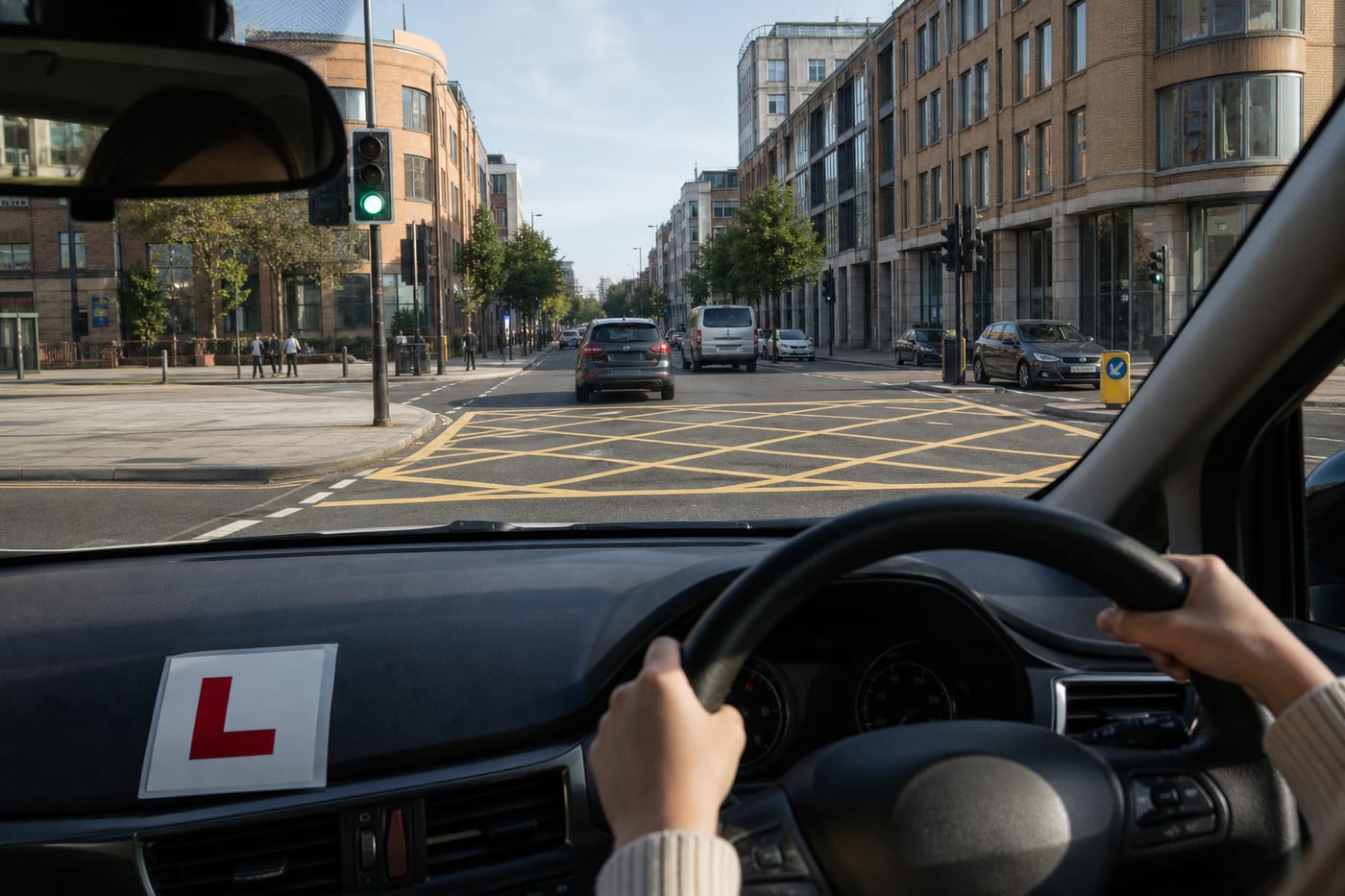
A yellow box junction is an area of road covered by yellow criss-cross lines. These markings are normally used at busy junctions where queuing traffic could otherwise block vehicles travelling in another direction.
The box is designed to keep the junction clear. If drivers enter without enough space to leave, they can become stranded across another traffic flow when the lights change. This causes congestion and may prevent other road users from moving safely through the junction.
Some boxes cover the whole junction, while others cover only part of it. Regardless of size, the same central principle applies: you should not enter until there is enough room for your entire vehicle on the other side.
Yellow boxes form part of a wider system of lines that organise and control traffic. Our complete guide to UK road markings explains how they compare with stop lines, lane markings, zigzags and other painted instructions.
The main yellow box junction rule
The Highway Code says that you must not enter the box until your exit road or lane is clear. You should therefore look beyond the yellow markings before committing to the junction.
It is not enough to see that the vehicle ahead is moving. You need a definite space beyond the box that is long enough to accommodate your vehicle completely. If your rear wheels would remain inside the box, you have not cleared it.
Imagine that your light is green but traffic is queuing immediately after the junction. A green signal allows you to proceed only when it is safe and legal to do so. It does not cancel the box-junction rule. If there is nowhere to go, remain behind the box and wait.
You may feel that you are holding up traffic, particularly if another driver sounds their horn. Do not allow pressure from behind to force you into the junction. The driver making the decision is responsible for ensuring that the exit is clear.
The right-turn exception
You may enter a yellow box and wait when you want to turn right, but only when you are prevented from completing the turn by:
- oncoming traffic; or
- other vehicles waiting to turn right.
This exception allows right-turning traffic to move into an appropriate position and wait for a safe gap. Without it, some busy junctions would be extremely difficult to negotiate.
When the exception does not apply
The right-turn exception does not give you permission to enter whenever your destination is to the right. The road you intend to join must still have room for your vehicle.
For example, suppose you enter the box to turn right, but the destination road is blocked by a queue. You cannot rely on the exception because congestion in the road you are joining—not oncoming or right-turning traffic—is preventing you from leaving.
Similarly, turning left does not carry an equivalent exception. If you are turning left, wait outside the box until you can complete the turn and clear the markings.
When preparing for more general junction questions, it is also useful to revise UK right-of-way rules at junctions, including the responsibilities of drivers turning across other traffic.
A safe routine for approaching a yellow box
Rather than treating the box as a last-second decision, start assessing it early. A simple routine can make your approach calmer and more consistent.
1. Identify the box in good time
Look well ahead for yellow criss-cross markings. Check for traffic lights, lane arrows, signs, pedestrians and vehicles waiting beyond the junction.
Early observation gives you time to reduce speed smoothly rather than braking abruptly at the edge of the box.
2. Check your mirrors
Use your mirrors before changing speed. A following driver may be expecting you to continue because the signal is green, so gradual braking is safer than a sudden stop.
If you are changing lanes before the junction, complete the manoeuvre early where possible. Avoid drifting between lanes while concentrating on the space beyond the box.
3. Select the correct lane
Choose the lane that matches your intended direction and any road arrows or signs. Your exit must be clear in the lane you need—not merely in a neighbouring lane.
Do not enter based on the assumption that you can change lanes on the far side. Another vehicle may occupy the space before you reach it.
4. Look through and beyond the junction
Ask yourself: Is there a stationary space beyond the box large enough for my whole vehicle?
Do not focus only on the rear of the vehicle ahead. Look further along the queue for brake lights, buses stopping, pedestrian crossings, narrowing lanes or vehicles attempting to turn.
5. Make a definite decision
If there is enough room and the signal permits you to proceed, enter at a controlled speed and clear the box without unnecessary delay.
If the space is uncertain, wait before the markings. Never creep into the box in the hope that the traffic ahead will move.
6. Reassess before moving
Traffic conditions can change while you wait. Before setting off, check that your intended space is still available and that pedestrians, cyclists or other vehicles have not moved into your path.
How to judge whether your exit is clear
Accurate space judgement improves with practice, but you can use several reliable clues.
First, allow enough room for the full length of your vehicle. Learners sometimes see a small gap and forget that the rear of the car must also leave the box. If you are driving a larger vehicle, you will need more space.
Second, distinguish between a real gap and a temporary moving gap. If the traffic beyond the junction is travelling freely, you may be able to proceed. If it is crawling and repeatedly stopping, be cautious. Wait until a clear space has opened rather than relying on continued movement.
Third, consider what could make the vehicle ahead stop. A pedestrian crossing, bus stop, side road or narrowing lane may interrupt the traffic. Developing the habit of looking for these clues also supports the observation skills covered in our guide to identifying road hazards early.
Traffic lights and yellow boxes
Traffic signals and box markings must be considered together. A green light does not mean that you should enter a blocked box, while an empty box does not allow you to pass a red signal.
If your light turns green but the exit remains blocked, stay behind the box. When space appears, check the signal again before moving. It may have changed while you were waiting.
If you are already waiting legally in the box to turn right, remain alert to the signal sequence and the movement of oncoming traffic. Complete the turn only when it is safe. Do not rush across the path of an approaching vehicle simply because the lights are changing.
Also watch for pedestrians crossing the road you intend to enter. Turning drivers should be prepared to give way as required, so include pedestrian activity in your decision before entering the box.
Common yellow box junction mistakes
Following the vehicle ahead without checking
A learner may copy the vehicle in front and enter automatically. The first vehicle might fit beyond the junction while the second becomes trapped in the box. Make your own assessment every time.
Treating green as an instruction to go
Green means you may proceed when the route is clear and it is safe. It does not override road markings, blocked exits or the presence of other road users.
Entering because traffic appears likely to move
A queue may stop unexpectedly. Enter only when a suitable space is already available, not because you expect one to appear.
Misunderstanding the right-turn exception
You may wait in the box while turning right only if oncoming traffic or other right-turning vehicles prevent you from completing the manoeuvre. A blocked destination road is not covered by that exception.
Stopping with part of the car in the box
Leaving only the front of the box is not enough. Your entire vehicle should clear the marked area.
Reacting to pressure from behind
Another driver’s impatience does not make an unsafe decision acceptable. Stay calm, keep observing and move when the conditions allow it.
Yellow box junctions in the theory test
Theory test questions may show a road layout or describe a queue at a signal-controlled junction. Focus on why your vehicle would need to stop inside the box.
A useful method is to ask:
- Is there enough room for my whole vehicle beyond the box?
- Am I turning right?
- If so, is oncoming traffic or another right-turning vehicle the only thing preventing me from completing the turn?
- Do the traffic signals and surrounding hazards allow me to proceed?
Be careful with answers suggesting that you may enter because the lights are green, because the vehicle ahead is moving or because you expect the queue to clear. These statements do not guarantee an available exit.
Using yellow boxes during driving lessons and the practical test
Ask your instructor to practise box junctions in light and moderate traffic before attempting particularly congested routes. Start by talking through what you can see beyond the junction, then gradually make the assessment independently.
On a practical test, demonstrate early observation and controlled decision-making. If the exit is blocked, slow smoothly and stop before the box. Keep checking the signal and traffic so that you are ready when a safe space becomes available.
Avoid excessive hesitation when the exit is clearly open. The aim is not to stop at every yellow box, but to assess it correctly. If you can proceed safely and legally, continue with confidence.
Can you receive a penalty for stopping in a yellow box?
Yellow box restrictions may be enforced, including through approved camera systems where the relevant authority has enforcement powers. Entering when your exit is blocked can result in a penalty charge.
The safest approach is not to base your decision on whether you can see a camera. Follow the rule at every box junction. It keeps crossing traffic moving and reduces the risk of conflict, congestion and penalties.
Conclusion
Mastering yellow box junctions comes down to observation, patience and accurate space judgement. Do not enter until there is room for your whole vehicle beyond the box. Remember the limited right-turn exception, obey the traffic signals and make your own decision rather than following the vehicle ahead.
With regular practice, you will learn to look through the junction early and deal with yellow boxes calmly in both your theory test and everyday driving.
Frequently asked questions
Can I enter a yellow box when the traffic light is green?
Only if your exit road or lane is clear and it is otherwise safe to proceed. A green light does not allow you to enter a box that you cannot clear.
Can I wait in a yellow box when turning right?
Yes, if you are prevented from completing the turn by oncoming traffic or by other vehicles waiting to turn right. The road you are turning into must still have sufficient space.
Does my whole car need to leave the yellow box?
Yes. Make sure there is enough room beyond the junction for the entire vehicle. Stopping with the rear of your car inside the box means you have not fully cleared it.
What should I do if another driver pressures me to enter?
Remain behind the box until your exit is clear. Ignore horns or impatient gestures, continue observing the traffic and move only when it is safe and legal.