Motorway signs and signals communicate important information at high speed. They can warn you about congestion, set a temporary speed limit, direct you away from a closed lane or help you find the correct exit. Missing or misunderstanding one may leave you with little time to respond safely.
For the theory test, you need to recognise both permanent motorway signs and electronic signals. In real driving, you must also understand how several instructions work together. This guide explains the main signs and signals you are likely to encounter and the safest way to react to them.
Why motorway signs require early attention
Motorway traffic generally travels faster than traffic on ordinary roads. That means a late decision can be particularly dangerous. Suddenly braking for an exit or swerving out of a closed lane may put several road users at risk.
Look well ahead and scan overhead gantries, signs beside the carriageway and road markings. Avoid staring at one display for too long. Take in the information, check your mirrors and make any necessary change smoothly.
Electronic signs can change while you are travelling. Do not assume that a blank signal or an earlier message means the road ahead is clear. Continue checking each new signal you approach.
For broader advice on joining, lane discipline and leaving safely, see our complete guide to safe motorway driving in the UK.
Understanding motorway signal colours and symbols
Electronic motorway signals are used to manage traffic and warn drivers about changing conditions. You may see them above individual lanes or on signs at the side of the motorway.
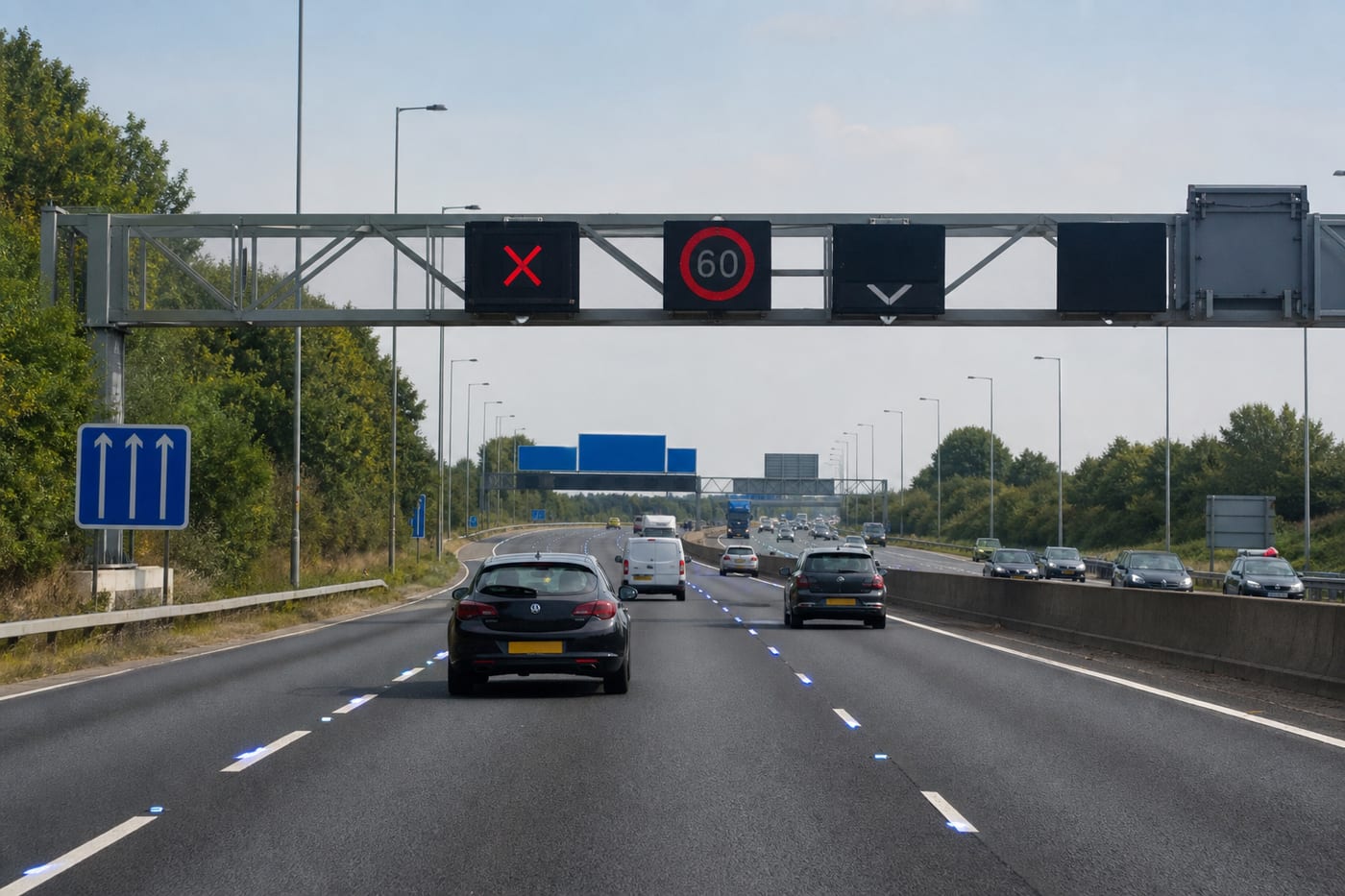
The red X: a closed lane
A red X means the lane beneath it is closed. You must not drive in that lane.
Move into an open lane as soon as it is safe. Use your mirrors, signal if necessary and change lane without forcing another driver to brake or alter course. Do not wait until you are directly under the red X before trying to move over.
A lane may be closed because of:
- a collision or broken-down vehicle
- people working in the carriageway
- debris or another obstruction
- flooding or damaged road surfaces
- an incident that you cannot yet see
Never assume that a lane looks safe simply because it appears empty. The danger may be beyond your visible range, and driving in a lane marked with a red X is an offence.
Remain out of the lane until signs show that it has reopened. Do not re-enter merely because you have passed the first hazard or other drivers are using it.
Red flashing light signals
Red flashing light signals are used to stop traffic. If red lights flash on a signal above every lane, you must not proceed beyond the signal in any lane.
This is different from a red X displayed over one or more individual lanes. In that situation, only the lanes marked with a red X are closed, although you must still respond early and carefully.
White arrows above lanes
A white arrow pointing downwards towards another lane tells you to move into the lane indicated. It provides advance warning that your current lane is closing ahead.
Check your mirrors and blind spot as appropriate, then merge when a safe gap is available. Avoid accelerating to pass a queue before the closure. Early, controlled merging is safer and helps traffic continue moving.
The arrow is a warning to change lanes; a red X means the lane is already closed. You should therefore act before the arrow is replaced by a red X.
Amber flashing signals and warning messages
Amber flashing signals warn of a hazard ahead. The accompanying display may show a suggested maximum speed, congestion, queues, an incident, poor weather or an obstruction.
Reduce your speed if necessary and be prepared for conditions to change. Increase the space between you and the vehicle ahead, especially if traffic may be slowing abruptly.
Do not accelerate immediately after passing the signal. The warning applies to the road ahead, and the hazard may be some distance away.
Variable and advisory speed displays
Recognising the difference between mandatory and advisory speed displays is essential.
Mandatory variable speed limits
A speed displayed inside a red circle is a mandatory speed limit. It applies to the relevant lane or carriageway and must not be exceeded.
Variable speed limits may be introduced to manage congestion, protect road workers or slow traffic approaching an incident. The displayed limit can change between gantries, so check every signal rather than relying on the previous one.
When a lower limit appears, respond smoothly. Check your mirrors before reducing speed and avoid harsh braking unless an immediate danger requires it.
Advisory speed limits
A speed displayed without a red circle is advisory. It indicates a suitable maximum speed for the conditions ahead. Although it does not have the same meaning as a mandatory limit, you should not ignore it.
An advisory speed may warn of queues, poor visibility or an incident. Ask yourself why the lower speed has been shown, create a larger following gap and expect traffic conditions to deteriorate.
Where a mandatory variable limit ends and no lower permanent limit applies, a national speed limit sign may be displayed. Always consider whether the weather, visibility and traffic make that speed safe; a speed limit is not a target.
Permanent motorway direction signs
Motorway direction signs generally have a blue background. They show route numbers, destinations, junction numbers and the layout of approaching exits.
Read the whole sign rather than focusing only on a familiar place name. The position of destinations and arrows helps you identify which lane or exit you need.
Junction numbers and exit signs
Junction numbers help you follow a route and judge how close you are to your exit. Start planning your lane position when advance signs first appear.
If you are overtaking, return to the left when it is safe rather than waiting until the last moment. Before leaving, signal in good time and move into the exit lane when the markings allow.
If you miss your exit, continue to the next suitable junction. Never reverse, stop on the carriageway or cross the hatched area separating the motorway from the slip road.
Countdown markers
Countdown markers have diagonal white bars on a blue background. They normally appear before the start of an exit slip road:
- three bars indicate 300 yards
- two bars indicate 200 yards
- one bar indicates 100 yards
They help you judge when the exit begins. They do not tell you to brake suddenly. Your preparation should already be under way before reaching the final marker.
Route numbers in brackets
A route number shown in brackets is reached by following the signed road; you are not yet joining that route. A route number without brackets identifies the road to which the sign directly refers.
This distinction is useful when following a planned route, particularly around large motorway interchanges.
Lane markings, studs and hatched areas
Signs rarely work in isolation. Lane arrows, solid lines, broken lines and reflective studs provide additional information about the motorway layout.
For example, a thick broken line can separate the main carriageway from an entry or exit slip road. Hatched areas help separate traffic streams, while studs make lane boundaries easier to identify in darkness or poor visibility.
Never move across a solid white line unless an exception permits it. If you are unsure how common markings work, revise our guide to UK road markings.
Roadworks and temporary motorway signs
Roadworks may introduce temporary speed limits, narrow lanes, lane closures or contraflow systems. Temporary signs often use a yellow background or are positioned on portable frames, but their instructions remain important.
Look for signs showing:
- lanes that are closed or moved
- reduced or changing speed limits
- temporary lane divisions
- works traffic entering or leaving
- an altered hard shoulder
- the distance to the end of the works
Keep within your lane and avoid drifting towards cones or temporary barriers. Leave extra space because narrow lanes can make drivers feel less comfortable, and traffic may slow unexpectedly.
In a contraflow, traffic may be directed onto the opposite carriageway with only cones or barriers separating opposing flows. Our guide to navigating contraflow systems safely explains the signs and practical precautions in more detail.
Driver location signs and emergency information
Small blue driver location signs appear at intervals beside many motorways. They show coded location information, including the motorway and your position along it.
If you need to report an emergency or breakdown, this information can help the emergency services or a breakdown operator identify your location. Directional arrows on marker posts can also guide you towards the nearest emergency telephone.
Emergency areas are identified by signs and orange surfacing on applicable motorways. They are intended for emergencies, not rest stops, phone calls or checking directions.
If you break down, follow the relevant signs and official safety guidance. Your safest action will depend on where the vehicle stops and whether you can reach a place away from moving traffic.
A safe routine for responding to motorway signals
Use this simple routine whenever a new sign or signal appears:
- Look early: Scan far enough ahead to notice overhead and roadside information.
- Read accurately: Identify whether it is a warning, prohibition, mandatory limit or direction.
- Check mirrors: Find out how closely other vehicles are following before changing speed or lane.
- Respond smoothly: Reduce speed progressively or change lane when there is a safe gap.
- Keep scanning: Look for the next signal, as the instruction may change.
Do not let a sat-nav override road signs. Navigation devices may contain outdated information, while temporary and electronic signs reflect the current situation.
Common theory test mistakes
Learners commonly confuse a lane-change arrow with a red X. Remember that an arrow directs you away from a lane that is closing; a red X means you must not use that lane.
Another mistake is treating every displayed speed in the same way. Look for the red circle: it makes the displayed limit mandatory. An advisory display still deserves a cautious response because it warns of conditions ahead.
Finally, do not assume that an empty lane is available. If it has a red X above it, it is closed regardless of what other drivers do.
Frequently asked questions
Can I drive under a red X if the lane appears clear?
No. A red X means the lane is closed, and you must not drive in it. Move into an open lane safely and stay out until signs indicate that the lane has reopened.
What does a motorway speed shown inside a red circle mean?
It is a mandatory speed limit. You must not exceed it. Continue checking later gantries because the variable limit may change.
What should I do if I miss my motorway exit?
Continue to the next suitable junction and adjust your route. Do not stop, reverse or cross hatch markings to reach a missed slip road.
Do motorway signs take priority over my sat-nav?
Yes. Follow current road signs, signals and police directions. A sat-nav is only an aid and may not know about temporary limits, closures or roadworks.
Conclusion
Interpreting motorway signs and signals safely depends on early observation and calm action. Learn the difference between warnings, mandatory limits, lane-change arrows and red X closures, then combine that knowledge with good mirror use and lane discipline.
Most importantly, never ignore a signal because the road appears clear. Motorway controls are often protecting you from a hazard that is not yet visible.