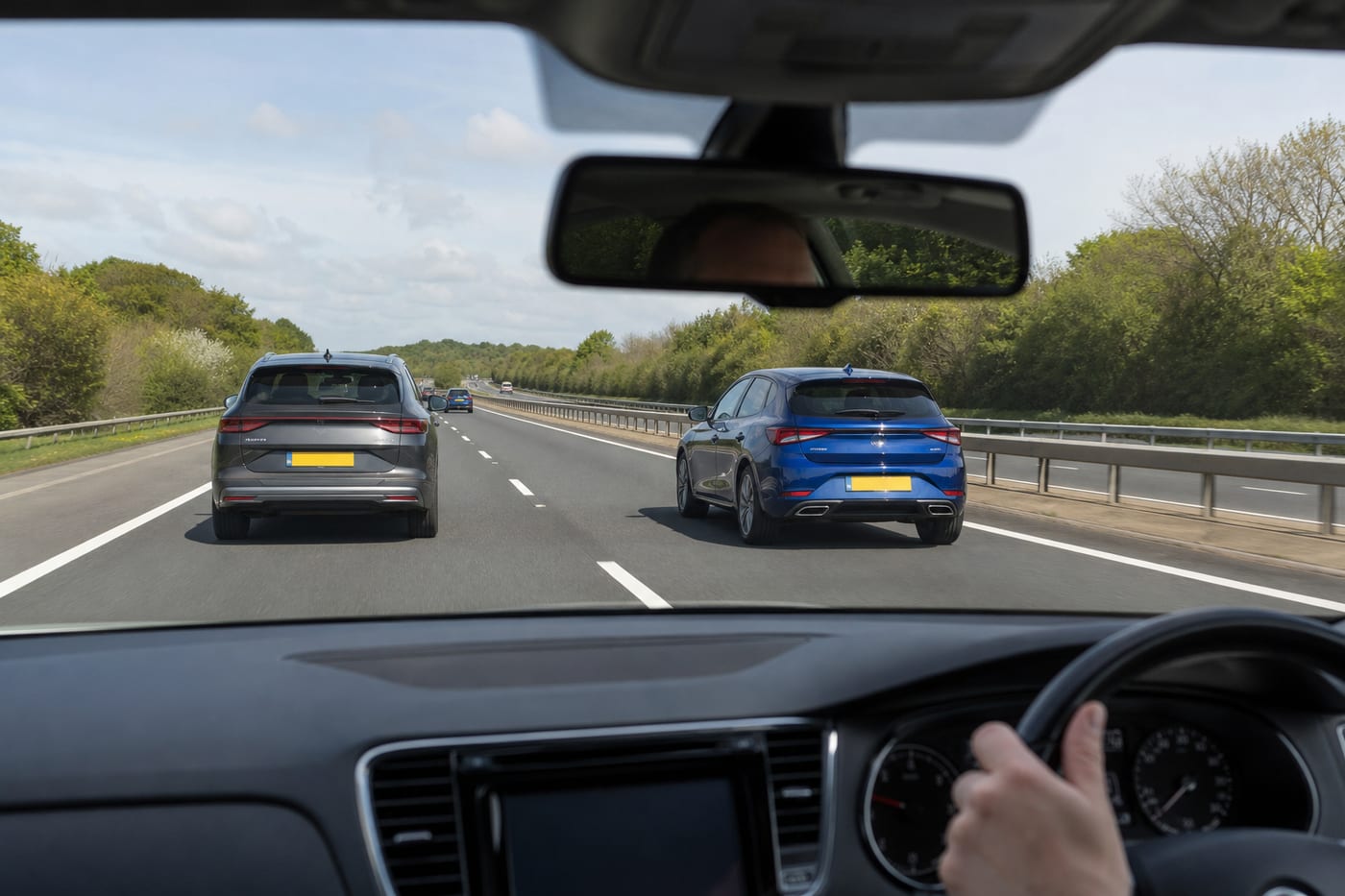
Overtaking on a motorway can appear straightforward because traffic travels in the same direction and there are no junctions crossing your path. However, high speeds mean that poor judgement, rushed lane changes or inadequate following distances can quickly create danger.
Safe motorway overtaking is not simply a matter of moving right and accelerating. You must assess the road well ahead, check what is happening behind and beside you, maintain a safe speed and return to the left only when there is enough room.
The following guidelines explain how to carry out the manoeuvre safely, legally and with consideration for other road users.
Understand basic motorway lane discipline
On a UK motorway, you should normally drive in the left-hand lane. The lanes to the right are primarily for overtaking, unless signs or road markings instruct you otherwise.
On a three-lane motorway, this generally means:
- Use the left lane for normal driving.
- Use the middle lane to overtake vehicles in the left lane.
- Use the right lane to overtake traffic in the other lanes.
- Return to a suitable lane on the left once you have completed the manoeuvre.
Remaining in the middle or right-hand lane when the lanes to your left are clear is poor lane discipline. It can obstruct traffic, encourage risky passing on the left and reduce the motorway’s usable capacity.
For broader advice covering joining, lane discipline and emergencies, see our complete guide to safe motorway driving in the UK.
Decide whether overtaking is necessary
Before changing lanes, ask whether you genuinely need to overtake. If the vehicle ahead is travelling only slightly more slowly than you, passing it may take a long time or tempt you to exceed the speed limit.
Look well ahead rather than focusing only on the vehicle immediately in front. Consider:
- Whether traffic farther ahead is also moving slowly
- Whether your chosen lane is clear for long enough
- Whether another driver is already overtaking you
- Whether you are approaching roadworks, congestion or a lane closure
- Whether an exit or motorway split will soon affect your lane choice
- Whether rain, spray, darkness or strong winds make the manoeuvre less safe
A safe driver does not overtake merely because another vehicle is present. Sometimes maintaining a safe following distance and staying in the left lane is the better choice.
Use a planned overtaking routine
A calm, organised routine helps you gather information before committing to a lane change.
1. Look well ahead
Check that you have enough space to overtake without becoming trapped behind slower traffic in the overtaking lane. Watch for brake lights, changing traffic speeds and overhead signals.
You should also identify vehicles that may move into your intended lane. A car closing on a lorry, for example, may pull out to overtake even if it has not yet signalled.
2. Check your mirrors
Use your interior mirror and the appropriate door mirror to judge the position and speed of traffic behind. A vehicle that appears distant may be approaching quickly.
Do not rely on one brief glance. Monitor the lane over several moments so that you can understand how the situation is developing.
3. Check the blind spot
Immediately before moving, take a quick sideways glance into the area that your mirrors do not cover. Keep the check brief so that your attention is not taken away from the road ahead for too long.
Blind-spot monitoring technology can help, but it does not replace direct observation and correct mirror use.
4. Signal clearly
If it is safe to proceed, signal right in good time. A signal tells other drivers what you intend to do; it does not give you priority or create a safe gap.
If another vehicle is already occupying the space, wait. Never begin moving and expect the other driver to brake or change lanes for you.
5. Move smoothly into the lane
Change lanes progressively rather than steering sharply. Maintain control and avoid drifting across the lane marking.
Once in the overtaking lane, cancel the signal if it has not cancelled automatically. Keep scanning well ahead and checking your mirrors.
Maintain a safe and legal speed
You must not exceed the speed limit to complete an overtake. For cars, the national speed limit on a motorway is normally 70 mph, but a lower limit may apply. Some vehicle types are also subject to lower limits.
Variable speed limits displayed on overhead gantries or roadside signs must be obeyed when shown in a red circle. Treat the speed limit as a maximum, not a target. Conditions may require a substantially lower speed.
Try to maintain a steady, appropriate speed during the manoeuvre. Speeding up aggressively, racing another vehicle or remaining beside it unnecessarily increases risk. If you cannot pass without exceeding the limit, stay behind at a safe distance.
Keep enough space throughout the manoeuvre
Do not move close to the vehicle ahead before pulling out. Tailgating restricts your view and leaves too little room if the other driver brakes.
In dry conditions, allow at least a two-second gap from the vehicle in front. Leave at least twice that gap on wet roads, and increase it further in icy conditions or poor visibility. Our guide to maintaining proper stopping distances explains how speed and weather affect the space required.
After moving into the overtaking lane, continue to maintain a safe gap from any traffic ahead. Do not use the manoeuvre to force your way into a small space.
Take extra care when overtaking large vehicles
Lorries, buses and coaches create additional risks. Their drivers may have substantial areas around the vehicle that are difficult or impossible to see directly.
Before passing a large vehicle:
- Make sure there is enough clear road to complete the overtake.
- Avoid lingering alongside it, especially near the cab.
- Expect spray in wet weather to reduce your visibility.
- Hold the steering wheel securely because air turbulence can affect your vehicle.
- Look for signs that the large vehicle may change lanes.
- Leave plenty of room before returning to the left.
Do not squeeze between a large vehicle and a central barrier. If the available space feels uncomfortably narrow, remain behind until the situation improves.
Be especially cautious on exposed bridges and in strong crosswinds. A large vehicle may shield your car from the wind temporarily, followed by a sudden sideways effect as you pass beyond it.
Return to the left safely
Once you have passed, do not cut sharply in front of the other vehicle. Continue until there is a safe gap, check your mirrors and signal left before moving back smoothly.
A useful practical guide is to wait until you can see the overtaken vehicle in your interior mirror, but this is not a substitute for judging the complete gap. Vehicle sizes, mirrors and speeds vary, so you must make sure you will not reduce the other driver’s safe following distance.
After returning to the left, cancel your signal and maintain an appropriate speed. If you are approaching another slower vehicle and would need to pull out again almost immediately, it may be safer to remain in the overtaking lane temporarily. However, return left as soon as it is safe and practical; do not stay out simply for convenience.
Do not overtake on the left
You should not move into a lane on the left in order to overtake. This is sometimes called undertaking and can be dangerous because drivers are less likely to expect a vehicle to pass on that side.
There is an important distinction during congestion. If traffic is queuing and lanes are moving at different speeds, you may keep up with the traffic in your lane even if it passes traffic to the right. Do not weave between lanes merely to make faster progress.
Never use the hard shoulder to overtake. A hard shoulder is not a normal traffic lane unless signs clearly show that it has been opened for use. Even then, you must obey all displayed signs and signals.
Obey signs, signals and red X closures
Motorway conditions can change quickly because of collisions, obstructions, roadworks or stopped vehicles. Pay attention to overhead gantries and roadside signs before and during an overtake.
A red X means the lane is closed. You must not drive in that lane beyond the signal. Move into an open lane when it is safe rather than waiting until the last moment. Never enter a closed lane to pass traffic.
Warning signs and flashing signals may tell you to slow down because of a hazard ahead. Adjust your speed early and avoid beginning an overtake if the road situation is becoming uncertain. Learn more in our guide to UK motorway signs and signals.
Common motorway overtaking mistakes
Several errors regularly make motorway overtaking less safe:
- Following too closely before pulling out: this reduces visibility and stopping space.
- Checking mirrors too late: early checks help you identify fast-approaching traffic.
- Assuming a signal creates priority: other drivers do not have to make room.
- Accelerating beyond the speed limit: overtaking does not provide an exemption.
- Changing multiple lanes at once: move one lane at a time and reassess between changes.
- Cutting back in too soon: leave a safe gap for the overtaken vehicle.
- Staying in an overtaking lane: return left when it is safe and practical.
- Passing on the left: do not change left merely to get ahead.
- Ignoring signs and variable limits: motorway controls may respond to hazards you cannot yet see.
Practical ways to build confidence
Learner drivers may use motorways only when accompanied by an approved driving instructor in a dual-controlled car. Motorway lessons are not compulsory, but suitable professional instruction can help you practise lane changes and overtaking in a controlled way.
Whether you are learning or newly qualified, begin in good weather and outside the busiest periods where possible. Talk through the routine before travelling and avoid attempting a manoeuvre if you feel rushed.
Build the habit of regularly checking your mirrors, looking far ahead and preserving a safe space around your car. Good overtaking starts long before the steering wheel is turned.
Conclusion
Secure motorway overtaking depends on observation, patience and disciplined lane use. Check the road ahead and behind, identify a safe gap, signal clearly and change lanes smoothly without exceeding the speed limit. Pass efficiently, leave plenty of room and return to the left when it is safe.
Most importantly, never treat overtaking as something you must complete at all costs. If conditions change or the gap is unsuitable, wait behind and reassess.
Frequently asked questions
Can I exceed 70 mph to overtake on a motorway?
No. You must remain within the applicable speed limit throughout the manoeuvre. If you cannot overtake safely without speeding, stay behind and maintain a safe following distance.
Is it illegal to stay in the middle lane?
You should keep left unless you are overtaking or signs and road conditions require another position. Remaining in the middle lane unnecessarily is poor lane discipline and may amount to careless driving.
Can I pass slower traffic on the left in a queue?
When traffic is congested and lanes are moving at different speeds, you may keep up with traffic in your own lane even if it passes vehicles to the right. You should not deliberately change to the left to overtake or weave between lanes.
When should I move back to the left after overtaking?
Return when you have passed the vehicle and can move left without cutting into its safe following space. Check your mirrors, signal and move smoothly. If you would need to pull out again almost immediately, you may remain in the overtaking lane briefly, but return left as soon as it is safe and practical.