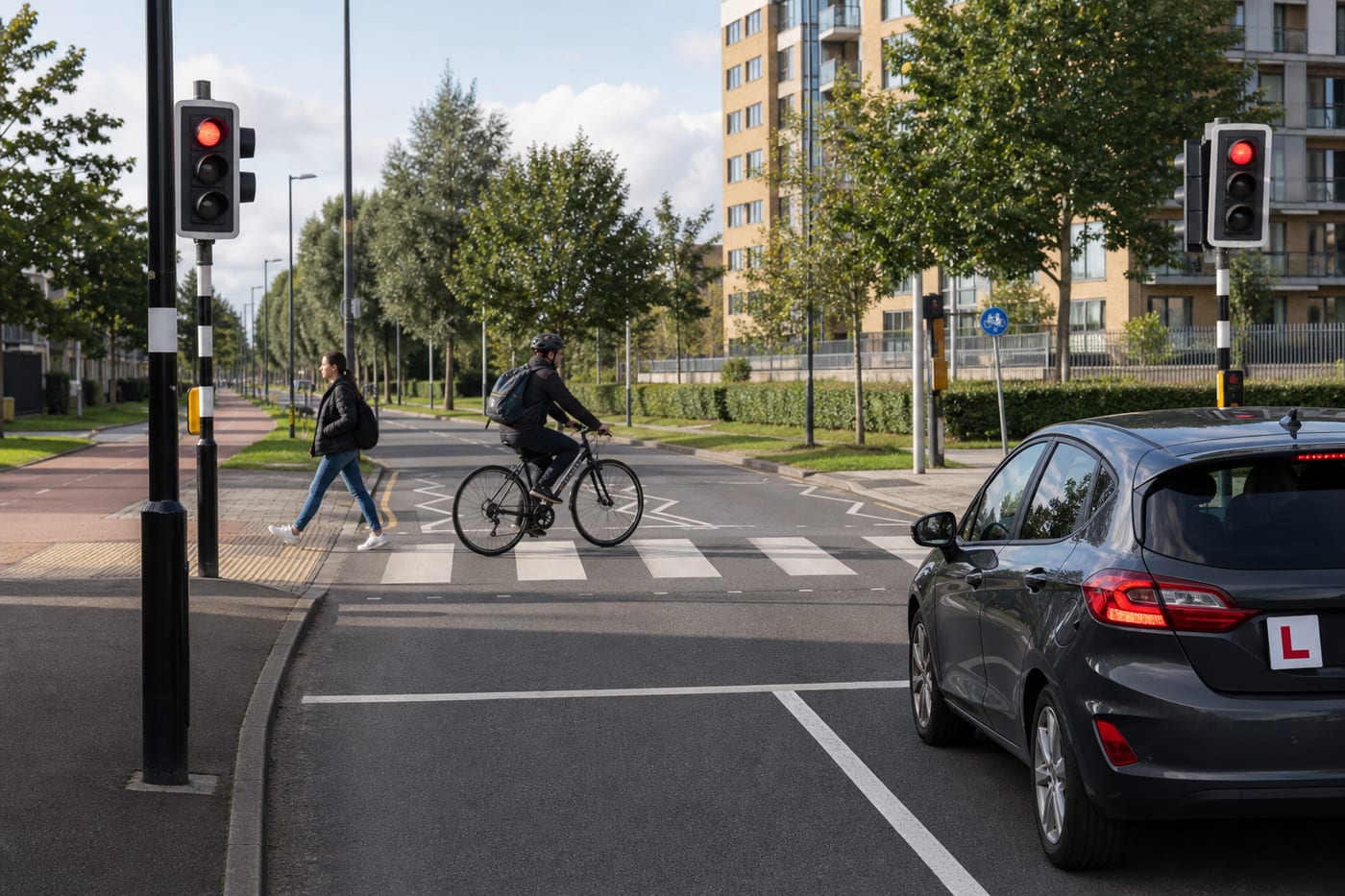
Toucan crossings are designed to help pedestrians and cyclists cross the road together. They are controlled by traffic lights and are commonly found where a cycle route or shared-use path meets a busy road.
For learner drivers, recognising a toucan crossing is only the first step. You also need to understand its light sequence, know where to stop and anticipate cyclists who may reach the crossing faster than pedestrians.
This guide explains everything you need to know about toucan crossings for the UK theory test, driving lessons and everyday road use.
What is a toucan crossing?
A toucan crossing is a signal-controlled road crossing that can be used by both pedestrians and cyclists. Its name is a useful memory aid: “two can” cross — people on foot and people riding bicycles.
Unlike at pelican, puffin and zebra crossings, cyclists are permitted to ride across a toucan crossing. They do not normally need to dismount and push their bicycle.
Toucan crossings are usually wider than ordinary pedestrian crossings so that cyclists and pedestrians have enough space to cross together. You will often find them beside cycle lanes, shared-use paths, parks and routes that are popular with people walking and cycling.
If you want to compare every major crossing type, see our guide to UK pedestrian crossings.
How to identify a toucan crossing
Several features can help you recognise a toucan crossing.
Pedestrian and bicycle symbols
The user signals display both a pedestrian and a bicycle symbol. A green symbol tells pedestrians and cyclists that they may begin crossing, while a red symbol tells them to wait.
Signal positioning and crossing designs can vary, so do not rely on one feature alone. Look at the whole layout, including the paths leading towards the crossing.
Traffic lights for drivers
Drivers face the familiar red, red-and-amber, green and amber traffic light sequence. There is normally a solid white stop line before the crossing.
Toucan crossings do not use the flashing amber phase traditionally associated with pelican crossings. Drivers must follow the ordinary traffic-light sequence.
A wider crossing area
Because the crossing accommodates bicycles as well as pedestrians, it is generally broader than a standard pedestrian-only crossing. It may connect shared pedestrian and cycle paths on each side of the road.
Push-button controls
People waiting to cross may use a push-button control to request the signals. Depending on the installation, detection equipment may also help manage the crossing phase.
As a driver, you should never assume that no one has requested the crossing simply because you did not see a button being pressed.
What each traffic light means for drivers
The signals at a toucan crossing have the same basic meaning as traffic lights elsewhere.
Green
A green light means you may proceed if the road and crossing are clear. It does not give you permission to drive into a blocked crossing or move towards someone who has not finished crossing.
Check both sides before entering. A cyclist or pedestrian may still be completing the crossing, particularly if they move slowly or the crossing is wide.
Amber
A steady amber light means stop at the stop line. The exception is when you have already crossed the line, or you are so close that stopping could cause a collision.
Do not accelerate to “beat” the red light. When approaching a light that has been green for some time, be ready for it to change.
Red
A red light means you must stop behind the stop line. Do not allow any part of your vehicle to move over it.
Remain stopped even if the crossing appears empty. The signal, not your personal judgement about whether anyone is crossing, controls when you may proceed.
Red and amber
Red and amber together mean that you must remain stopped but may prepare to move. Check that the crossing is clear, select the appropriate gear if necessary and carry out your observations.
You must not pass the stop line until the green light appears.
How to approach a toucan crossing safely
A good approach begins well before the stop line. Use the following routine during lessons and independent driving.
1. Identify the crossing early
Look for traffic lights, zigzag markings, cycle paths and people waiting near the kerb. Early recognition gives you more time to assess the situation and adjust your speed smoothly.
2. Check your mirrors
Check your mirrors before changing speed. This helps you understand how closely another vehicle is following and allows you to brake progressively where possible.
Mirror checks do not change what a red or amber signal requires, but they help you manage the approach safely.
3. Reduce your speed when necessary
If pedestrians or cyclists are waiting, expect the lights to change. Ease off the accelerator and be prepared to stop rather than maintaining speed until the last moment.
Cyclists can arrive at the crossing quickly, including from paths that may initially be outside your central field of view. Keep scanning both sides.
4. Stop in the correct place
Stop behind the solid white line. Avoid stopping on the crossing, over the line or across an adjoining cycle path.
If traffic is queuing beyond the crossing, wait before the stop line until there is enough space for your vehicle on the other side. A green light does not justify blocking the crossing.
5. Move away only when it is safe
When the signal turns green, check that everyone has cleared your path. Look for slower pedestrians, children, mobility scooter users and cyclists who may still be crossing.
Move away smoothly rather than accelerating sharply. Further guidance on recognising changing risks is available in our practical guide to identifying road hazards.
Zigzag markings at toucan crossings
You may see zigzag road markings on the approaches to a toucan crossing. These markings protect visibility and reduce dangerous behaviour near the crossing.
You must not park on the zigzags. You must also obey the restrictions on overtaking near the crossing, including not overtaking the moving vehicle nearest the crossing or a vehicle that has stopped to give way.
These rules matter because the stopped vehicle may be hiding a pedestrian or cyclist. Never assume that a vehicle ahead has stopped unnecessarily.
Keep the crossing area clear in slow traffic. Blocking it can force pedestrians or cyclists to move around your vehicle and into a less visible position.
Toucan crossings compared with other crossings
Crossing types can look similar under theory test pressure. The key differences are easier to remember when you focus on who may use them and how traffic is controlled.
| Crossing | Main users | Driver control | Can cyclists ride across? | |---|---|---|---| | Toucan | Pedestrians and cyclists | Traffic lights | Yes | | Pelican | Pedestrians | Traffic lights, traditionally including flashing amber | No | | Puffin | Pedestrians | Traffic lights, often with near-side signals and detection | No | | Zebra | Pedestrians | No traffic lights | No; cyclists should dismount to use it as a pedestrian crossing | | Equestrian crossing | Horse riders, and sometimes other users depending on the layout | Traffic lights | Depends on the specific crossing layout |
The easiest toucan clue is the combined pedestrian and bicycle signal. For a closer comparison of the three signal-controlled types, use our puffin, toucan and pelican crossing guide.
Advice for cyclists using a toucan crossing
Cyclists may ride across a toucan crossing, but permission to ride does not remove the need for care.
Approach at a speed that allows you to stop. Wait when the red bicycle signal is showing and cross only when the appropriate green signal appears. Check that traffic has stopped before entering the road, even when the signal is in your favour.
Be considerate of pedestrians sharing the space. Avoid passing closely, cutting across someone’s path or entering the crossing so quickly that drivers have little opportunity to notice you.
After crossing, rejoin the appropriate cycle route or road carefully. Do not make an abrupt turn into moving traffic.
Advice for pedestrians using a toucan crossing
Use the push-button control where one is provided, then wait for the green signal. Do not begin crossing while the red pedestrian symbol is displayed.
When the green signal appears, check that vehicles have stopped before stepping into the road. Continue across without unnecessary delay, but do not run if doing so could make you trip or lose awareness of other users.
Remember that cyclists may be crossing alongside you. Keep a predictable line and supervise young children closely.
Common mistakes made by learner drivers
Confusing a toucan with a pelican crossing
A learner may expect a flashing amber light and become uncertain when it does not appear. At a toucan crossing, follow the standard traffic-light sequence and wait for green.
Looking only for pedestrians
Because cyclists can use the crossing while mounted, scan adjoining cycle paths as well as pavements. A bicycle may reach the kerb much sooner than a person walking.
Moving as soon as the light turns green
A green signal does not mean “go regardless”. Check that pedestrians and cyclists have completely cleared the part of the crossing you need to use.
Stopping beyond the line
Poor speed planning can leave the car over the stop line or on the crossing. Anticipate signal changes and brake progressively.
Following another vehicle onto a blocked crossing
Do not enter unless your exit is clear. If the vehicle ahead stops, you could become stranded across the route used by pedestrians and cyclists.
Toucan crossings in the theory and hazard perception tests
Theory test questions may ask you to identify who can use a toucan crossing, interpret its signals or choose the safest action when someone is still crossing.
Remember these core points:
- Toucan crossings are for pedestrians and cyclists.
- Cyclists may ride across them.
- Drivers follow the normal traffic-light sequence.
- A steady amber light normally means stop.
- Drivers must stop at red and remain behind the stop line.
- You should not proceed until the crossing and your exit are clear.
In hazard perception clips, a cyclist approaching a toucan crossing may be a potential hazard. The situation becomes a developing hazard when the cyclist’s movement means you need to change speed or direction, such as when they approach the crossing as the lights begin to change.
Conclusion
Toucan crossings allow pedestrians and cyclists to cross together under traffic-light control. For drivers, safe handling depends on early observation, controlled braking, correct positioning and patience.
The simplest way to remember the crossing is “two can cross”. However, passing your theory test and driving safely require more than recognising the name: always obey the signals, watch for fast-approaching cyclists and make sure the crossing is completely clear before proceeding.
Frequently asked questions
Why is it called a toucan crossing?
The name is based on the phrase “two can cross”, referring to pedestrians and cyclists. It does not relate to the bird when identifying the crossing on the road.
Can cyclists ride over a toucan crossing?
Yes. Toucan crossings are specifically designed to allow cyclists and pedestrians to cross together. Cyclists should still obey the red and green crossing signals and ride considerately around pedestrians.
Do toucan crossings have a flashing amber light?
No. Toucan crossings use the normal traffic-light sequence for drivers. The flashing amber phase is associated with traditional pelican crossings, where drivers may proceed only if the crossing is clear.
What should I do if the light turns green while someone is still crossing?
Wait until the person or cyclist has cleared your path. A green light allows you to proceed only when it is safe, so do not move towards someone who is still on the crossing.