Pelican crossings allow pedestrians to stop traffic and cross the road using a push-button system. For drivers, they require early observation, controlled braking and a clear understanding of the traffic-light sequence—particularly the flashing amber phase.
As a learner driver, you must be ready for pedestrians to press the button, step towards the kerb or remain on the crossing after your signal changes. Simply recognising the crossing is not enough: you need to anticipate what could happen and respond without rushing.
This guide explains how to identify a pelican crossing, what each signal means and how to navigate one safely during lessons, on your practical test and after you have passed.
What is a pelican crossing?
A pelican crossing is a signal-controlled pedestrian crossing. The name comes from “pedestrian light-controlled crossing”. Pedestrians normally press a button and wait for the green figure before crossing.
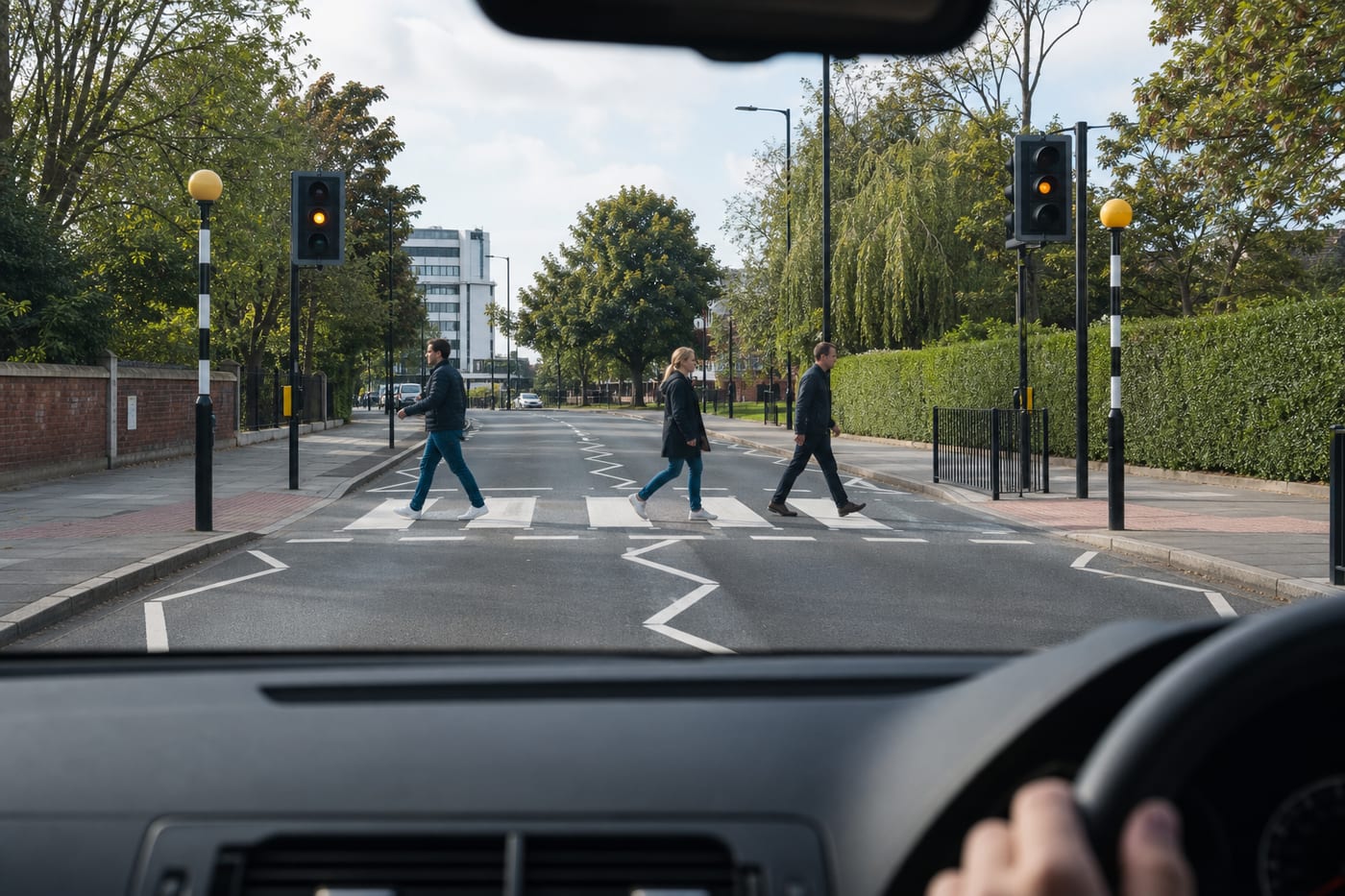
Drivers are controlled by a standard set of traffic lights. Unlike a puffin crossing, a traditional pelican crossing has a flashing amber phase for traffic. Its pedestrian red and green figures are generally positioned on the opposite side of the road, where people waiting to cross can see them.
Pelican crossings also usually have:
- Traffic lights facing approaching vehicles
- A white stop line
- Zigzag markings on both approaches
- A pedestrian push-button unit
- Red and green pedestrian figures
- Black-and-white striped signal poles
Pelican, puffin and toucan crossings can look similar at first. Our guide to puffin, toucan and pelican crossings explains the main differences.
Understanding the pelican crossing light sequence
Knowing the signal sequence helps you make safe decisions without hesitation. However, you must always combine the lights with observation. A green signal does not give you permission to drive into an occupied or blocked crossing.
Green light
A green light means you may proceed if the crossing and the road beyond it are clear. Continue checking both pavements, especially if someone is approaching the push-button unit or standing close to the kerb.
Do not accelerate merely because the light is green. A pedestrian may behave unexpectedly, and traffic ahead could stop and leave you unable to clear the crossing.
Amber light
A steady amber light means stop at the stop line unless you have already crossed the line or are so close that stopping might cause a collision.
Good forward planning should usually prevent a last-second decision. If you identify the crossing early and ease off the accelerator, you will be better prepared for the lights to change.
Red light
A red light means you must stop behind the white stop line. Do not allow the front of the vehicle to creep over it, and do not move away while the signal remains red.
Leave enough room to see the stop line where practical. Keep the car secured and continue observing the crossing rather than becoming distracted by the controls or surrounding traffic.
Red and amber together
Red and amber together mean that the lights are about to turn green, but you must remain behind the stop line. Prepare the car to move, check the crossing and wait for green.
Avoid treating red and amber as an instruction to set off. Moving across the stop line before green is both unsafe and unlawful.
Flashing amber
The flashing amber phase is the feature learner drivers most strongly associate with a pelican crossing. It means you must give way to anyone still on the crossing. If the crossing is completely clear, you may proceed with care.
Never pressure a pedestrian by edging forwards or revving the engine. Some people need more time because of age, disability, injury or poor visibility. Wait patiently until they have cleared your path.
If no one is crossing, check carefully in both directions before moving. A pedestrian may be partly obscured by another vehicle, street furniture or the windscreen pillar.
How to approach a pelican crossing safely
A reliable routine makes your actions smoother and gives you more time to react.
1. Identify the crossing early
Look well ahead for traffic lights, zigzag markings, push-button units and people waiting near the kerb. Brake lights on vehicles ahead may give you an early clue that the signals are changing.
Treat people near the crossing as potential hazards even if they have not pressed the button. Children may run ahead, while distracted pedestrians may step into the road without checking properly. Developing strong observation is also useful for the theory test; see our guide to identifying road hazards.
2. Check your mirrors
Check the interior mirror as you approach, followed by the appropriate door mirror when necessary. You need to know whether another road user is following closely before you reduce speed.
Mirror checks do not remove the need to stop. Instead, they help you brake progressively and communicate your intentions early. A gentle initial application of the brakes illuminates your brake lights and warns following traffic.
3. Adjust your speed
Ease off the accelerator and approach at a speed that allows you to stop safely if the lights change. Your speed should reflect visibility, weather, traffic and the presence of pedestrians.
Avoid accelerating towards a green light in the hope of getting through before it changes. This reduces your stopping time and may turn an ordinary crossing into an urgent situation.
4. Stop in the correct place
If required to stop, do so behind the white stop line. Brake progressively unless an unexpected event demands firmer action.
Stopping too far back can confuse following traffic, while stopping over the line may obstruct pedestrians and place your vehicle within the controlled area. Aim for an accurate, comfortable stop without fixating on the line so much that you neglect the crossing.
5. Observe throughout the wait
Keep watching pedestrians, signals and nearby traffic. Look for people who are crossing slowly or who started near the end of their permitted phase.
Be particularly careful where a large vehicle blocks your view. A pedestrian may emerge from in front of a bus, van or lorry.
6. Move away only when it is safe
When your signal allows you to proceed, check that the crossing is clear and that there is enough room beyond it. Move away smoothly, checking for pedestrians who may still be close to your path.
On flashing amber, pedestrians already on the crossing take priority. On green, you should still wait if someone remains in the road.
Pelican crossing zigzag markings
The zigzag lines protect visibility around pedestrian crossings. You must not park on them or overtake the moving vehicle nearest the crossing. You must also not overtake a vehicle that has stopped to give way to pedestrians.
These restrictions help approaching drivers and pedestrians see one another. A parked vehicle can hide a child or wheelchair user, while overtaking near a crossing creates a serious risk because the other vehicle may be slowing for somebody you cannot see.
Do not use the zigzag area for dropping off or collecting passengers, even briefly. For more detail about controlled areas and other painted restrictions, review our guide to UK road markings.
Common mistakes learner drivers should avoid
Reacting only when the light changes
If you wait for amber before considering whether you can stop, you may brake harshly. Scan ahead and prepare while the signal is still green.
Moving automatically on flashing amber
Flashing amber is not the same as an unrestricted green light. You must first give way to pedestrians on the crossing.
Following the vehicle ahead without checking
The driver in front may move while a pedestrian is still crossing another part of the road. Make your own observations and decision rather than following automatically.
Blocking the crossing
Never enter unless you can clear it. If traffic is queuing beyond the crossing, wait behind the stop line even if the signal is green.
Waving pedestrians across
Avoid beckoning someone into the road. Another vehicle may not stop, especially on a multi-lane road. Remain stopped when required and allow the pedestrian to make their own decision based on the signals and traffic conditions.
Being distracted while waiting
Do not switch off mentally at a red light. Signals can change, pedestrians can alter direction and cyclists or emergency vehicles may approach. Maintain awareness and be ready to respond safely.
Pelican crossings in unusual situations
Pedestrians are still crossing when traffic receives green
Wait until they are safely clear of your path. A green light permits movement; it does not justify driving towards someone who remains in the road.
An emergency vehicle approaches from behind
Stay calm and avoid crossing the stop line against a red light. Do not commit an offence or endanger pedestrians in an attempt to make space. Allow the emergency driver to find a safe route, moving only when you can do so legally and safely or when directed by a police officer.
The signals appear faulty
Approach with great caution and be prepared to stop. Do not assume that pedestrians know the signals are faulty. If the lights are stuck on red, do not simply drive through them. Follow any directions given by a police officer or authorised traffic official and report faulty signals when it is safe to do so.
The crossing has a central island
Look carefully at the layout and signals. Where a crossing is staggered on either side of a central island, each section may operate as a separate crossing. Respond to the signals controlling your section rather than looking at a signal intended for another lane or carriageway.
Practical driving test advice
During the practical test, the examiner will expect you to identify crossings early, use mirrors appropriately, control your speed and comply with the lights. They will also assess whether you protect vulnerable road users and make safe observations before moving away.
You do not need to narrate the light sequence. Concentrate on a calm routine:
- Look well ahead
- Check the mirrors
- Ease off when there is a possible need to stop
- Brake progressively
- Stop behind the line
- Keep observing pedestrians
- Move only when the signal and conditions allow
If the lights change at an awkward moment, make the safest lawful decision. Do not brake violently when it would be unsafe to stop, but never accelerate aggressively to beat the signal.
Frequently asked questions
Can I drive through a pelican crossing on flashing amber?
You may proceed on flashing amber only when no pedestrians remain on the crossing. If anyone is still crossing, you must give way and wait until your path is clear.
Must I stop if the light changes to steady amber?
Yes, unless you have already crossed the stop line or are so close that stopping could cause a collision. Approaching at a controlled speed makes it easier to respond safely.
Can I move when red and amber show together?
No. Red and amber mean prepare to move, but you must not cross the stop line until the green light appears and it is safe to proceed.
What is the main difference between a pelican and a puffin crossing?
A pelican crossing uses a flashing amber phase and normally has pedestrian signals on the opposite side of the road. A puffin crossing uses sensors, has no flashing amber phase and usually places the pedestrian signal beside the push button.
Conclusion
Safely navigating a pelican crossing depends on early observation, an appropriate approach speed and a proper understanding of the flashing amber phase. Check your mirrors, stop behind the line when required and give pedestrians as much time as they need. Even when the lights permit you to move, proceed only after confirming that the crossing and the road ahead are clear.