Leaving a motorway may appear simpler than joining one, but it still requires planning, observation and careful speed control. At motorway speeds, a late lane change or sudden reduction in speed can create a serious risk for you and the traffic behind.
The correct technique is to identify your exit early, move into the appropriate lane in good time, signal clearly and reduce speed mainly after entering the exit slip road. You must then adapt to whatever comes next, such as a roundabout, traffic lights, a sharp bend or a lower speed limit.
This guide explains each stage of exiting a UK motorway safely and highlights the mistakes learner and newly qualified drivers should avoid.
Start planning well before the junction
Safe motorway exits begin with early preparation. Direction signs are normally provided in advance so that drivers can choose the correct route and lane without rushing.
Look for your destination, route number and junction number. Do not rely entirely on satellite navigation. It can help with route planning, but road signs and markings provide the instructions that apply at the junction.
If you need to leave the motorway, begin checking your mirrors and surrounding traffic as soon as you recognise the exit. Unless signs or road markings indicate otherwise, you will normally leave from the left-hand lane.
If you are overtaking, complete the manoeuvre safely and return to the left when there is a suitable gap. Do not cut across several lanes at the last moment. Our complete guide to safe motorway driving explains lane discipline, safe gaps and overtaking in more detail.
Use countdown markers
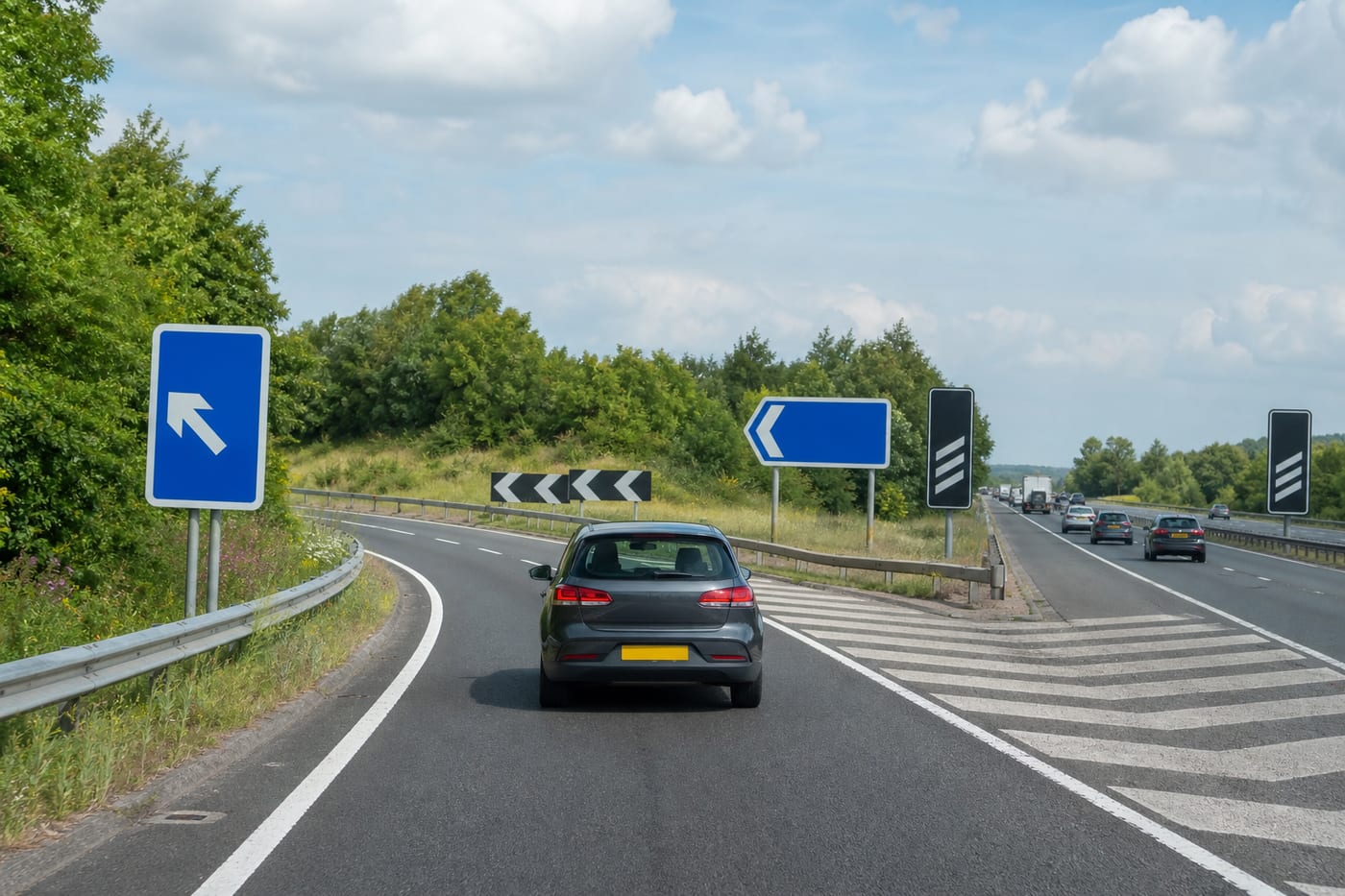
Motorway exits are often preceded by countdown marker boards. These display three, two and then one diagonal bar as the exit approaches. They are normally positioned approximately 300, 200 and 100 yards before the start of the slip road.
Use these markers to judge the distance remaining, but do not wait until the final board before preparing. By that point, you should already be in the correct lane unless traffic conditions or signs require a different approach.
The correct motorway exit routine
A useful routine is to divide the manoeuvre into five stages: identify, observe, position, signal and adjust your speed.
1. Identify the correct exit
Read the advance direction signs carefully. Confirm the destination, route and junction rather than assuming that every exit leads to the same local area.
Some motorway junctions have several lanes or separate branches. Arrows painted on the carriageway may show which lane leads to a particular destination. Follow these markings early and avoid changing lanes after solid white lines begin.
For help recognising overhead signals, lane closures and direction signs, see our guide to UK motorway signs and signals.
2. Check your mirrors
Check the interior mirror and the relevant door mirror before changing position or speed. You need to know whether another vehicle is alongside you, approaching quickly from behind or already moving towards the same lane.
Remember that motorcycles can be harder to see and may appear quickly. Use repeated mirror checks rather than relying on a single glance.
If you must change lanes to the left, make sure there is a safe gap. A signal tells other road users what you intend to do; it does not give you priority.
3. Move into the correct lane early
Move left one lane at a time when it is safe. Maintain a steady speed while changing lanes and leave an appropriate gap from the vehicle ahead.
Do not squeeze into a small gap, cross solid white lines or force another driver to brake. If heavy traffic prevents you from reaching the exit safely, continue along the motorway and find another route.
Once you are in the lane for the exit, maintain your lane position. Be alert for vehicles joining from another carriageway or moving across towards the same slip road.
4. Signal left in good time
Signal left well before leaving the motorway. A timely signal helps drivers behind understand that you intend to take the exit rather than simply continue in the left-hand lane.
Your signal should be early enough to be useful but not so early that it could confuse others, particularly if there is another slip road, service area or junction before your intended exit.
Keep monitoring your mirrors after signalling. Other drivers may respond by changing speed or position.
5. Enter the slip road before reducing speed significantly
On a normal free-flowing exit, avoid braking sharply while still on the main motorway. Enter the slip road smoothly and then adjust your speed to suit its layout, signs, traffic and weather conditions.
Slip roads are designed to provide space for deceleration, but their length and shape vary. Some are long and straight; others tighten into sharp bends. A slip road can also end at queuing traffic, a roundabout or traffic lights.
Ease off the accelerator and brake progressively. In a manual car, select an appropriate gear for the lower speed without coasting or looking down at the gear lever.
Watch for speed limits and bend warnings
Do not judge a slip-road bend by motorway standards. After travelling at a high speed, a much lower speed can feel unusually slow, which may cause you to approach the bend too quickly.
Look for warning signs, chevron boards and speed limit signs. A number inside a red circle is a mandatory maximum speed limit. Other signs may provide advisory information for a bend or hazard. Whatever the posted information, you must always drive at a speed that allows you to remain in control and stop within the distance you can see to be clear.
Wet or icy conditions may require a much greater reduction in speed. Leave extra space from the vehicle ahead because braking distances increase when road grip is reduced. You can revise this topic using our guide to maintaining proper stopping distances.
Prepare for the end of the slip road
As soon as you enter the slip road, look ahead to identify what comes next. Check for:
- Traffic lights or a roundabout
- A queue hidden by a bend or crest
- A give-way or stop line
- Pedestrians, cyclists or local traffic
- A lower speed limit
- Multiple lanes for different destinations
Choose the correct lane early and reduce speed progressively. Continue checking your mirrors, particularly before braking.
If the slip road leads to a roundabout, read the signs and road markings before reaching it. Do not remain focused on the motorway behind you; your attention must now shift to the junction ahead.
Make sure your indicator has cancelled if it is no longer appropriate. Leaving a left signal on could mislead other road users at the next junction.
Lane-drop exits and more complex junctions
Not every exit is a simple slip road branching from the left-hand lane. At some junctions, a lane leaves the motorway completely. This is known as a lane drop.
Overhead signs and road markings will show which lanes continue on the motorway and which leave at the junction. If you want to stay on the motorway, move out of the lane that is ending when safe. If you want to leave, remain in the marked exit lane.
Some motorway interchanges divide into separate carriageways with several destination lanes. Follow the signs rather than assuming that the furthest-left lane is always correct. Once lanes are separated by solid white lines or a hatched area, do not make a last-second correction across them.
A red X above a motorway lane means that the lane is closed. You must not drive in it. Follow the displayed signals and move into an open lane safely, even if the closed lane appears to lead towards your intended exit.
Common mistakes when leaving a motorway
Slowing down too early
Heavy braking on the main carriageway can surprise following drivers. Unless congestion or another hazard requires you to slow sooner, carry your speed safely into the slip road and decelerate there.
Cutting across lanes
Trying to cross two or three lanes close to the junction is dangerous. Move left early and change one lane at a time. If you cannot reach the exit safely, miss it.
Entering the hatched area
The painted area separating the motorway from the exit is not an extra lane. Never use it to recover from a missed exit. Solid white boundary lines must not be crossed except in limited circumstances permitted by the Highway Code.
Following too closely
Drivers ahead may brake sharply when they reach a tight bend or queue. Maintain a safe following distance and increase it in poor conditions.
Relying only on satellite navigation
Navigation instructions can be delayed, unclear or incorrect. Use them alongside signs and road markings, not instead of them.
Stopping on the slip road unnecessarily
Do not stop on an exit slip road to check directions. Continue to a safe and legal place away from moving traffic before changing your route.
What should you do if you miss your exit?
Continue to the next junction and re-route from there. Never reverse, stop, make a U-turn or cross the central reservation. Do not drive over chevrons or the physical divider between the carriageway and slip road.
Missing an exit may be inconvenient, but a safe delay is always preferable to a dangerous last-second manoeuvre. Stay calm and allow your navigation system to calculate another route, or follow signs to a suitable place where you can stop safely and check directions.
Practising motorway exits as a learner
Learner car drivers may use motorways in England, Scotland and Wales only when accompanied by an approved driving instructor and driving a car fitted with dual controls. Motorway lessons are optional, but supervised practice can help you learn how early to prepare, how to interpret overhead signs and how motorway speed affects your judgement.
Practise on quieter routes before tackling complicated interchanges. Ask your instructor to explain lane-drop junctions, countdown markers and the transition from motorway speed to local roads.
Conclusion
The safest motorway exit is calm, early and predictable. Read the signs in advance, check your mirrors, move into the correct lane one lane at a time and signal clearly. Avoid heavy braking on the main carriageway, then use the slip road to reduce speed progressively and prepare for the junction ahead.
Most importantly, never attempt a sudden manoeuvre to rescue a missed exit. Continue safely and take the next available route.
Frequently asked questions
When should I signal to leave a motorway?
Signal left well before the exit so that other drivers have time to understand your intention. The precise timing depends on the junction layout. Avoid signalling so early that it could be mistaken for an earlier exit or service area.
Should I brake before entering the exit slip road?
On a clear, normal exit, avoid reducing speed sharply on the main carriageway. Enter the slip road smoothly and then brake progressively. However, you must slow earlier if congestion, a short slip road, warning signs or another hazard makes it necessary.
What happens if I am in the wrong lane near my exit?
Change lanes only if you can do so safely and legally. Do not cut across traffic, solid white lines or hatched areas. If there is no safe opportunity to reach the exit, continue to the next junction and adjust your route.
Does the motorway speed limit apply on the exit slip road?
Follow the signs applying to the road and never assume that motorway speed is suitable for a slip road. Look for mandatory speed limits and warning signs, and reduce your speed enough to deal safely with bends, queues and the junction at the end.