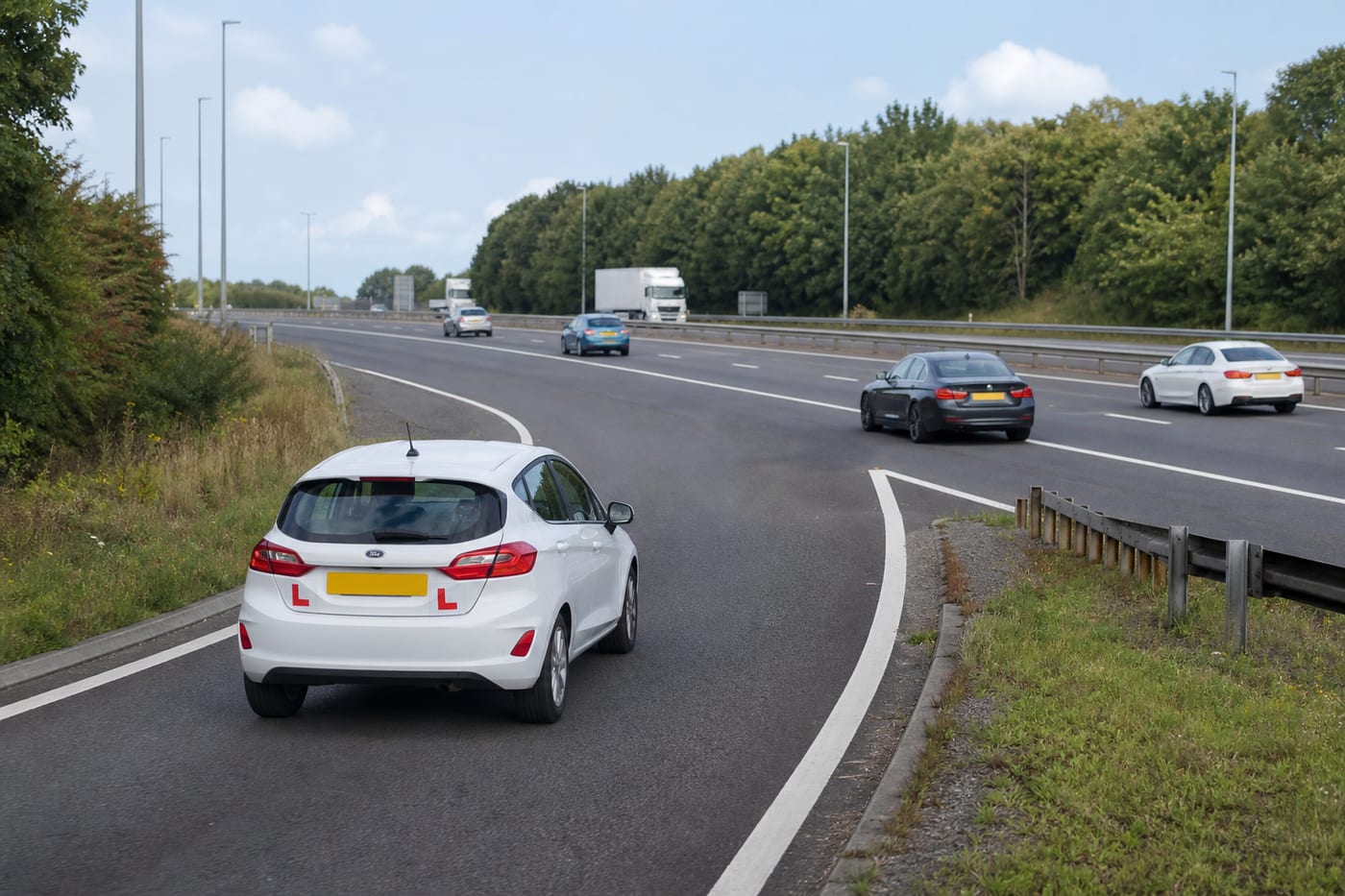
Joining a motorway can feel intimidating when you are used to quieter roads. Traffic may be moving quickly, the slip road is running out ahead, and you must observe, signal, control your speed and select a suitable gap at the same time.
The key is to treat merging as a planned process rather than a last-second manoeuvre. Use the slip road to assess the motorway, build an appropriate speed and position your car so that you can enter a safe gap without making other drivers brake or change direction suddenly.
This guide explains how to merge onto a UK motorway safely, what to do when traffic is busy and which common mistakes learner and newly qualified drivers should avoid.
Who has priority when you join a motorway?
Traffic already travelling on the motorway has priority over vehicles joining from the slip road. It is your responsibility to adjust your speed and enter only when there is a safe gap.
Some motorway drivers may move into lane two to help joining traffic, provided it is safe for them to do so. However, you must never expect or rely on this. They may be unable to move because another vehicle is overtaking them, or they may need to remain in lane one for an approaching exit.
A signal shows your intention, but it does not give you priority. Do not assume that activating your right indicator means another driver must let you in.
A safe step-by-step motorway merging routine
1. Read the road before reaching the slip road
As you approach the motorway junction, check the signs and road markings. Establish which direction you need and select the correct lane early.
Look for features that could change how you join, including:
- A short or sharply curved slip road
- More than one joining lane
- Traffic lights controlling access
- Roadworks or temporary restrictions
- A lane that continues onto the motorway as an additional lane
- Queuing or slow-moving traffic ahead
Motorway layouts vary, so do not assume every slip road will work in exactly the same way. If the joining lane becomes an extra motorway lane rather than ending, remain in it initially and reassess once you have joined.
2. Use the slip road to build speed
The slip road gives you space to accelerate before joining the main carriageway. Build speed progressively once the road straightens and conditions allow.
Your aim is to match your speed to the traffic in lane one as closely as possible. If motorway traffic is flowing normally, joining at a much lower speed can make it difficult to fit into a gap and may force following drivers to brake.
Matching speed does not mean exceeding the limit or driving faster than conditions permit. A wet surface, poor visibility, congestion or a tight bend may require a lower speed. The correct speed is one that lets you maintain control and enter the traffic flow safely.
If you drive a manual car, choose a gear that provides enough acceleration without making the engine struggle. Smooth gear changes and timely acceleration will help you avoid reaching the end of the slip road too slowly. Our guide to smooth and safe manual gear changes explains how to select gears without losing unnecessary momentum.
3. Observe the motorway early
Begin checking the motorway as soon as you have a useful view of it. Use your mirrors to understand what is behind and beside you, then make brief sideways checks where necessary.
You need to identify:
- The speed of traffic in lane one
- The size of the available gaps
- Vehicles that may be hidden alongside you
- Large vehicles with limited visibility around them
- Other traffic joining in front of or behind you
- Drivers moving between lanes
Avoid staring over your shoulder for too long. Your vehicle will still be moving forwards, and traffic ahead on the slip road may slow unexpectedly. Alternate between looking ahead, checking your mirrors and making quick effective sideways observations.
4. Select a gap, not an individual vehicle
Look for a space between two vehicles rather than focusing only on the car immediately alongside you. Ask yourself whether the gap will remain safe by the time you reach the motorway.
A good gap should allow you to join without forcing either vehicle to brake sharply. It must also leave enough space in front once you are established in lane one.
Try to position your car slightly ahead of or behind the vehicle beside you. Remaining exactly level with it for the length of the slip road limits your options and increases the chance of entering its blind spot.
If the gap is ahead, accelerate smoothly. If it is behind, ease off the accelerator early and let the vehicle pass. Small, planned speed changes are usually safer than harsh acceleration or sudden braking near the end of the slip road.
5. Signal clearly
Signal right when it will help motorway traffic understand that you intend to join. Do not signal so early that your intention is unclear, but avoid leaving it until the final moment.
Continue monitoring the gap after signalling. A driver may accelerate, slow down or move lanes, so a gap that initially looked suitable can change.
Before crossing into lane one, make a final mirror check and check the area beside your vehicle. This is particularly important if a car or motorcycle has disappeared from view.
6. Merge smoothly and cancel the signal
When the gap is safe, steer gradually across the broken line. Avoid making a sudden movement or drifting across more than one lane.
Once established, cancel your indicator if it has not cancelled automatically. Settle into lane one, maintain a safe speed and rebuild an appropriate following distance. The two-second rule can help in good, dry conditions, but you should leave a larger gap when the road is wet or visibility is poor. See our guide to maintaining proper stopping distances for advice about adjusting the space ahead.
Remain in lane one unless you need to overtake or signs and markings direct you otherwise.
What if there is no safe gap?
Adjust your speed early rather than waiting until the slip road is about to end. Often, easing off slightly will allow one vehicle to pass and create a safer space behind it.
You should avoid stopping on a slip road unless traffic conditions make it necessary. Joining from a standstill is much harder because you no longer have the speed needed to merge smoothly. However, you must not force your way onto the motorway simply to avoid stopping. If there is genuinely no safe gap, slow down and stop if necessary rather than causing a collision.
Never use the hard shoulder to continue accelerating. Do not cross a solid white line separating the slip road from the motorway, and never reverse if you miss an opportunity to join.
In heavy congestion, motorway traffic may be moving slowly enough for vehicles to create spaces for joining traffic. Continue to give priority, keep your observations active and enter a suitable gap at low speed. Do not push the front of your vehicle into a space that is too small.
Merging safely around lorries
Large vehicles require extra care. A lorry may be travelling more slowly than other motorway traffic, but that does not automatically make it safe to accelerate around its front.
Avoid staying alongside a lorry because the driver may not be able to see you clearly. Decide early whether you can safely join well ahead of it or whether it is better to ease off and enter behind.
If joining behind, leave a generous gap. Following too closely restricts your view of signs, congestion and hazards ahead. It also reduces your stopping distance.
Remember that a long vehicle cannot always move into the next lane quickly, even if its driver has noticed you. Never rely on a lorry changing lanes to make room.
Common motorway merging mistakes
Joining too slowly
Excessively cautious acceleration can create a large speed difference between you and motorway traffic. Use the available slip road to build speed where conditions permit.
Looking only in the mirrors
Mirrors do not show every area around your car. Combine mirror checks with brief sideways observations while continuing to monitor the road ahead.
Fixating on the end of the slip road
Looking only at the lane ending can increase anxiety and encourage rushed decisions. Scan the traffic flow and plan where your car will fit.
Forcing another driver to react
If a motorway driver must brake sharply or swerve because you have joined, the gap was not safe. Adjust your own speed instead of expecting others to create space.
Moving straight into lane two
Join lane one first unless the signs or road layout indicate otherwise. Do not cross directly into another lane as part of the same movement.
Assuming a signal creates priority
An indicator communicates intention; it does not give you the right to enter. Keep checking until the manoeuvre is complete.
How weather and darkness affect joining
Rain increases stopping distances and can make road markings harder to see. Accelerate and steer smoothly, leave a larger following gap and avoid sudden changes of speed.
In fog or heavy spray, it may be difficult to judge how fast motorway traffic is approaching. Take more time to assess gaps and use dipped headlights when required. Do not use another vehicle’s rear lights as your only guide to the road.
At night, judging speed and distance can also be more difficult. A pair of headlights may be approaching faster than it first appears. Check repeatedly rather than making a decision from one glance.
Building confidence before your first motorway journey
Learner drivers in Great Britain may have motorway lessons only when accompanied by an approved driving instructor in a dual-control car. Motorway lessons are voluntary and should take place when the instructor considers the learner ready. Different rules apply in Northern Ireland, where learner drivers are not permitted on motorways.
If you have recently passed, consider asking an instructor for additional motorway tuition before attempting a busy route alone. Start in daylight and good weather where possible, plan your junctions in advance and avoid adding unnecessary pressure with a strict arrival time.
Understanding the full journey is as important as mastering the merge. Our complete guide to safe motorway driving in the UK covers lane discipline, overtaking, leaving the motorway and dealing with emergencies.
Motorway merging in the theory test
Theory test questions about joining a motorway often assess whether you understand priority, speed matching and safe use of the slip road.
Remember these core points:
- Give priority to traffic already on the motorway
- Use the slip road to match the traffic’s speed when safe
- Look for a suitable gap before joining
- Do not cross a solid white line
- Do not use the hard shoulder as an extension of the slip road
- Do not assume other drivers will move over
In hazard perception clips, watch for joining vehicles that are travelling too slowly, drivers remaining alongside one another and traffic changing lanes near a junction. These situations may develop into hazards if someone has to alter speed or direction.
Frequently asked questions
Should I indicate when joining a motorway?
Yes. A right signal normally helps motorway traffic understand that you intend to join. Signal at an appropriate time, continue checking that the gap remains safe and remember that signalling does not give you priority.
What speed should I reach on the slip road?
There is no single joining speed suitable for every situation. Aim to match the speed of traffic in lane one without exceeding the limit or travelling too fast for the conditions. Congestion, weather and the design of the slip road will affect the appropriate speed.
Can I stop at the end of a motorway slip road?
You should plan and adjust your speed early so that stopping is unlikely. However, if no safe gap exists, you must not force your way onto the motorway. Stop if necessary, then wait until you can join safely. Never continue along the hard shoulder.
Should motorway drivers move over for joining traffic?
They may move into lane two when it is safe and appropriate, but they are not required to create a gap by making an unsafe lane change. The driver joining from the slip road must give priority and find a safe space.
Conclusion
Safe motorway merging depends on early observation, controlled acceleration and patient gap selection. Use the slip road fully, match the traffic’s speed where conditions allow and remember that vehicles already on the motorway have priority.
Do not rush simply because the joining lane is ending. A calm, planned adjustment of speed will usually create the space you need to enter lane one smoothly and safely.